Affinity diagramming (also known as affinity mapping or the KJ method) is an effective technique for organizing and synthesizing large amounts of data.
In broad strokes, in an affinity-diagramming workshop, individual items, such as feature ideas or user-research observations, are each written onto a different sticky note, and all the sticky notes are placed onto a wall. A team then works together to cluster related sticky notes, eventually giving groups descriptive names. The end result is a set of groups.
In many UX scenarios, affinity diagramming is followed by a prioritization exercise to determine which group needs to be addressed first.
While affinity diagramming seems quite simple and straightforward, it is often done wrong. The reality is that it takes time and skill both to facilitate and to participate in an affinity-diagramming workshop. There are several pitfalls that impact the validity of results.
No Clear Goal or Question to Focus on
When I first started facilitating affinity-diagramming sessions, I would explain how the process of sorting worked, and I would pause to see if the team had any questions. Typically, there were none — sorting seems relatively simple in theory. Then, I would start a timer and turn participants loose on the wall. But rather than diving into a flurry of sorting, the participants would stare at the wall, blank faced, unsure where to start. Eventually, one timid hand would go up, followed by the question, “Wait, so what are we sorting these based on?”
Often, “sort these based on theme” is not a sufficient instruction. There are many arguably valid ways of sorting a pile of items.
After this happened a few times, I learned the importance of starting with a “focus question.” Choosing the right focus question is critical, as it can dramatically change how the data will get sorted.
Let me provide two examples: first, a basic one about food, and then a UX-related example.
Let’s say you are presented with this board:

How would you begin to sort these stickies? The answer relies heavily on why you want to sort them. For example, consider these scenarios:
- Maybe you’re a grocery store, trying to figure out where in the store to stock certain items. In this case, you’d probably separate out all of the beverages into one group, and place all of the fruits into another.
- Maybe you’re a manufacturer, concerned about which ingredients each item comprises. In this case, you’d probably want to group Apples with Apple cider and Grapes with Grape juice.
- Or perhaps you’re a dietician, concerned about basic food groups. In this case, maybe you’d put Carrot juice into its own vegetable category, and all of the other items would be grouped together as fruit.
Clearly, an affinity-diagramming team would need to know the question it needs to address. Sometimes, the answer is obvious, but in other situations it can be ambiguous. Consider this example board containing observations from a round of usability testing:

Now, consider the following two ways of sorting these stickies.
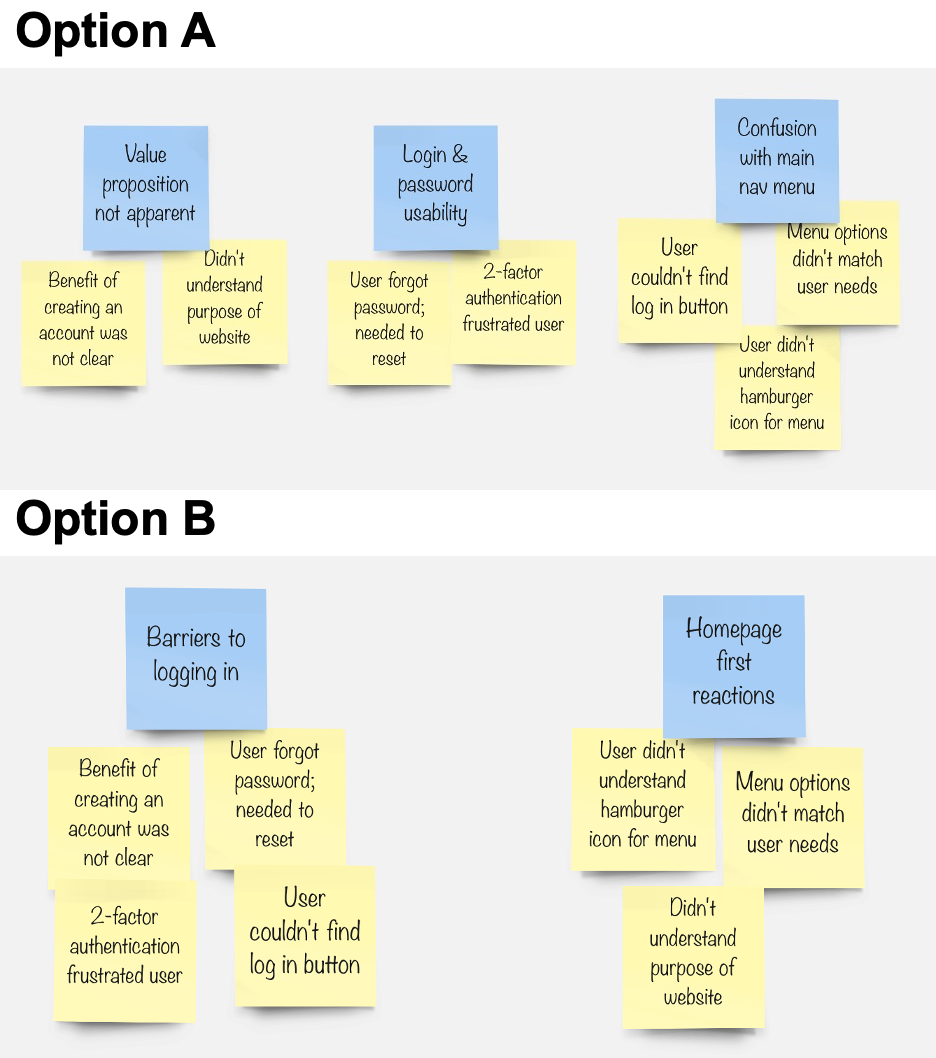
Arguably, both methods are completely valid ways of sorting the same data, but they arrive at different results and point towards different conclusions. If this study was early-stage research aimed at uncovering new issues with the homepage experience, option A would probably be right. But imagine, instead, that the research was part of a targeted effort to drive users to log into their profiles on the website. In that case, maybe option B would be more appropriate. One could even imagine that the Barriers to logging in group could later be further subdivided, while Homepage first reactions could be moved to a parking lot, as not strictly relevant to this effort. I now always identify the focus question to any affinity-diagramming activity prior to showing up to facilitate it. Focus questions should be clear and succinct, such as:
- Where should we place various items within our grocery store?
- Why aren’t more users logging in?
Coming up with a question is fairly easy when there is a well-established project goal. However, affinity mapping is also frequently used in discovery phases, when project goals are murkier. In those situations, you can start with broader focus questions such as:
- What usability issues exist?
- What user needs are not met?
During the workshop, this focus question should be clearly visible — either written on a whiteboard or pulled up on a slide. As I observe the participants starting to sort the stickies, I sometimes find it necessary to direct attention back to the focus question if I see irrelevant or illogical clusters being formed. This simple addition to my facilitation process has allowed teams to maintain focus on the goals at hand and to form clusters that are in service of achieving those goals.
(Note: Sometimes, it might make sense to conduct multiple rounds of affinity diagramming — for example, if you have a large number of stickies or a broad area of focus. In these cases, it often is helpful to have a different focus question for each round. For example, the focus question in round 1 might be Where or when did users encounter these issues? — leading to a rough sort based on specific pages, elements, or journey steps. Round 2 might then ask What usability issues were encountered? leading participants to further subdivide those groups into UX problems.
Keyword Matching
Keyword matching is a concept that emerges from card-sorting methodology (a process with mechanics nearly identical to affinity-diagramming, though with different aims). It refers to the sorting of sticky notes based on keywords that they share.
For example, let’s take again our food-related stickies, and let’s imagine that we are indeed a grocery store attempting to determine where to stock items. A team engaged in keyword matching might place Apples and Apple cider and put those together. A particularly careless team might even add Pineapples to that pile.
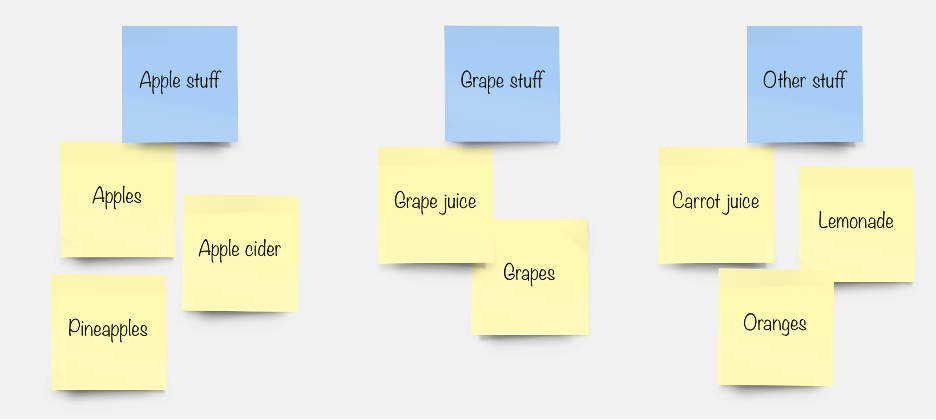
Keyword matching often leads to superficial groupings that end up not being useful to the team going through the exercise. There is no easy way to get around it. (In theory, you could change the wording of the stickies to avoid common words, but that is often not realistic.)
That said, I do have two methods that I use to minimize keyword matching.
- Explain keyword matching to the team. In the introduction to the exercise, explain the danger of keyword matching, and provide examples. Tell participants that you are going to be on the lookout for keyword matching and will call it out when you see it. Encourage them to do likewise.
- Encourage descriptive cluster labels. One of the telltale signs of keyword matching is broad, nondescriptive cluster names. For example, if someone clustered together cards containing the phrases Menu button, Login button, and Add to Cart button, the cluster label would almost certainly be Button Issues, because there is simply nothing else tying the stickies together. Unfortunately, Button issues conveys zero useful information and is, therefore, a bad label.I like to give my teams specific rules about how to phrase cluster labels, — to make the groupings more useful overall, but also to guard against keyword matching. Some examples of label rules are "Labels should be short sentences describing a problem and should include a verb" (e.g., Users failed to log in) or “Labels must be short, made-up user quotes” (e.g., I don’t know what this site is for). Both of these have the added benefits of maintaining a focus on the user and preventing participants from jumping to the solution space too early.
Groupthink
Facilitators must always be on the lookout for the emergence of groupthink in UX workshops. The primary benefit of a workshop derives from the diversity of opinions from different roles and backgrounds. If an overly vocal minority starts to impact the mindset of the team, that benefit is drastically reduced.
Groupthink typically occurs in affinity-diagramming workshops because of three types of well-intentioned yet dominating participants:
- The helpful HIPPO: A participant with a high level of authority who unintentionally intimidates others and inhibits their contributions
- The eager enthusiast: An overly passionate participant who inadvertently dominates conversation due to their fervor
- The enlightened expert: A subject matter expert who overshares irrelevant topical knowledge or background context
Often, one of these types of people will interject early on in the clustering process, perhaps with a well-meaning suggestion for the most efficient method of sorting the sticky notes. Often, other participants will fall in line, leading to the dreaded groupthink.
This is a problem because one of the intended benefits of affinity diagramming comes from the initial period of “organized chaos,” in which different people start sorting using different strategies and frameworks. Eventually, the most relevant or successful of these strategies will rise to the top organically. If the team falls in line behind one framework from the outset, other superior strategies will never be given the space to emerge.
Luckily, the solution to this is simple (though sometimes difficult to enforce): silence. Explain to the participants that the clustering should be done in silence. Warn people that the process will feel challenging and possibly chaotic, but that working in silence is part of the requisite journey towards the exercise’s goal.
Frequently, participants will struggle to overcome their impulse to speak, requiring reminders from the facilitator. Silence is particularly important at the beginning of the exercise, when grouping strategies and frameworks are just starting to emerge. Later in the activity, once firm clusters have been established and the participants are laboring to categorize straggler sticky notes, I tend to relax the policy of silence and allow for some productive conversation. However, always be on the lookout for dominating behaviors, and reinforce silence if necessary to combat them.
Conclusion
The deceptively simple mechanics of affinity diagramming can falsely lead to the conclusion that this activity is easy and foolproof. In reality, it is an advanced method that requires a skilled facilitator and conscientious participants. By providing a clear focus question and guarding against keyword matching and groupthink, you can sidestep some of the most common pitfalls associated with the method.