
There’s a sense of excitement in the UX community right now. Advancements in AI are bringing opportunities and changing what’s possible to deliver in user experiences.
But this excitement is also bringing a sense of panic — leaders are feeling immense pressure to integrate AI into their products and services, and (in many cases) they’re pushing that pressure onto their design teams.
Types of AI Chatbots
To discuss the rush towards AI chat, let’s first align on three important terms as we’ll use them in this article.
An AI chatbot (also called AI chat) is a conversational interface where people can use natural language to interact with an AI tool.
Depending on their scope of knowledge, AI chatbots can be either universal or product-specific.
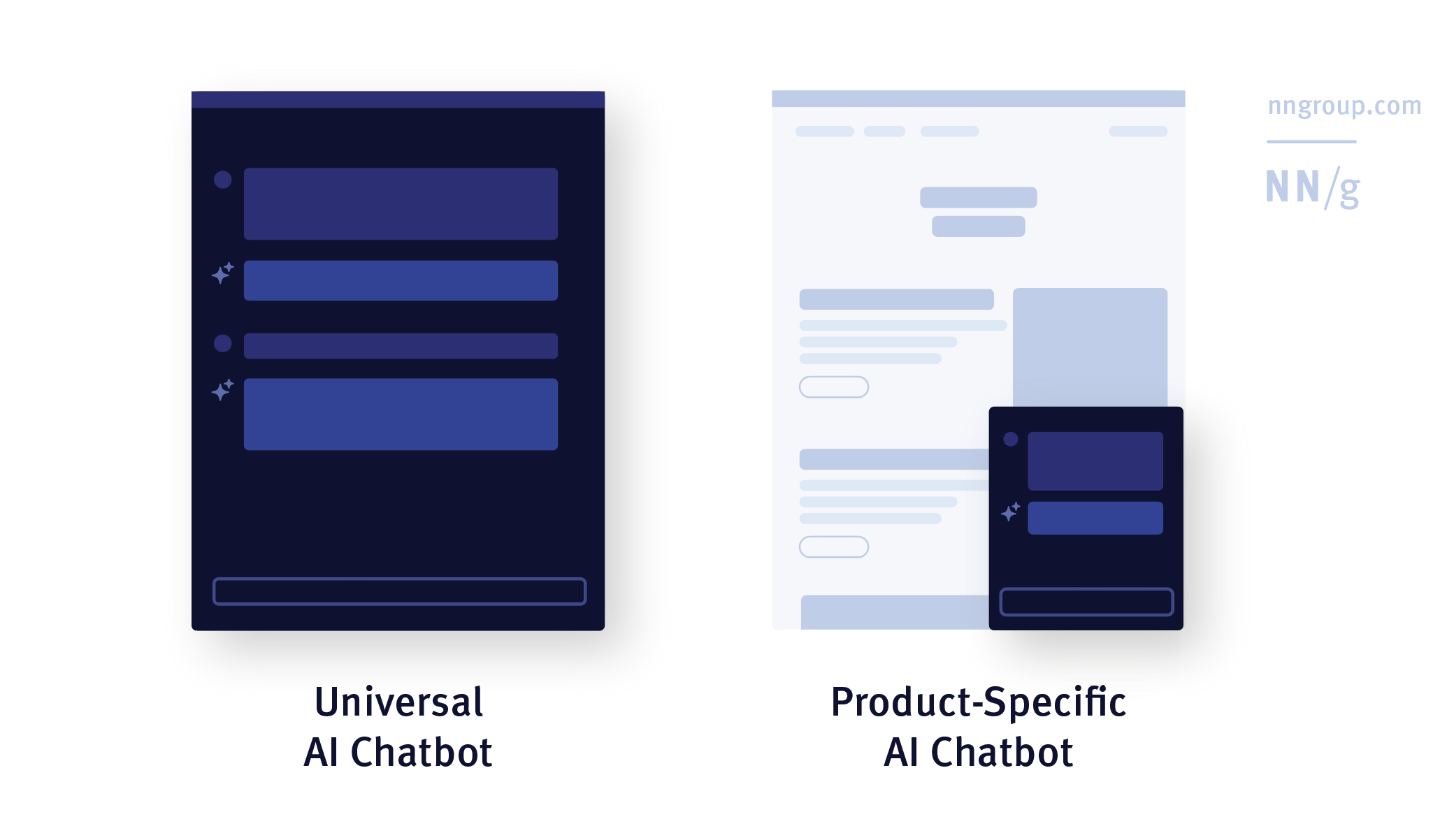
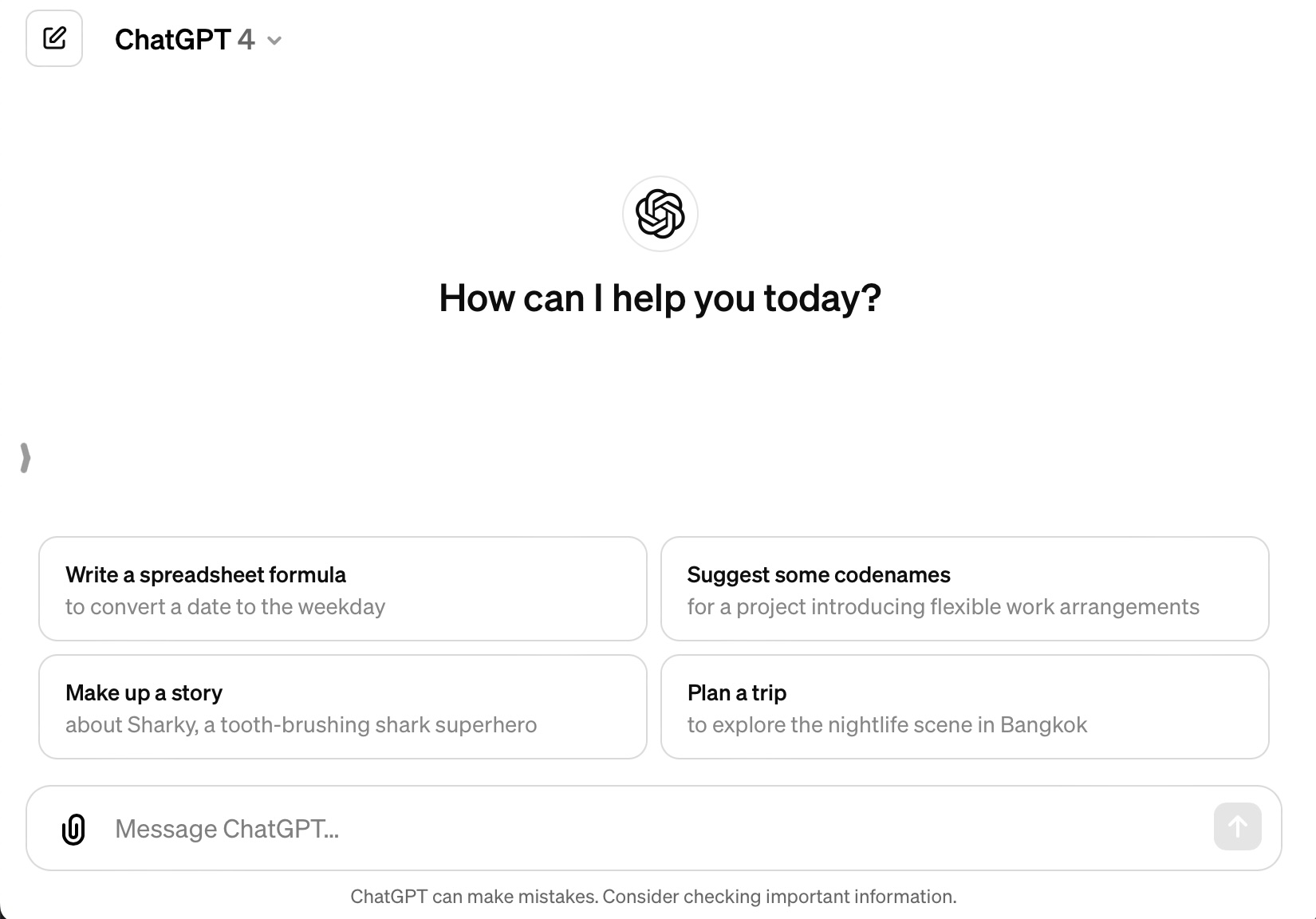
A universal AI chatbot is a standalone AI chat system that has been trained on a wide range of information. For example, OpenAI’s publicly available ChatGPT has been fed a large portion of the internet in addition to books. Its scope of knowledge is vast and general.
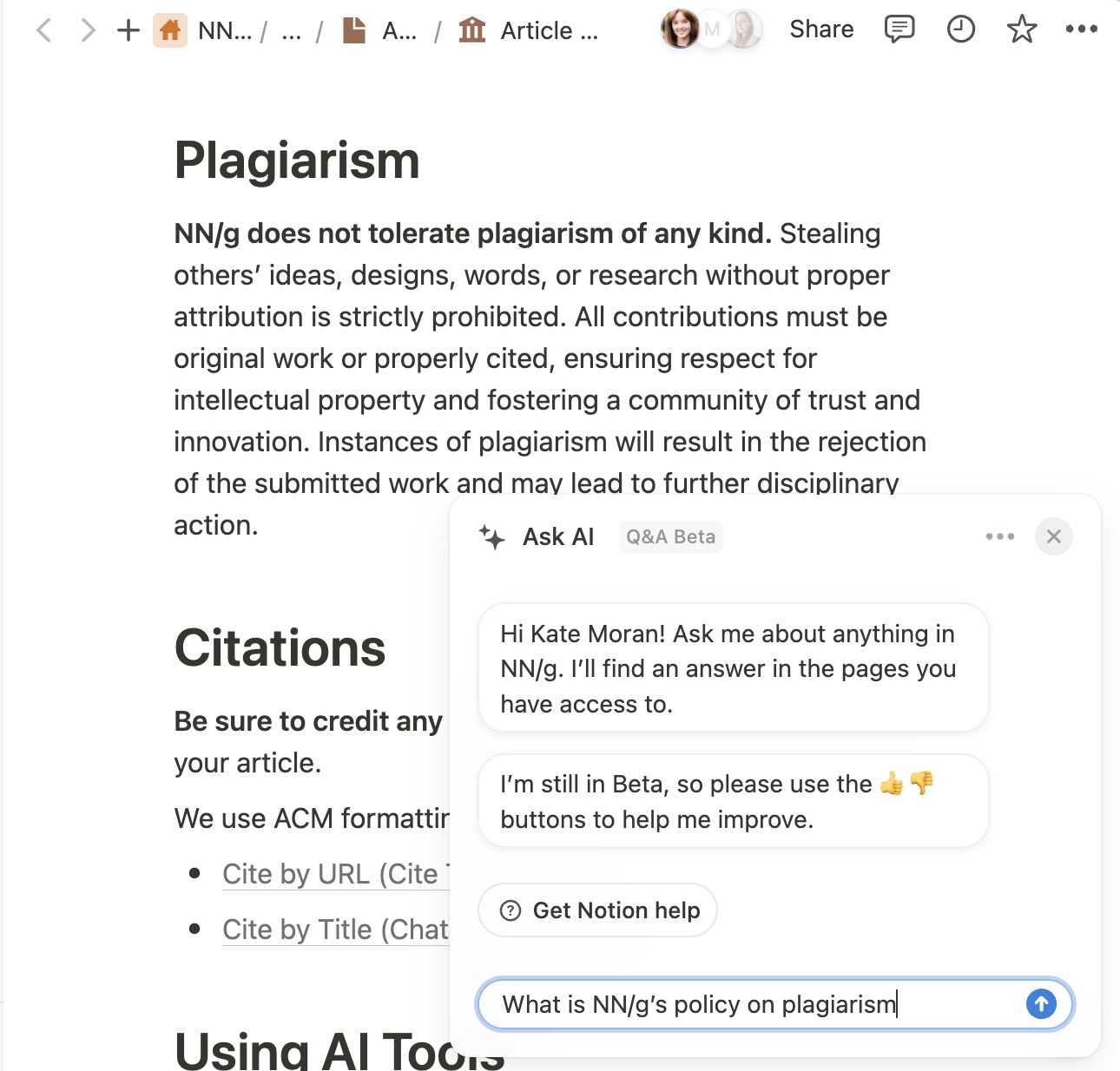
A product-specific AI chatbot is a feature within an app, website, or platform that is focused on the content specific to that product. In comparison to universal AI chat, product-specific AI chat has a much narrower, confined scope of knowledge. These are sometimes presented as “intelligent virtual assistants.”
| Scope of Knowledge | Use Case | |
|---|---|---|
| Universal AI Chatbot | General and global | Standalone product with broad expertise serving a broad group of people |
| Product-Specific AI Chatbot | Company, organization, or service specific | Embedded conversational feature meant to answer specific, contextual needs |
This difference between universal AI chat and product-specific AI chat is quite similar to the difference between web search (provided by search engines like Google) and site-specific search.
Rush Towards AI Chat and Conversational UI
With the immensely successful example of ChatGPT, AI chat may feel like the most obvious way to integrate AI into digital products. This is leading to an explosion of AI chatbots in products — in many cases, without providing much value.
Good Example: AI Chat for Customer Support
AI chat can be extremely useful in certain use cases, like customer support. But it doesn’t universally solve user problems.

As a field, we need to think critically and creatively about how AI could power and improve the experiences we deliver and convince leaders that these are better solutions than just plugging in a chatbot.
Bad Example: LinkedIn’s AI Chat — AI for the Sake of AI
LinkedIn recently introduced its AI-Powered Premium Experience, which is essentially a product-specific AI chat.
The feature shows suggested followup questions at the bottom of LinkedIn posts. The intention is clearly to encourage content consumption within the LinkedIn platform.
When a Premium LinkedIn member selects a question, a chat window appears.

As avid LinkedIn users, this misuse of AI disappoints us. The current LinkedIn experience has many issues that AI could address. Instead, LinkedIn used AI to solve an (arguably nonexistent) one.
This is the problem with rushing into a design solution without pausing to consider context and user needs. Instead of a product-specific AI chat, LinkedIn could consider a range of other use cases for AI. For example:
- Vetting the quality of recommendation-oriented posts based on the experience and track record of the poster
- Recommending potential profile adjustments to job seekers so they can increase recruiter visibility
- Allowing users to compare various job listings and identify patterns or similarities
- Increasing users’ awareness of networking events related to their interests (even if they occur outside of Linkedin)
Expanding Your (Stakeholder’s) Thinking
The push from stakeholders to integrate AI chat into our products presents a familiar challenge: aligning tech trends with fundamental user needs. As the integration of AI becomes a priority for our stakeholders, our responsibility is to ensure that its implementation is user-friendly, scalable, and in sync with our overall business strategy.
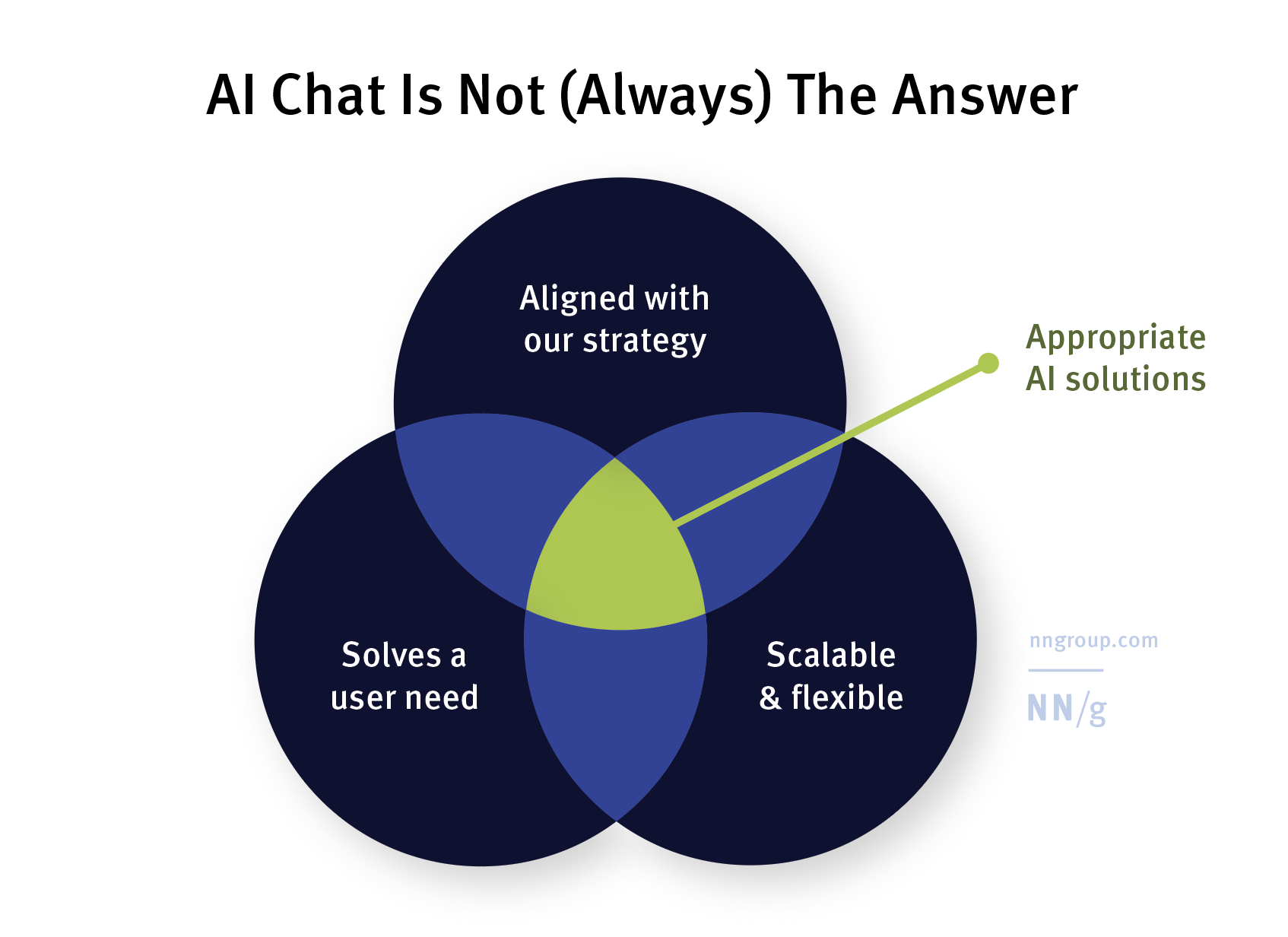
If your stakeholder is pushing for an AI chat, ask them these questions.
Does it solve a real user need?
- What specific problem will it solve for our users?
- Have we validated that this problem is significant and widespread enough among our user base?
- How will solving this problem improve the end-to-end customer journey?
- Is AI the only solution to that problem? Are there alternative solutions to this problem that might address the same user need more effectively?
- Are there potential drawbacks or challenges for users and how do we plan to mitigate them?
Does it align with our strategy?
- How does integrating AI generate a return on investment (ROI)? How will ROI be tracked and evaluated?
- What is our strategic plan for incorporating AI into our product long term?
- What are the opportunity costs of pursuing this integration? How does the AI integration align with our product strategy?
Does it scale or allow for future flexibility?
- What processes must be put in place for maintaining and updating the integration over time?
- Will this integration scale with the quickly advancing technology?
Alternatives to Chat
AI does not have to be anthropomorphized, conversational, or even visible to the user to add value to an experience. Broaden your stakeholders’ and teams’ thinking by considering diverse ways to integrate AI into a product. For example:
- Personalization: Tailor content and recommendations to fit individuals. While this concept is not new (Netflix’s recommendation algorithms have been using AI for years), AI systems will allow for more powerful and detailed personalization than ever before.
- Predictive analytics: AI can help your company predict future trends or user actions based on historical data or past actions. For example, Airbnb has leveraging AI since 2015 in its smart-pricing algorithm for hosts, which combines conversion rates and market demand to suggest competitive rates.
- Strategic automation: Look for redundant, repetitive, or time-intensive tasks in your user journeys. Consider how AI could streamline and accelerate those tasks.
- Automate customer support: An AI chat is one way to do this, but AI can also assist in automating and writing email responses, processing support tickets, and providing customized instructions.