Mentorship is one of the most valuable and underused career tools available. There are real benefits to gain from mentorship, but many talk themselves out of it before they even try. Have you ever thought:
- I already know what I’m doing. Mentorship is just for junior people.
- I just need a mentoring session or two to work through my current challenges.
- I’m better off investing my time into my actual work tasks.
- I don’t need a mentor because I have a great manager.
This article discusses why all these statements are misguided and are holding you back from experiencing the advantages of mentorship wherever you are in your career.
Mentorship and Its Benefits
I started my design career as a solo designer helping enterprise teams build usable software in a low UX-maturity organization. While working there, I became resentful of my development colleagues because they blocked my attempts at user research and gutted my designs for expediency. I gradually saw them as obstacles instead of collaborators.
Years later, I was mentored by a development leader who had recently left the same company. When I discussed my challenges with him, I learned that those developers were, in fact, not in control. He described how the company’s executives dictated work to the developers and often put them under significant strain. Had I sought this mentorship earlier, it would have improved my relationships and performance years sooner.
Mentorship is a one-on-one professional relationship in which a more experienced professional (a mentor) provides career guidance, fresh perspectives, organizational insight, and support to a less experienced professional (the mentee) over an extended period.
A mentor doesn’t have to have more years of experience than you — although that is usually the case. Sometimes, a senior person may be mentored by a more junior person (known as reverse mentoring) in an area where the junior person is more in touch or knowledgeable, such as emerging industry trends.
A good mentor helps you improve:
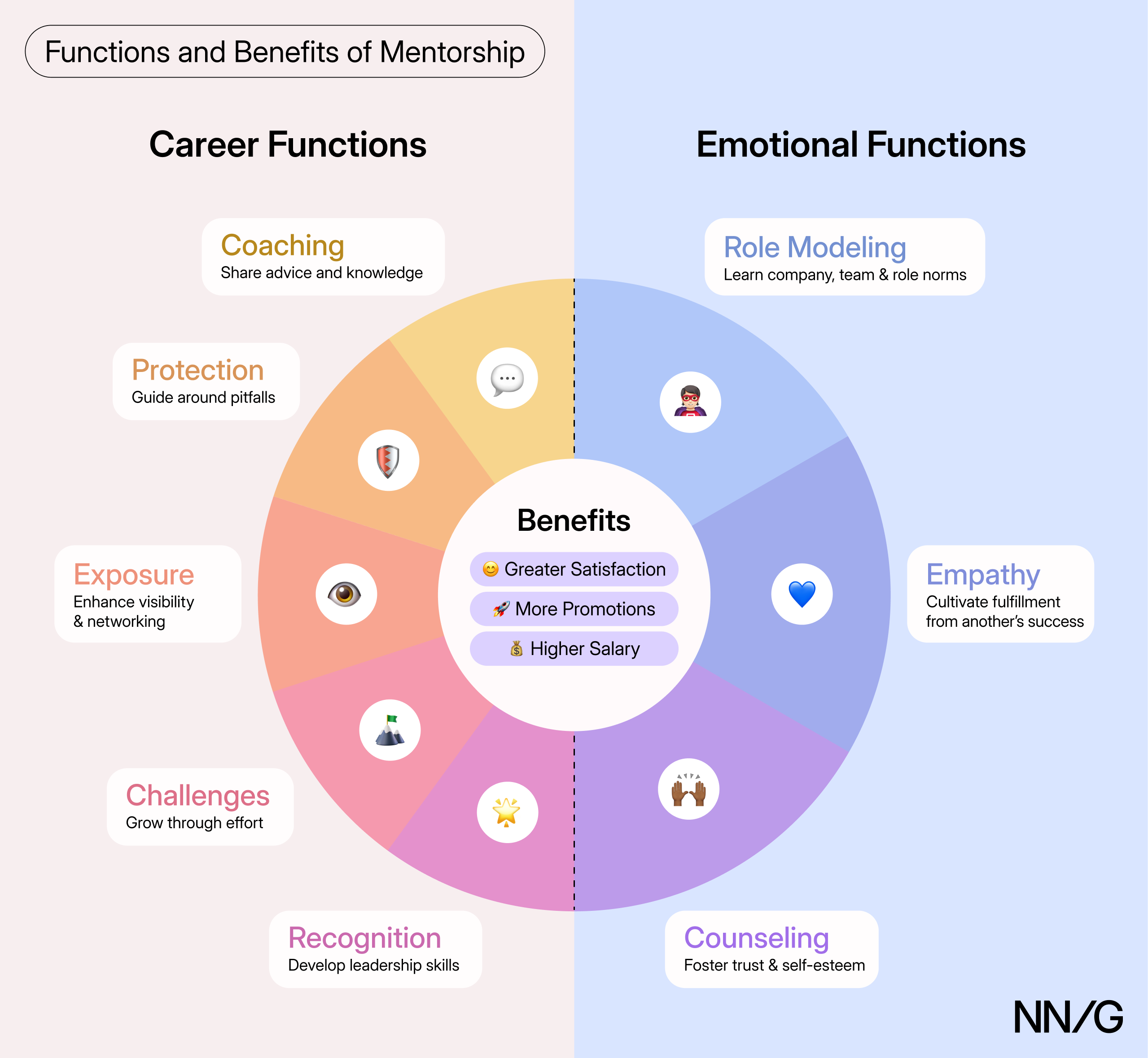
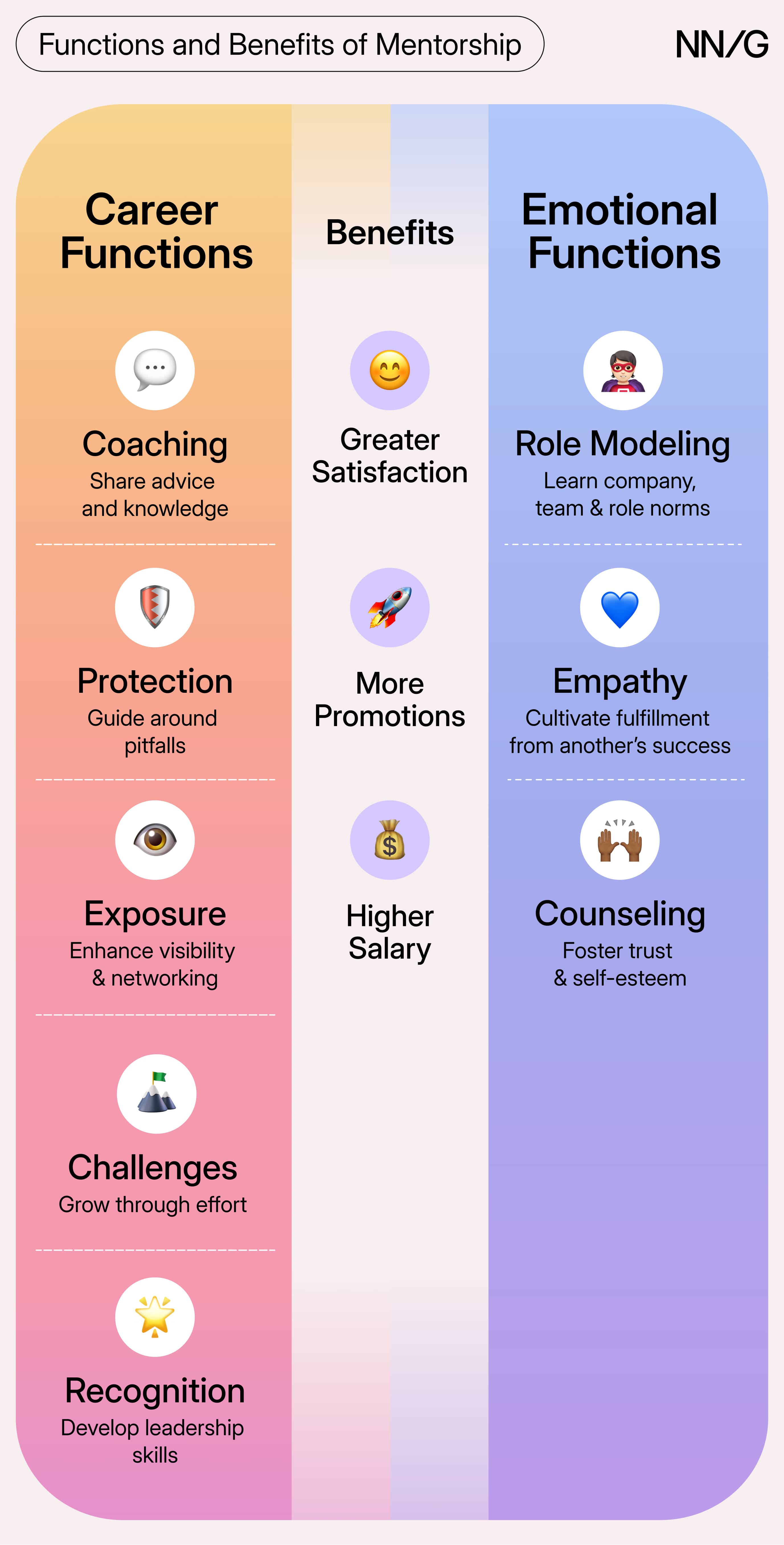
- The quality of your work: Mentorship supports your professional standing through sharing knowledge, protection from pitfalls, exposure and networking, stretch assignments, and recognition.
- How you emotionally respond to the work: Mentorship can increase your confidence, fulfillment, and sense of belonging. Mentors can role-model effective behavior, be present and listen, reframe things from a different point of view, and offer encouragement.
Mentorship isn’t idle socializing; done well, it pays off for everyone involved. Academic research shows that mentees (and mentors) experience:
- More promotions
- Higher career satisfaction and commitment
- Greater compensation and salary growth
- Less burnout
The benefits don’t stop there. Research suggests that organizations with mentorship programs increase marginalized groups' promotion, retention, and managerial representation by up to 24%.
Why Mentorships Underdeliver
Sadly, many mentorships fail to deliver those benefits, leaving a bad impression that can put either person off mentorship for good. Some of the most common causes include:
- The mentee chooses a mentor they can’t speak freely with.
- The mentee doesn’t put the mentor’s guidance into practice.
- Sessions happen haphazardly, too often, or too rarely.
- The mentor lacks the knowledge, experience, or connections the mentee needs to grow.
- The mentee doesn’t communicate goals or questions to direct the mentor’s guidance.
- The mentor fails to demonstrate empathy or admirable traits.
Choose the Right Mentor
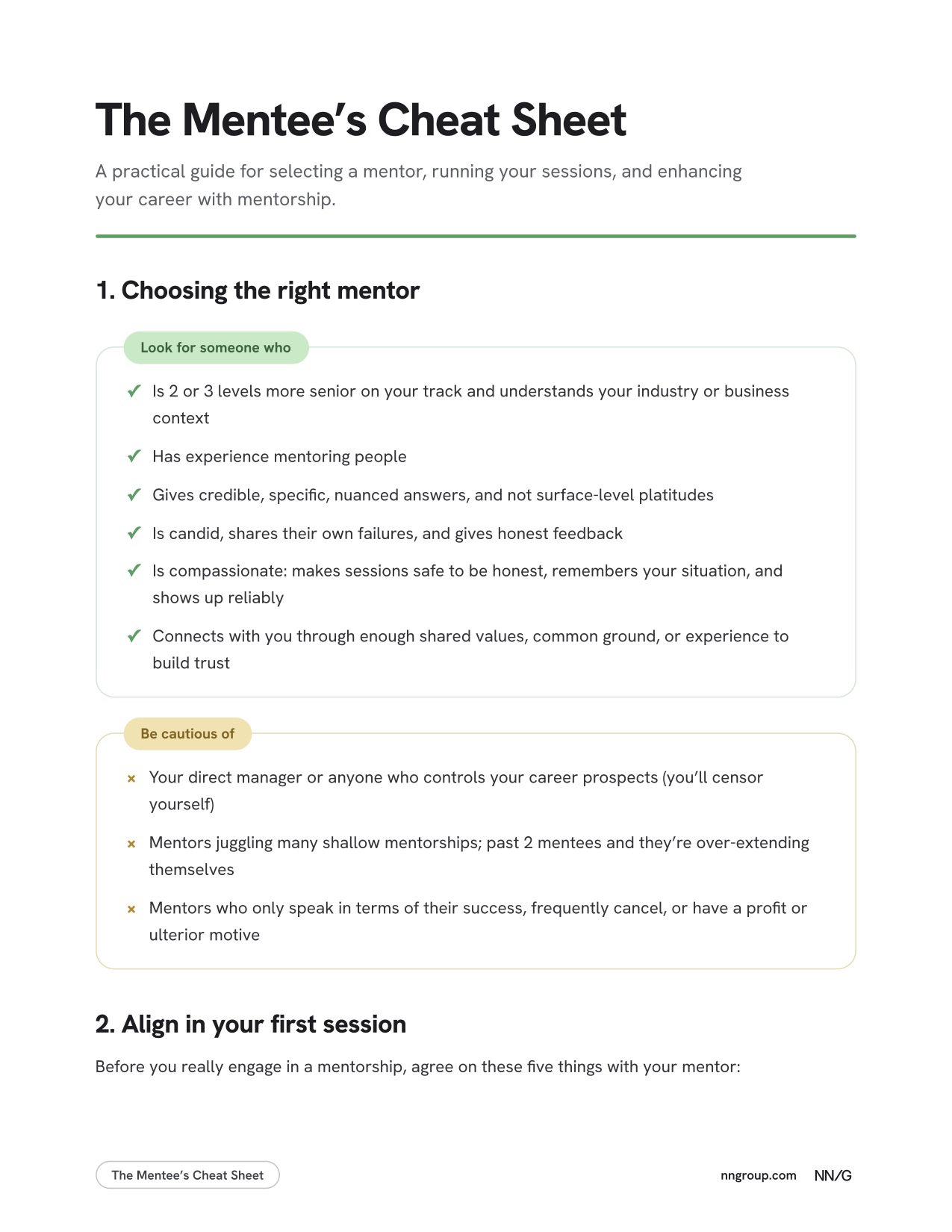
Look for mentors who:
- are two or three levels higher in seniority than your role
- understand your company or industry
- have demonstrated experience mentoring others
Avoid mentors who engage in multiple shallow, superficial mentorships. A mentor should ideally have only 1–2 mentees at a time. Be aware that some people who market themselves as mentors charge for their time. Paid, short-term sessions are more like career coaching than mentorship. If you need targeted advice quickly and have the money, then coaching might be helpful, but it isn’t the same as an ongoing mentorship.
Search through a formal mentoring program at your organization or an established local mentoring group. Alternatively, consider former bosses, former colleagues, or experts you respect from other organizations. Your professional network is the ideal source for a mentor, but several organizations offer mentorship programs to help you find and evaluate a potential mentor:
Internal vs. External Mentors
Consider the tradeoffs between mentors internal to your current employer and those external. Your career circumstances should guide your preference, but a quality mentorship of any type is better than none.
Internal Mentors
Internal mentors work for your current employer. They can provide political insight, tactical project guidance, organization-relevant domain knowledge, and access to internal networks. However, internal mentorship requires strong trust, which some employers struggle to build among staff.
Avoid choosing your supervisor or anyone with managerial responsibility over your career. You will naturally be more reserved and less candid towards anyone who controls your career prospects, which will diminish mentorship’s value.
External Mentors with Knowledge of Your Employer
These people have prior experience with your current employer but no longer work there. They can offer a useful mix of candor and context if they left on good terms within the past few years and have no intention of returning. These can be especially helpful in low-trust workplaces with few prospective internal mentors.
External Mentors with No Connection to Your Employer
These types of mentors offer the most diverse and well-rounded perspectives. They can challenge insular thinking, are much more likely to be candid with you, but they won’t have insider knowledge on people or projects in your workplace.
Reaching Out to the Potential Mentor
After identifying an ideal mentor candidate, send them a short email saying what you admire about their work. Explain that you're interested in getting their perspective and would like to meet for 30 minutes (see our templates and tools for job seekers for an example message). If they agree, use this meeting to evaluate the potential mentor and follow up with a note of thanks and, if desired, a request to meet regularly as part of a mentorship.Don’t count yourself out before requesting the mentorship. That senior leader you admire may be glad that you asked.
During that initial meeting and in the first 1–2 mentorship sessions, evaluate if your mentor demonstrates these qualities:
- They should have credible wisdom to share from years of experience in the roles and topics where you want to grow. They have the career experience you hope to have someday. Credible mentors will give specific, nuanced answers that show they possess more than a superficial understanding of your topic or role. Watch out for evidence of misrepresentation in their public profile and resume.
- They should be candid, vulnerable, and give thoughtful feedback. They will openly discuss their professional failures and lessons learned from those experiences. Steer clear of mentors who share answers framed exclusively around their successes. This is unrealistic and will degrade the quality of feedback you’ll receive.
- They should act compassionately and understand that helping you grow also helps them grow. A mentor who forgets important details about your situation, frequently cancels on you, or focuses on an ulterior motive (like getting paid for mentoring you) lacks the proper motivation.
- They should share a connection with you over similar values, ideas, interests, or personal affinities to enhance the mentorship bond. They don’t need to share your background, but some common ground fosters mutual understanding. For example, a mentor who successfully made a career change from development into design would be ideal if that is also your aspiration.
Listen to your intuition and politely conclude the mentorship if your mentor seems to lack any of these qualities.
Your Responsibilities as a Mentee
You have some significant responsibilities as the mentee. An exceptional mentor won’t want to waste their time on a mentee who doesn’t respect their time and put in the effort.
- Always be considerate of your mentor’s time, promptly schedule sessions, and be accommodating if they need to reschedule. Respect your mentor’s preferences.
- Cooperate with your mentor’s advice and put it into practice. Attempt the tasks they set for you, even if you’re skeptical or the task feels unfamiliar.
- Be committed and take personal responsibility for your own development. Have an objective, attend sessions reliably, and prepare questions in advance.
- Focus on communicating with your mentor. Listen carefully, answer their questions, and ask thoughtful follow-ups. Share session agendas in advance to give your mentor a chance to prepare.
As early as possible, align with your mentor on the following:
- The goal of the mentorship: Share one or two concrete goals with your mentor (e.g., improve leading design critiques, secure a job at a nonprofit, decide whether to move into management). This objective will influence the topics of subsequent sessions. Achieving the objective may be a catalyst for concluding the mentorship. Your objective may also change over time as you learn more during the mentorship.
- How you’ll meet: Video calls, phone, or in person at a café are all suitable.
- Session frequency: A practical starting cadence is once a month for the first 3–6 months. As a mentorship matures, you can meet less often and stay in touch by message between sessions. (Research suggests that highly effective mentorships last for a couple of years, not just a handful of sessions.)
- Session duration: One hour is usually ideal, which is enough time to cover a topic without the session becoming fatiguing.
- Communication tools: Decide whether texting apps, Slack, Discord, or email are appropriate, and agree on when and how often to use them. Collect questions that arise across all agreed communication channels and revisit them during your sessions.
Mentorship Sessions
Bring something specific to discuss to each mentoring session, like a design problem, a decision you are weighing, or a piece of work to show. This is the topic for this session, and it should relate to your overall mentorship objective.
Come prepared to engage in these steps:
- Establish rapport by checking in with your mentor and briefly trading personal updates. Keep this to about 5–10 minutes before moving on to step 2.
- Share the agenda a day ahead so your mentor can come better prepared.
- Take notes during the session, whether by hand or with a note-taking app (with your mentor’s permission). Since mentorship is not a daily or weekly activity, notes will help you remember what was covered.
- Leave with one action item you will try before the next session such as revising a portfolio case study or having that difficult promotion conversation you have been avoiding with your manager. These action items don’t always have to be a tangible deliverable, but if your mentor asks you to contemplate a different point of view or to read something — do it and be prepared to discuss it.
- Report back at the start of the next session with what happened when you tried your mentor’s advice.
Do not skip the last two steps. Showing a mentor that their advice led to action and learning about the impact is what makes them want to keep investing in you.
Concluding a Mentorship
Every mentorship changes over time, whether in mentoring needs, organizational roles, or emotional experiences. For example, a promotion may make a mentor's experiences less insightful or relevant to the mentee. Or the mentor may become less available and lack the time to continue the mentorship productively. These changes may lead to one or both wanting to end the mentorship. The mentee or mentor can respectfully conclude the mentorship at any time.
All mentorships eventually end; conclusions are a normal part of this process. Sometimes a concluding mentorship can transform into friendship. Don’t judge yourself or your mentor harshly if that isn’t the case. A positive outcome is learning from the experience and changing how you think and behave in your career, not necessarily making a new friend.
Conclusion
The mentor who corrected my view of those developers reshaped my professional perspective for the better. I wish I had found him sooner. Mentorship is not merely chitchat and is not just for the inexperienced; it offers research-backed benefits in higher pay, more promotions, and more career satisfaction if you approach it smartly.
As AI pervades our workplaces, people need authentic human mentorship more than ever. If you’ve never been mentored, commit to connecting with a potential mentor this month. If you’ve never been a mentor, make yourself available and say “yes” to that promising mentee. Perhaps you’ll gain a new friend, or at least an appreciation for mentorship that you can pass on to the next aspiring professional.
References
Kathy E. Kram. 1983. Phases of the Mentor Relationship. Academy of Management Journal 26, 4 (Dec. 1983), 608-625. DOI: https://doi.org/10.2307/255910
Tammy D. Allen, Lillian T. Eby, Mark L. Poteet, Elizabeth Lentz, and Lizzette Lima. 2004. Career Benefits Associated With Mentoring for Proteges: A Meta-Analysis. Journal of Applied Psychology 89, 1, 127–136. DOI: https://doi.org/10.1037/0021-9010.89.1.127
Tammy D. Allen, Elizabeth Lentz, and Rachel Day. 2006. Career Success Outcomes Associated With Mentoring Others: A Comparison of Mentors and Nonmentors. Journal of Career Development 32, 3 ( March 2006), 272-285. DOI: https://doi.org/10.1177/0894845305282942
Christina M. Underhill. 2006. The effectiveness of mentoring programs in corporate settings: A meta-analytical review of the literature. Journal of Vocational Behavior 68, 2 (April 2006), 292-307. DOI: https://doi.org/10.1016/j.jvb.2005.05.003
Katelyn Cavanaugh, Bret Belfer, Debbie Cline, Courtney Holladay, Todd Pickard, Evan Thoman, and Shine Chang. 2022. The positive impact of mentoring on burnout: Organizational research and best practice interventions for cancer hospital employees. Journal of Clinical Oncology 39, 15_suppl (May 2021), 11012–11012. DOI: http://dx.doi.org/10.1200/jco.2021.39.15_suppl.11012
Ulrich Fasbender, Anne Burmeister, and Mo Wang. 2023. Managing the Risks and Side Effects of Workplace Friendships: The Moderating Role of Workplace Friendship Self-Efficacy. Journal of Vocational Behavior 143, (April 2023). DOI: https://doi.org/10.1016/j.jvb.2023.103875
Connie Deng and Nick Turner. 2023. Identifying key mentor characteristics for successful workplace mentoring relationships and programmes. Personnel Review. March 2023. https://doi.org/10.1108/PR-08-2022-0535
Kaitlyn Conboy and Chris Kelly. 2016. What Evidence is There that Mentoring Works to Retain and Promote Employees, Especially Diverse Employees, Within a Single Company. https://ecommons.cornell.edu/handle/1813/74541
Sharon E. Straus, Mallory O. Johnson, Christine Marquez, and Mitchell D. Feldman. 2013. Characteristics of Successful and Failed Mentoring Relationships: A Qualitative Study Across Two Academic Health Centers. Academic Medicine. 88, 1 (Jan. 2013), 82-89. DOI: https://doi.org/10.1097%2FACM.0b013e31827647a0