
A parking lot is a useful technique during workshops and lengthy meetings to deal with distracting topics or non-agenda items. Parking lots can be extremely helpful but can also quickly become a graveyard of questions you don’t want to deal with.
Parking Lot: Definition
A parking lot is a place to capture comments, topics, or questions that are not related to the meeting agenda.
The parking lot keeps the focus on the immediate discussion while deferring (i.e., “parking”) other topics for later.
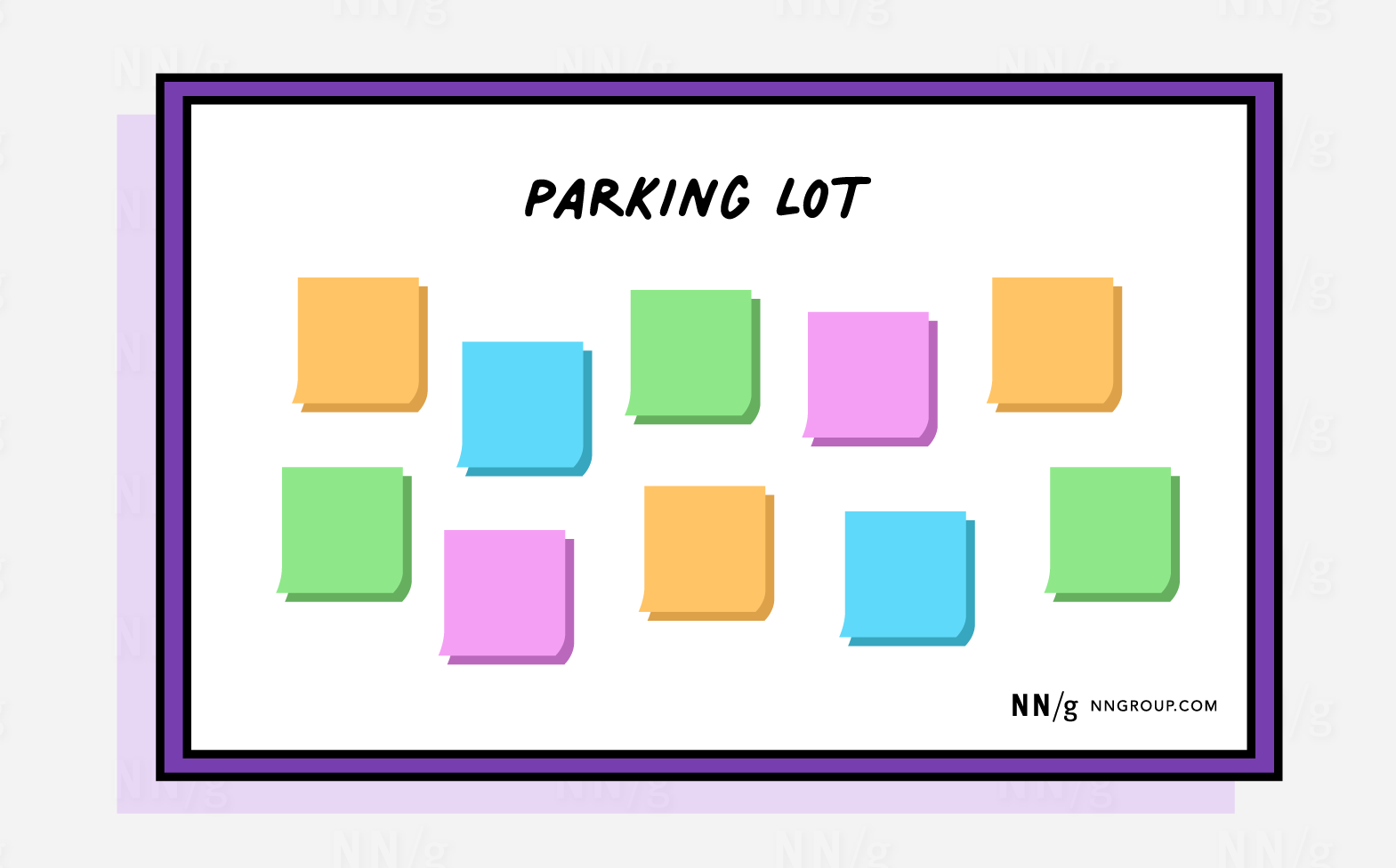
Think of an actual parking lot — the cars are the topics that come up during the meeting, and the lot is where you keep these until you’re able to tackle them.
Physical or Digital Parking Lots
Parking-lot items can be captured in two ways:
- Physically, on the wall. For in-person workshops, parking lots are often created on large sticky notes, whiteboards, or flip-charts. Nonagenda items are added on smaller sticky notes by the facilitator or workshop participants. Items can be clustered (using affinity diagramming) to organize related topics. This format works best when participants can generate the items and add them to the parking lot during activities or breaks.
- Digitally, in a shared space. For virtual or hybrid meetings, collaborative tools (such as Miro, FigJam, or Google Docs) allow participants to add items in real time. Participants can use advanced features built into the tool to tag, categorize, or upvote items. This format works best when all participants can access the tool and add topics at any time.
Regardless of the format, a parking lot should be collaborative and visible to everyone. It should be a group artifact, which means that all participants should understand how the parking lot works and why a given item belongs there. Its collaborative nature ensures buy-in and accountability for those next steps derived from parking lot items. It also prevents the parking lot from becoming a graveyard of unwanted discussions.
Benefits of a Parking Lot
Parking lots work especially well with:
- Participants who tend to stray off-topic: They help manage discussions without shutting them down completely.
- Complex and abstract topics: These discussions can lead to scope creep, which parking lots can defer for later exploration.
A parking lot, when used effectively:
- Keeps conversation on topic. For example, if a team is discussing user needs and someone is focusing too much on solutions, the solution can be put in the parking lot to avoid derailing the discussion or losing the idea.
- Captures questions or assumptions for future research. Use parking lots to document questions or assumptions made about research. This resource could then inform a new research plan as workshop followup, but not halt progress during the workshop. Similarly, the parking lot can avoid “rabbit holing” by deferring overly detailed discussion of an otherwise relevant issue that threatens to overwhelm the bigger picture.
- Outlines action items for followup. A parking lot created during a meeting or workshop can act as an outline for next steps. As items are added to the parking lot, topics can be immediately designated as action items with an owner and a timeline. This approach decreases the amount of time needed during the wrapup, as future to-dos are already captured and assigned.
Drawbacks of a Parking Lot
Parking lots can do more harm than good if not used correctly:
- Dismissive in nature. Deferring discussion to a parking lot can be a big insult to a fellow colleague who presents an idea only to have it put to the side and never returned to for followup. Such a response could ruin team dynamic and decrease overall participation.
- Lack of consensus around next steps. Parking lots should offer outlines for future discussion, research, or meetings. If they do not inform future action, they become only a way to kindly tell someone that their contribution is worthless.
Parking-Lot Recommendations
To combat these drawbacks, use these 5 best practices:
1. Allot Dedicated Time to Tackle the Parking Lot
If something is put in the parking lot, participants will know that there is already dedicated time to discuss it. The parking-lot time can be the last 20–30 minutes of a meeting or a separate followup meeting 1-2 days after the original meeting. This approach negates friction that can surface when the contributor of an idea feels it is pertinent and discussion-worthy.
2. Introduce Clear Parking-Lot Purpose and Rules
Even if colleagues know what a parking lot is, briefly introduce the concept, ground rules, and purpose. Doing so sets expectations, creates a shared language, and primes participants to use the parking lot correctly. For example:
“We are going to use the concept of a parking lot today. This is so we can accomplish our goal in the time allotted, but not lose other ideas, questions, or related topics if they naturally come up.”
As off-topic items are brought up, swiftly identify them verbally as beyond the scope of the meeting. For items that are in the gray area, time-box the conversation: if the discussion continues past an allotted time, move it to the parking lot and ask the key contributors to finish the conversation after the meeting.
3. Organize the Parking Lot as You Go
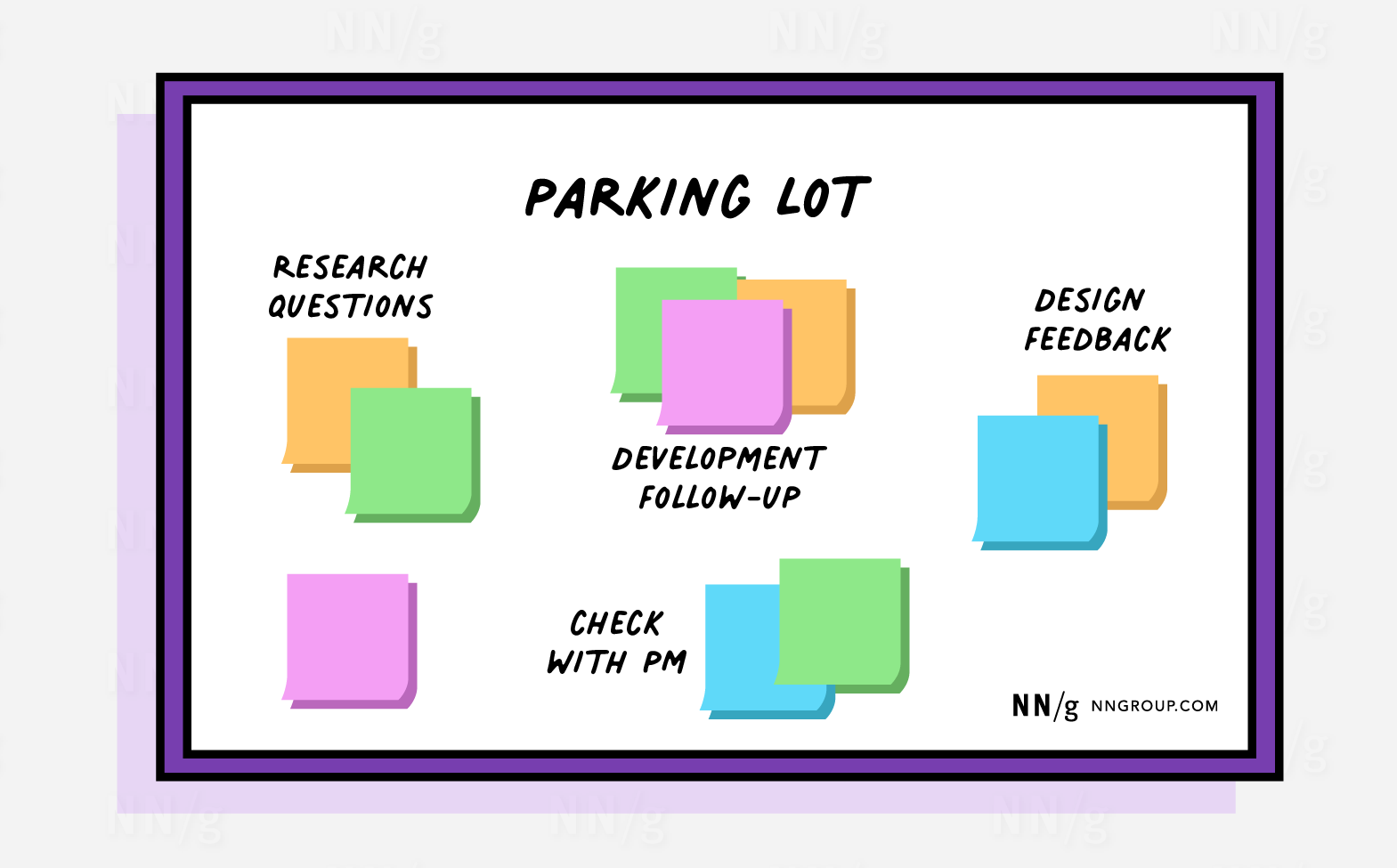
As items are added to the parking lot, use affinity diagramming to cluster similar items (for example, group all items that are development-centric and group all items that are design-centric). This approach organizes items by topic for a quick and efficient discussion at the end of the meeting, if time permits. If time runs out, each cluster can be assigned as a to-do to the correct audience subgroup — with each subgroup having to follow up on their assigned cluster and email the next steps to the larger group.
4. Assign Owners and Timelines
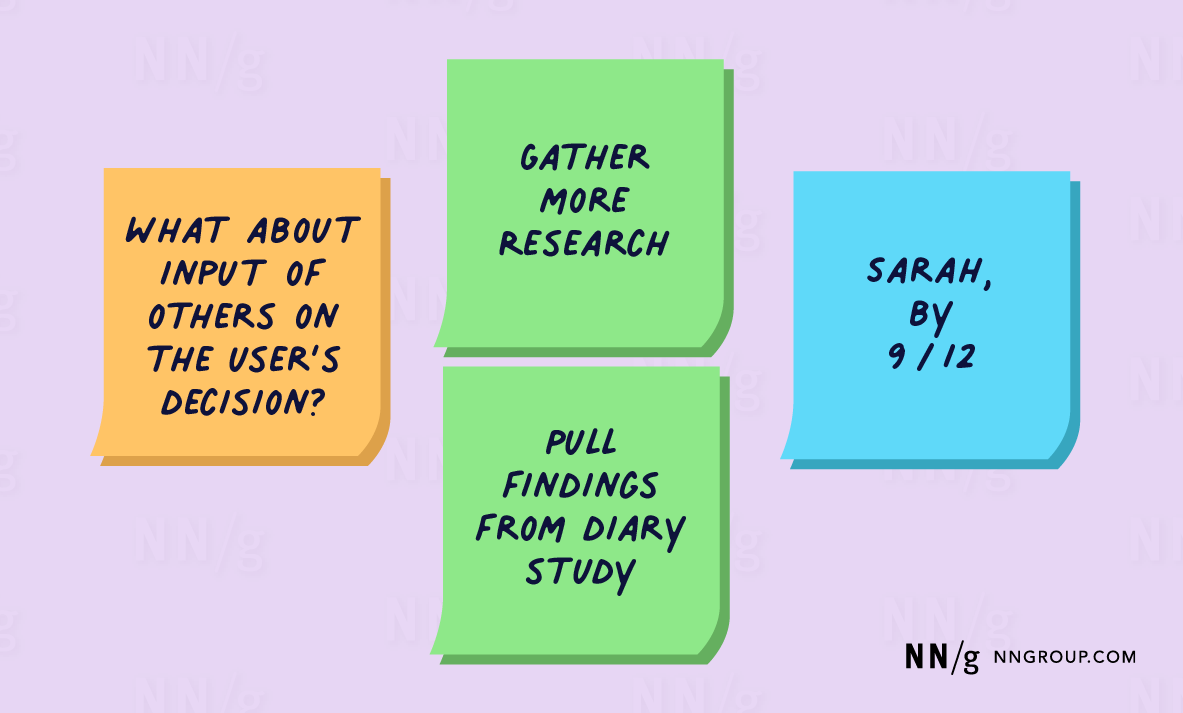
For each item in the parking lot, assign a specific to-do and a timeline. Decide how that question will be answered and who will be responsible for doing it. Think “W.W.W.”: who does what, when.
5. Include Parking Lot To-Dos in Meeting Notes
Always include the parking lot in meeting followups. In this way, new ideas, tangential comments, or questions are not lost but rather shared and can be referred to by all participants. This approach makes everyone publicly accountable for the items and the next steps associated with them.
Conclusion
Make the parking lot method your own — adapt the above guidelines as needed, depending on your needs and context. Iterate on how you introduce it to others, the format, and theme of the parking lot. For example, try introducing a separate research-questions parking lot that will capture only open questions or assumptions about the data.
When used correctly, parking lots can do more than just document out-of-scope ideas and questions. They are a tangible artifact that ultimately helps build common ground, increases productivity within a workshop, and contributes towards shared accountability amongst a team.


