This article covers 4 of the most popular qualitative-research methods: usability testing, user interview, field studies (including contextual inquiry), and diary studies.
This article is intended as a companion to Quantitative User-Research Methodologies: An Overview. As in the quant overview, we estimate the cost and difficulty of each method. These estimates are rough and relative. Your costs will depend on your tools, your participants, and how you adapt the method to your needs.
Qualitative vs Quantitative Research
Qualitative and quantitative research answer different kinds of questions:
- Qualitative research helps you understand people’s behaviors, experiences, needs, and problems. It answers why and how questions. Its findings are observations and themes, usually based on a small number of participants.
- Quantitative research measures. It reveals patterns and tells you how common a behavior or phenomenon is: how many, how much, and how often. Its findings are numbers, usually based on larger samples and analyzed with statistics.
The method alone doesn’t make a study qual or quant. Some methods, like usability testing, can be used for both. What makes the difference is your research question and how you set up the study. A qual usability test with a handful of participants looks for problems and their causes. A quant usability test with a larger sample (around 40 participants) measures metrics like success rate and time on task.
The two approaches complement each other: qual research tells you what’s happening and why, and quant research tells you how widespread it is.
Why Qualitative Research
Most UX teams run far more qualitative (qual) studies than quantitative (quant) ones, and for good reason. Qual methods are flexible, relatively inexpensive, and useful at almost any stage of a project.
But because qual methods look simple (watch a few people use your site, talk to a few more), they’re also easy to get wrong. Pick the wrong method or run the right one carelessly, and you’ll end up with misleading findings and a false sense of confidence. Done well, qual methods allow you to:
- Discover what’s wrong with a design and why.
- Understand your users’ needs, goals, pain points, and mental models before you design anything.
- See how people really behave in their own environments, including the workarounds, interruptions, and extra tools they rely on.
- Build empathy across your team. Watching a real person struggle with your product is often more persuasive than any report.
Choosing a Method
This table summarizes the methods discussed above. Costs and difficulties are general comparative estimates; ultimately, the cost of a study will depend on its goals and specific setup.
| Method | Typically Used for | Cost | Difficulty of Collection | Difficulty of Analysis | Type | Context of Use |
|---|---|---|---|---|---|---|
| Qualitative Usability Testing | Identifying problems in a design and why they occur | Low–Medium | Medium | Low–Medium | Behavioral | Task-Based |
| User Interviews | Learning about users’ experiences, needs, and motivations | Low | Medium | Medium | Attitudinal | Not Using Product |
| Field Studies (Including Contextual Inquiry) | Understanding users’ real environments, workflows, and workarounds | Low–High | High | High | Behavioral and attitudinal | Natural Use |
| Diary Studies | Understanding behaviors and experiences over time | Medium | High | High | Attitudinal | Natural Use |
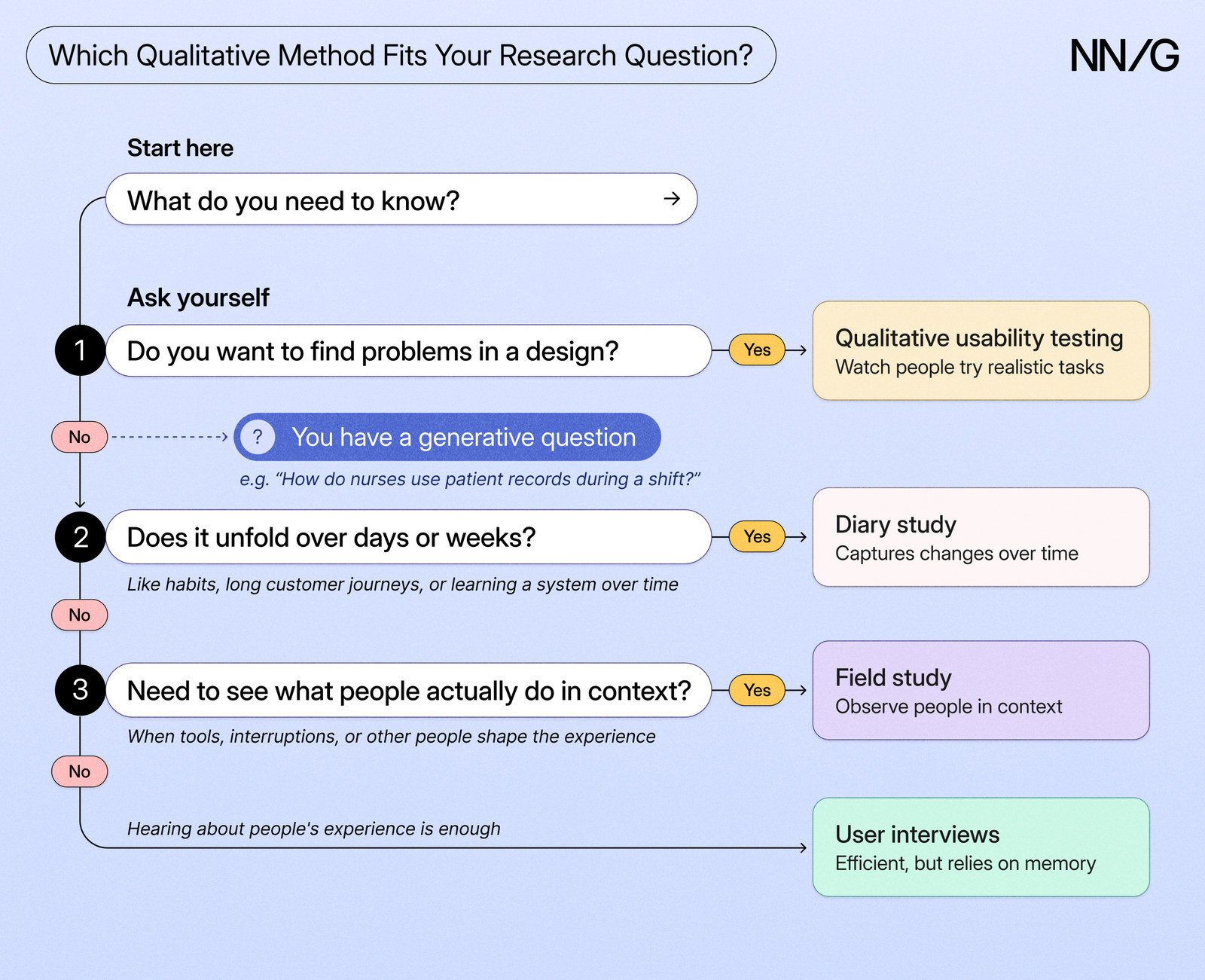
To pick the right method, lead with your research question. What do you need to know?
If you want to find problems in a design and understand why they occur, you have an evaluative question. For example:
- Do people find and understand the shipping costs before they reach checkout?
- Why are users abandoning our signup form?
- Which parts of our new prototype confuse people?
For these questions, you’ll likely want to use qualitative usability testing. (Note, if you want to measure how well a design performs, such as its success rate or time on task, you need quantitative usability testing instead.)
If you’re trying to understand people’s needs, behaviors, and experiences, you have a generative question. For example:
- What are the biggest frustrations people have when planning a vacation?
- How do nurses use patient records during a shift?
- How do people decide which meal-delivery app to use, and does that change over time?
For these questions, you’ll probably want to use user interviews, field studies, or diary studies. To choose among them, ask yourself:
- Do you need to see what people do, or is hearing about it enough? Interviews are efficient but rely on people’s memories. If accuracy about real behavior matters, observe.
- Does the environment matter? If tools, interruptions, or other people shape the experience, or if accuracy about real behavior matters, run a field study. (For complex or expert work, consider contextual inquiry.)
Does the experience unfold over days or weeks? If so, a diary study will capture it better than any single session.
Qualitative Usability Testing
- Use: Identifying problems in a design and understanding why they occur
- Cost: Low–Medium
- Difficulty of Collection: Medium
- Difficulty of Analysis: Low–Medium
- Type of Method: Behavioral (what people do)
- Context of Use: Task-based
- Typical Sample Size: About 5 participants per user group, per round of testing
In a usability test, a facilitator asks a participant to perform realistic tasks using a design, then observes what the participant does and listens to what they say. Participants are usually asked to think aloud — to narrate their thoughts as they work — so you can hear their expectations, confusion, and reasoning in the moment.

Qual and quant usability testing look alike on the surface, but they have different goals. Quant usability testing collects metrics like success rate and time on task. Qual usability testing prioritizes observations: Where did people get stuck? What did they expect to happen? Why did they choose the wrong link? Because the goal is insight, not measurement, the facilitator can ask followup questions and adjust the study as it goes.
You don’t need many participants. For a typical qual study with a single user group, testing with 5 users uncovers many of the common usability problems in a design. Testing with additional participants generally has diminishing returns, so rather than spending your budget on one big study, test with a few people, fix what you found, and test again.
Qual usability testing works at any stage, from paper prototypes to live products. You can run sessions in person, remotely with a facilitator, or remotely without one. Each format changes the cost and the amount of control you have over the session.
The biggest risk is accidentally influencing participants. Small wording problems in your tasks can prime people to look for a specific word or feature, and an untrained facilitator can change participants’ behavior by interrupting at the wrong time. Good facilitation takes practice.
For the skills you need to plan, facilitate, and analyze usability tests, see our course Usability Testing.
User Interviews
- Use: Learning about users’ experiences, needs, pain points, and motivations
- Cost: Low
- Difficulty of Collection: Medium
- Difficulty of Analysis: Medium
- Type of Method: Attitudinal (what people say)
- Context of Use: Not using product
- Typical Sample Size: Often 5–12 for a focused study; 20–30 or more for a broad one
In a user interview, the interviewer asks a participant questions about a topic, listens to their responses, and follows up to learn more. Interviews are especially useful in the discovery phase, when you’re trying to understand who your users are, what their lives are like, and what problems you could solve for them. The insights often feed into artifacts like personas and customer-journey maps.

User interviews are often confused with usability tests, but the two methods serve different purposes. A usability test evaluates a design by observing how people use it. An interview generates new knowledge about people’s experiences; participants usually don’t see or try a design at all.
A good interview is a research study, not a casual chat. Start with clear research goals, then write an interview guide with a few open-ended questions that get people talking. Ask about specific events rather than general habits. For example, Tell me about the last time you booked a vacation will produce richer, more accurate details than How do you usually book vacations? Then probe with followup questions like Tell me more about that or Why was that important to you?
How many people should you interview? It depends on how broad your research goals are and how varied your users are. Five interviews are sometimes too few for exploratory research. Start with a small sample (5 or 6), analyze as you go, and add participants until you stop learning new things.
Interviews have an important limitation: they collect reported behavior, not observed behavior. People forget details, leave out things they don’t realize are relevant, and sometimes present themselves in a flattering light. And the quality of the data depends heavily on the interviewer’s skill. A few leading questions can undermine an entire study. When you need to know what people actually do, pair interviews with an observational method.
For hands-on practice planning and conducting interviews, see our course User Interviews.
Field Studies (Including Contextual Inquiry)
- Use: Understanding users’ real environments, workflows, tools, and workarounds
- Cost: Low-High
- Difficulty of Collection: High
- Difficulty of Analysis: High
- Type of Method: Behavioral and attitudinal (mostly what people do)
- Context of Use: Natural use
- Typical Sample Size: Small; recruit until you reach saturation
A field study takes place in the user’s natural environment (their home, office, car, store, or hospital ward) rather than in a lab or conference room. Field studies and diary studies are both context methods: they show you how people behave in real life, not in a hypothetical scenario you’ve set up for them.
Context reveals things you wouldn’t know to ask about. When you watch people in their own environment, you see the sticky notes on their monitors, the spreadsheet they keep open next to your app, the coworker they turn to for help, and the constant interruptions that pull them away from their tasks. You also see the gap between what people say they do and what they actually do.
Field studies range from fully immersive to tightly focused. Common types include:
- Direct observation: The researcher watches without intervening or asking questions.
- Contextual inquiry: The researcher combines observation with in-the-moment questions.
- Customer-site visits: The customer leads the researcher through their facility or system.
- Ethnography: The researcher immerses themselves in a group’s setting for an extended period.
Whichever type you choose, prioritize observation over questions. Once you’ve gone to the trouble of visiting someone in person, the most valuable data you can collect is what they do.
Field studies can be expensive to run if they require a lot of travel to reach your users. They can also be challenging to set up logistically because they may require permissions and scheduling around participants’ work. Finally, they can be challenging to analyze because of the amount of unstructured data they produce. But a simple field study doesn’t require a team of anthropologists. Everyone on a design team can and should go on customer visits from time to time.
Contextual Inquiry
Contextual inquiry is one of the most useful field methods for UX teams. It combines in-depth observation with interviews to understand people’s work practices and the reasoning behind them, and it can sometimes be done remotely. The method is based on the relationship between a master craftsperson and an apprentice. The participant (the master) does their work as usual. The researcher (the apprentice) watches, then pauses to ask questions when something is unclear or to check an interpretation. Sessions usually follow 4 parts:
- Primer: Build rapport, explain the session, and get a summary of the work.
- Transition: Explicitly shift from interviewing to observing, so the participant knows to work normally while you watch.
- Contextual interview: Alternate between watching and discussing what you’ve seen.
- Wrapup: Summarize your interpretations so the participant can correct or confirm them.
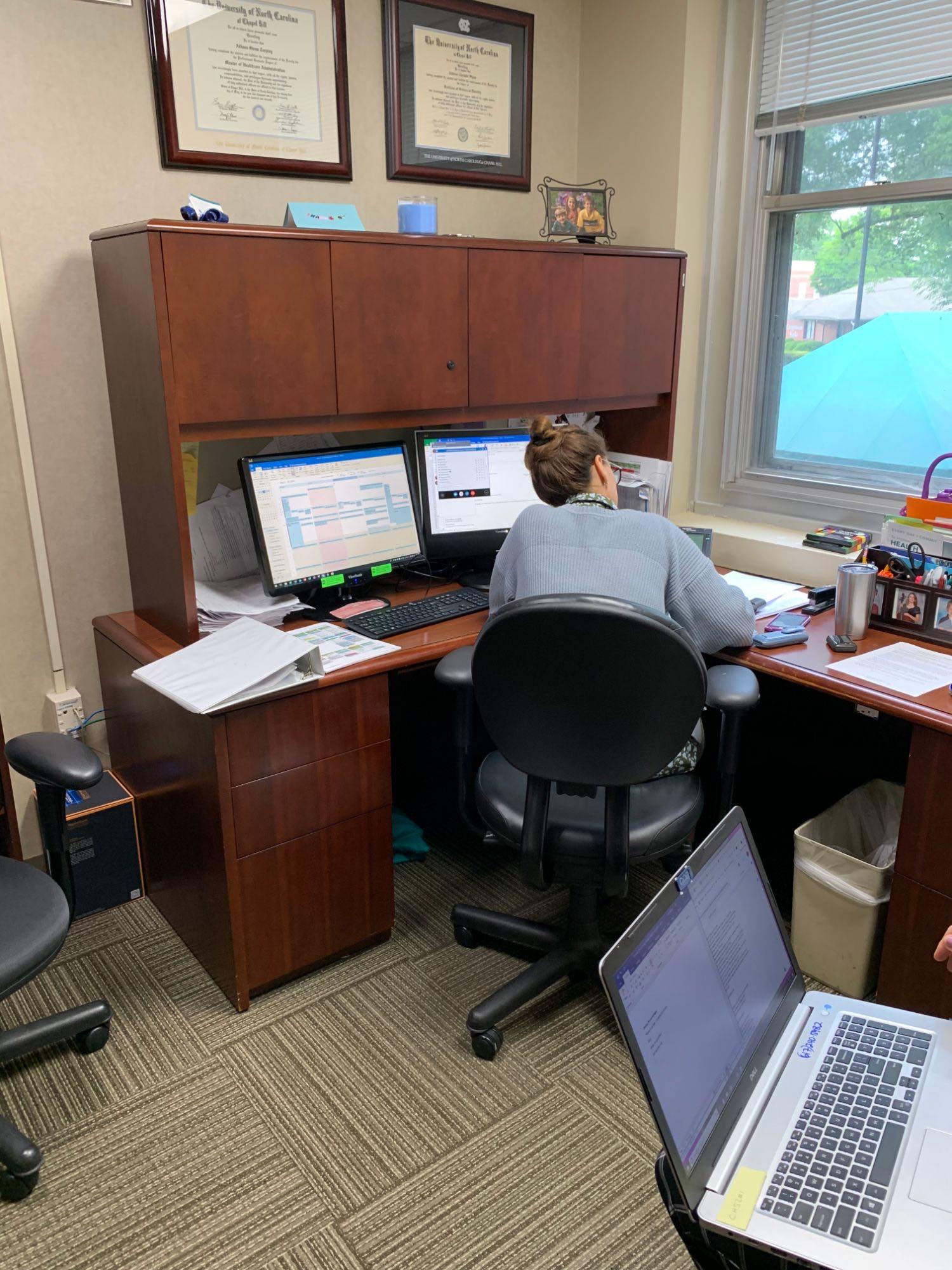
Contextual inquiry is powerful because, as people do a task, they can describe what they’re doing and why — details that they may struggle to recall later. In one redesign project, insurance specialists described a simple copy-and-paste process during interviews. Observing them at work revealed extra steps they hadn’t mentioned, such as checking a second application for missing information and repeatedly clicking Save even though the software saved automatically. Both insights shaped the new design.
Contextual inquiry is best suited for complex systems, in-depth processes, and expert users. It’s overkill for simple interfaces, like a newsletter-signup form.
A common pitfall: participants may slip into interview mode and start summarizing their work instead of doing it. A clear transition (and gentle reminders to work as usual) helps.
For more on field studies and other discovery methods, see our courses UX Research Methods: From Observation to Insight and Discovery.
Diary Studies
- Use: Understanding behaviors and experiences over time and in context
- Cost: Medium
- Difficulty of Collection: High
- Difficulty of Analysis: High
- Type of Method: Attitudinal and self-reported behavioral (what people say they do)
- Context of Use: Natural use
- Typical Sample Size: About 5–12 for small discovery projects; 12–30 for large ones
In a diary study, participants log their activities and experiences as they happen, over a period of days, weeks, or even a month or longer. For example, you might ask people to report every time they use a meal-delivery app over 3 weeks, or ask nurses to log every interaction they have with patient-health records.
Diary studies capture something no single-session method can: how behaviors and perceptions change over time. They’re a good fit for research questions about habits, long customer journeys, how people learn a system, and how they move between channels and devices.
Like field studies, diary studies are a context method. But because they’re run remotely and asynchronously, they’re usually cheaper than field studies and make it easier to include participants in many locations.
Unlike field studies, diary studies rely on self-reporting rather than observation. Because the participants report events close to when they occurred, a diary study somewhat reduces the recall problems associated with interviews. But it does not completely remove self-report biases.
Participants typically create entries in one of three ways:
- Event-based: They log an entry whenever a relevant event occurs.
- Interval-based: They log an entry at regular intervals (for example, every evening).
- Signal-based: They log an entry whenever you prompt them (for example, by text message).
Diary studies require a lot of planning. You’ll need to choose a logging tool, write clear instructions and example entries, and decide on a reporting period long enough to capture the behavior you care about. Plan to monitor entries as they come in, so you can ask followup questions while the experience is still fresh. Many diary studies also start with a pre-study briefing and end with a followup interview to explore each participant’s entries in depth.
Because participants are committing to days or weeks of effort, expect some to drop out. Overrecruit, and offer higher incentives than you would for a single session.
The data is all self-reported, so diary studies share some of the limitations of interviews. And they generate a lot of qualitative data: set aside plenty of time to analyze it.
Combine Methods
You rarely have to pick just one method. Some combinations work especially well:
- Start a usability test with a short interview to learn about the participant’s background (but avoid questions that draw attention to parts of the design you’re testing).
- Interview participants before or after you observe them in the field.
- Bookend a diary study with a kickoff briefing and a followup interview.
- Follow a qual study with a quant one to learn how common your findings are. (See Quantitative User-Research Methodologies for options.)
Consider Time and Cost
After the research question, budget and time are usually the next biggest factors.
Qualitative usability testing and user interviews are the least expensive and quickest methods here. A simple usability study can take as little as 3 days of your time: one to plan, one to test, and one to analyze. Remote sessions can lower costs further by eliminating travel and lab rentals.
Diary studies cost more than single sessions because of the higher incentives, the time needed to monitor participants, and (sometimes) specialized software. Field studies can be the most expensive if they require a lot of travel. If you can’t afford to go into the field, a remote diary study can give you some of the same contextual insights.
The number of participants included in the study also contributes to the cost. Sample sizes work differently in qual research than in quant research. Instead of calculating how many participants you need for statistical significance, researchers using generative methods (interviews, field studies, and diary studies) aim for saturation.
Saturation is the point in a qualitative study where additional sessions no longer produce new insights that would change your themes.
Saturation can be achieved with just a few participants when research questions are fairly narrow (e.g., how nurses hand off patient records at a shift change). Broader goals or more varied users need more participants (e.g., how people use personal assistants).
Qualitative usability testing is a little different. Rather than running one large study until you stop finding new issues, we recommend spreading your budget across several small rounds of testing: test with a few users, fix the problems they uncovered, and test the revised design. The first few users in a round reveal most of the common problems, so each additional user mostly repeats what you’ve already seen. A new round, on the other hand, shows whether your fixes worked and uncovers problems that the earlier ones hid. That’s why we recommend 4–6 users per round.
Next Steps
Once you’ve picked a method, learn about it before you start. We’ve included links throughout this article, as well as a Resources section at the end.
Be warned: Qualitative doesn’t mean casual. Qual findings are based on the researcher’s observations and interpretations. Unlike quant data, they don’t come with statistical protection against chance. That means rigor matters at every step:
- Write clear research goals before you plan your sessions.
- Recruit participants who represent your actual users.
- Avoid leading questions and other behaviors that bias participants.
- Analyze your data systematically (for example, with thematic analysis or affinity diagramming) rather than relying on the most memorable quotes.
It takes practice to do qual research well. But it’s the most direct way to learn what your users need and why your designs do (or don’t) work for them.
Resources
General
Quantitative User-Research Methodologies: An Overview (Article)
Quantitative vs. Qualitative Usability Testing (Article)
When to Use Which User-Experience Research Methods (Article)
Attitudinal vs. Behavioral Research in UX (Article)
Analyze Qualitative Data: Thematic Analysis (Article)
Analyzing Qualitative UX Data (Course)
Qualitative Usability Testing
Usability Testing 101 (Article)
Qualitative Usability Testing: Study Guide (Study Guide)
Thinking Aloud: The #1 Usability Tool (Article)
Why You Only Need to Test with 5 Users (Article)
Turn User Goals into Task Scenarios for Usability Testing (Article)
Remote Usability Tests: Moderated and Unmoderated (Article)
User Interviews
User Interviews 101 (Article)
Writing an Effective Guide for a UX Interview (Article)
How Many Participants for a UX Interview? (Article)
Open-Ended vs. Closed Questions in User Research (Article)
Why User Interviews Fail (Article)
Field Studies and Contextual Inquiry
Field Studies (Article)
Contextual Inquiry: Inspire Design by Observing and Interviewing Users in Their Context (Article)
Remote Contextual Inquiry: Lessons Learned (Article)
Field Studies Done Right: Fast and Observational (Article)
When to Use Context Methods: Field and Diary Studies (Article)
Diary Studies
Diary Studies: Understanding Long-Term User Behavior and Experiences (Article)
6 Tips for Better Participant Engagement in Diary Studies (Article)
Incentive Structures for Diary Studies (Article)