In an episode of the NN/g UX Podcast, NN/g’s Director of Research Maria Rosala spoke with Kate Towsey, author of Research That Scales: The Research Operations Handbook. Maria and Kate discussed building effective research systems and demonstrating value.
Meet Kate Towsey

Kate Towsey is a pioneering figure in research operations. She helped establish some of the first ResearchOps systems at the UK's Government Digital Service (GDS) and later at Atlassian. She is also widely recognized for her role in building a global ResearchOps community. With a background spanning radio journalism and content strategy, she brings a unique systems-thinking perspective to research operations.
Defining Research Operations (ResearchOps or ReOps)
Research operations, as Kate defines it, is about delivering “the systems that enable people to do research, […] consume research, and act on research."
It's not just about supporting researchers — it's about creating “a cohesive space” where stakeholders, participants, and research consumers can effectively share and use knowledge to make better decisions.
The City of Research: Civic-Design Analogy
Kate compares research operations to civic design. Just as a city needs various buildings (libraries, banks, community centers) connected by transportation systems, ResearchOps needs various functions connected by well-designed processes.
Kate Towsey:
"The way something is shaped and how it feels […] will change how you experience and therefore how you feel and think about it — in this case, the ‘city of research.’”
According to Kate, successful ResearchOps work requires a systematic, service-design approach. The tools and processes that research leaders build are not separate, disconnected elements, but a complex interconnected network of primary functions within a company’s culture and practice. Those functions include:
- Participant recruitment
- Knowledge management
- Onboarding and support
- Tools and vendors
- Ethics and privacy
- Money and metrics
- Program management
- People and skills
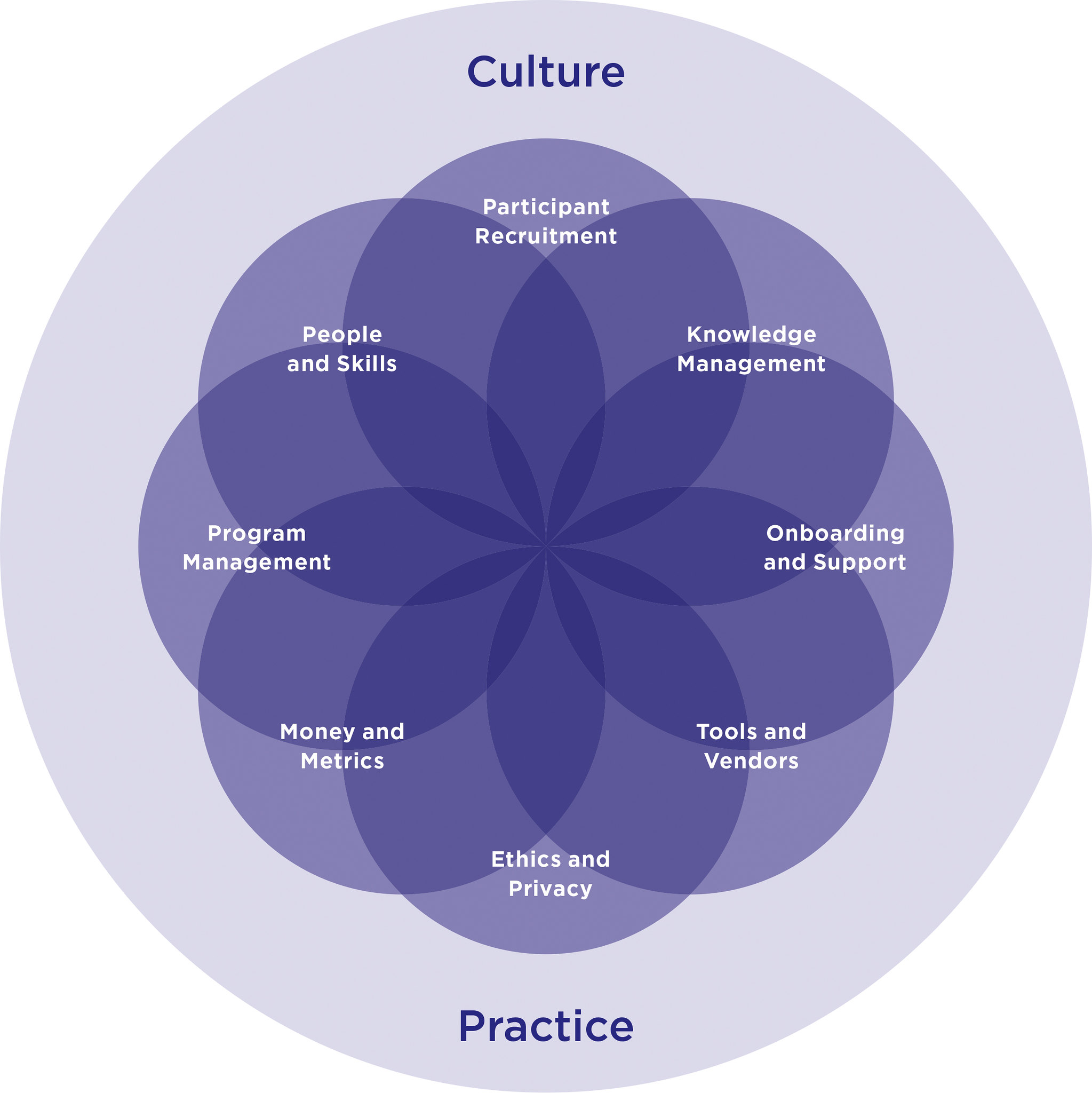
It’s important to take this holistic view for ResearchOps efforts to be successful.
Kate Towsey:
"If you touch one, you will end up working on them all. One of the key reasons that ResearchOps is often so misunderstood, so wildly underestimated in the amount of time it takes [... ] is because this Venn diagram is not understood."
Strategic Operations, Not Knee-Jerk Operations
When companies start working on research operations, Kate often sees them fail because they’re reacting to an immediate need (like a research library or recruitment panel) but not considering how that need fits into the larger picture of the organization’s goals. She calls this short-sighted, reactive approach “knee-jerk operations.”
Of course, every organization has to start somewhere, and it’s usually in smaller, scoped projects. "Every city started as a village," Kate said. "Hold that in mind that no one's expecting you to come and manifest Rome in one day."
She advises focusing on one clear challenge or opportunity but also considering the full journey by asking:
- Who needs to use this system?
- How will they get there? At what point in the research process?
- What experience do you want them to have?
- What capabilities and resources do they have?
Strategic-Research Example: Expanding in Japan or Dubai
As an example, Kate described a scenario where a corporation was focusing on expanding in Japan. This strategic priority would require understanding Japanese users and their culture. The research team needed to decide whether to do the research internally or hire a local agency in Japan to conduct the research.
From a ResearchOps perspective, the chosen direction had significant implications. If the team did the research internally, the ResearchOps team would need to:
- Learn how to recruit Japanese participants effectively
- Understand cultural differences in recruitment practices
- Adapt research processes to a different cultural context
Kate contrasted this example with another one from Dubai, where she noted that people weren't as familiar with user research — they hadn't experienced user testing before. This meant ResearchOps needed to spend more time explaining what participation in research involved. The organization’s goals (in this example, expanding in Japan or Dubai) inform the research strategy, which informs all of the many decisions that must be made.
She used these examples to emphasize that you can’t create effective operational systems without first having a clear research strategy within the context of your organization’s business goals. The strategy must determine what kind of operational support and systems you need to build.
Kate Towsey:
"Systems are defined as being specific [...] and you cannot create a specific system if you're not specific about what you want to achieve. That’s the number one thing.”
Getting Buy-In for Research Operations
Having a defined strategy allows for defining clear success metrics, which is crucial for building leadership buy-in for ResearchOps work.
In addition, Maria and Kate suggested the following strategies for securing resources for ResearchOps work.
- Find alignment with organizational priorities. What do organization leaders care about?
- Start with small, achievable goals — even if you’re trying to build a larger system eventually.
- Track success metrics for your tools and processes and communicate impact to leadership. This might include reporting numbers like the number of people recruited, the number of reports produced, or the number of people impacted by the ResearchOps improvements.
Maria Rosala:
“Speaking to the right people and having that visibility at the right level is so important. A lot of ResearchOps professionals aren’t working at a strategic level where people can notice all the great work they’re doing. And so that’s something research professionals need to think about if they aren’t getting buy-in.”
The Role of AI in Research Operations
While AI promises new efficiencies, Kate advocated for a measured approach: "I think it's got incredible value. I still feel like it's a tool. Like all tools, you have to think about how it’s used."
She noted that once teams move past either panic or over-optimism about AI, the real work begins: carefully evaluating where AI can genuinely smooth processes, enable automation, or take over specific tasks entirely.
However, Kate highlighted a critical tension in the current landscape. While organizational appetite for AI-driven efficiency is at an all-time high, teams face practical challenges in implementation:
- Many teams have experienced layoffs, leaving fewer people to handle the same workload.
- Remaining team members must simultaneously learn new AI tools while maintaining existing operations.
- Organizations are investing heavily in AI tools with the expectation of reducing headcount, often before proving the technology's effectiveness.
Kate Towsey:
"Because of […] budget cuts, [,..] the word of the moment for everybody is efficiency. It always has been, but it's now in capital letters, underscore, italics. And AI came in just at this time. It's […] unfortunate timing."
She predicted that, within six months to a year, the industry would see more "intelligent, jargon-free conversation" emerge about AI's practical applications in research operations — identifying where it proves most valuable and where human involvement remains essential. The key, Kate suggested, was maintaining a balanced view: embracing AI's potential while thoughtfully considering where and how it fits within existing research systems and processes.
Her perspective emphasized that AI tools, like any other operational element, need to be integrated thoughtfully into the broader research ecosystem, with careful consideration of:
- Where AI truly improves efficiency
- When human involvement is crucial
- How to maintain quality and trust in research processes
- What new workflows and systems need to be developed
Summary
ResearchOps sits at an interesting intersection of well-established practices (knowledge management, community building, training) and cutting-edge technology. Success requires balancing both, while staying focused on the fundamental goal: enabling better decision making through research.
As Kate concluded, "The appetite for research is massive. No one's arguing that research isn't valuable."
The challenge for ResearchOps professionals is to build systems that make research more accessible, impactful, and efficient — whether that's through traditional methods or emerging technologies.
Listen In for the Full Conversation
To hear Maria and Kate's conversation, listen to our full podcast episode.
For more thought-provoking conversations about current UX topics, subscribe to the NN/g UX Podcast.