
The funnel technique has been around since qualitative interviews emerged as a research method. This technique involves asking broad open-ended questions before gradually introducing more narrowly-scoped open-ended questions, as well as closed questions.
Why Is It Called the Funnel Technique?
This idea of starting broad before getting more specific is valuable in other types of studies besides user interviews. This technique can help you organize:
- Interview questions
- Followup questions
- Usability tasks
- Research in a multimethod study
This article discusses how the funnel technique can be used in user interviews and in moderated usability tests.
A funnel is broad at the top and narrow at the bottom, which makes it easy to pour a substance (for example, oil or rice) into a container with a narrow opening (for example, a bottle or jar).
Similarly, the funnel technique in user research involves moving from broad to narrow — in other words, from general to specific. The funnel is a fitting metaphor because a user interview or usability-test session should start with broad, exploratory questions or tasks before introducing specific, narrowly scoped questions or tasks.
The purpose of the funnel technique is to avoid influencing user behavior or perceptions as much as possible. When we ask specific questions or give specific tasks too early in a research session, we risk introducing bias and missing important data.

The Funnel Technique in User Interviews
An interview guide for a user interview will usually consist of 5–8 open-ended questions that get participants to share relevant stories or experiences. These are followed by followup questions, which can be open-ended or closed.
An interview should start with broad, open-ended questions like Tell me about the last time you ordered movie tickets.
Starting with broad open-ended questions:
- Gets the participant comfortable with talking
- Allows the participant to begin sharing stories
- Generates lots of new, unanticipated information
- Avoids the researcher priming the participant
After the participant responds, the interviewer should ask open-ended followup questions (known as probing questions) to dig into areas of the participant’s response that the researcher wants to learn more about. These include questions like:
- Can you expand on that?
- What do you mean by that?
- How do you feel about that?
- Why do you think that?
The interviewer may also want to gather additional information and details that the participant omitted, by introducing closed questions, such as:
- When did you see this movie?
- Did you go alone?
- How long was the movie?
For each main question prepared in the interview guide, the interviewer is moving from broad open-ended questions to closed questions. With each new question in the guide, the funneling process repeats.

When we make use of the funnel technique, we allow space for us to learn new things before gathering detail. This approach to interviewing is the best way to build rapport and learn what users really think without priming them.
The Funnel Technique in Qualitative Usability Tests
In qualitative usability testing, funneling can be used in:
- Creating and ordering tasks
- Devising the sequence of followup questions after a participant completes a task
Funneling Tasks
The same process of moving from broad to specific can apply to constructing and ordering tasks for a qualitative usability test. Broad exploratory tasks — which allow us to learn how people do things on their own — should be given before specific, directed tasks that ask users to find or do something that they might not otherwise do.
Another metaphor for the funnel technique is a mouse in a maze. Imagine a researcher in a lab wants to see if a mouse can find a piece of cheese in a large maze. They might start off by giving the mouse the entire maze and seeing whether it finds the cheese. After some time, if the mouse hasn’t arrived at the cheese, they could slowly start closing off incorrect pathways, increasing the chances that the mouse will find the cheese.

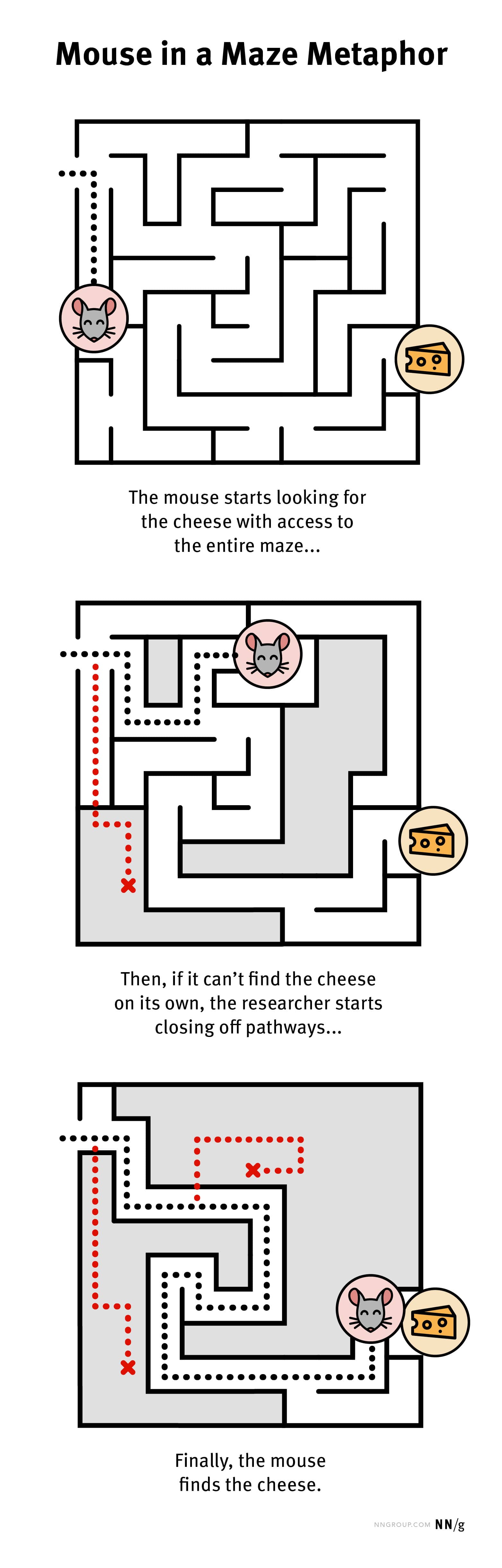
In this metaphor, the mouse is the participant, and the cheese is the aspect of the design that we’re interested in studying. It’s better to first see if our participants get there on their own, but we might have to nudge them a bit.
|
Task to give the participant |
Rationale |
|
Task 1: Using the site, see if there’s a recipe you might like to cook. |
Broad exploratory task: We’re allowing the user to define the end point of the task and complete it in their own way. |
|
Task 2: Use the site to find an easy recipe you might like to cook for dinner. |
Directed task: This task has a defined end point and success criterion. We’re asking participants to find something that they might not otherwise look for. |
|
Task 3: Using the search, find a recipe for chicken noodle soup. |
Directed task: This task asks users to use a specific feature to do a task. We’re asking users to find something they might not otherwise look for and use a feature they might not use otherwise. |
If we started with task 3, and moved in the reverse order, we would prime participants on how to behave in task 1 and task 2. It’s likely that we would miss out on learning how they would do things on their own without prompting. Funneling tasks, by starting with broad exploratory tasks before introducing directed tasks, ensures you get valid data about behavior.

The funnel technique is the idea behind stepped tasks. Stepped tasks are multistep tasks that start broad and then provide more specific instructions as necessary.
For example, let’s imagine that we’re interested in studying the comparison feature on an ecommerce site.
| Task to give the participant | Rationale |
|---|---|
|
Task 4: Choose a pair of headphones you might like to buy and add them to your cart. |
Broad task: We’re giving participants a very natural task and hoping that they happen to use the feature we’re interested in along the way. |
|
Task 4.1: Your friend is considering buying the Apple Airpods or Apple Airpods Pro but isn’t sure which one to get. Use the site to decide which one you’d recommend to your friend and why. |
If the participant doesn’t naturally discover and use the comparison feature on their own, we might give them a followup instruction like this. The goal is to put the participant in a more specific situation that might be less natural but will encourage them to use the feature. |
|
Task 4.2: Can you find a way to compare those two headphones without having to switch back and forth between pages? |
If the participant still doesn’t engage with the feature of interest, we might get even more direct. In this example, we’re strongly hinting that the comparison feature exists and asking the participant to use it. |
If we get to Task 4.2 in the stepped task example above, we might conclude that there are some discoverability or desirability issues with the feature. However, providing this level of specificity would allow us to make those conclusions while also getting a chance to see if there are any interaction-design problems with the feature itself.
Funneling in Followup Questions
In qualitative usability tests, the facilitator will make use of the funnel technique when asking followup questions. For example, we might ask the following questions after the participant has finished a task:
|
Question to give the participant |
Rationale |
|
Question 1: Do you have any thoughts about doing this activity on the website? |
This broad, open-ended question allows participants to share anything related to the task they have completed. |
|
Question 2: Was there anything easy or difficult? |
This more specific open-ended question is focused on the ease of use. Here we’re prompting users to recall anything they might have liked using or had difficulty doing. |
|
Question 3: What did you think about the filters you were using? |
This open-ended question is even more specific. Here, we’re drawing the user’s attention to a specific UI element that they used in the task. |
In the above example, we are starting with broad, open-ended questions before narrowing the scope to specific, open-ended questions that relate to a UI element that we want more feedback on.
We shouldn’t start with Question 3 and move in the reverse direction, because it’s always better if participants volunteer information unprompted. We’re hoping the participant will organically provide feedback without our specific direction, because unsolicited feedback is more likely to be the participant’s true opinion. Asking participants for feedback on specific elements can be risky — there’s always a chance that the participant will simply make up an opinion for the researcher. For example, if the participant said the filters were really helpful in response to question 1, we can be more confident that they really think so than if they gave us a similar response to question 3.
Summary
The funnel technique can be used when administering questions or tasks in user interviews or usability tests. Start with broad open-ended questions or tasks before introducing more specific questions or tasks. This approach helps to ensure that you don’t miss out on important information and you avoid prompting or priming participants too early.