Empathy mapping depends on real research, and real research takes time. When the workshop is on the calendar and the data isn’t there, reaching for an AI tool feels like a reasonable fix. Ask it to think like a frustrated user, and within seconds, you have a page full of sticky notes. However, what the sticky notes are created from matters more than how quickly they are created.
What Is an Empathy Map?
An empathy map is a visualization that articulates what a team knows about a particular type of user, organized into four quadrants: Says, Thinks, Does, and Feels.
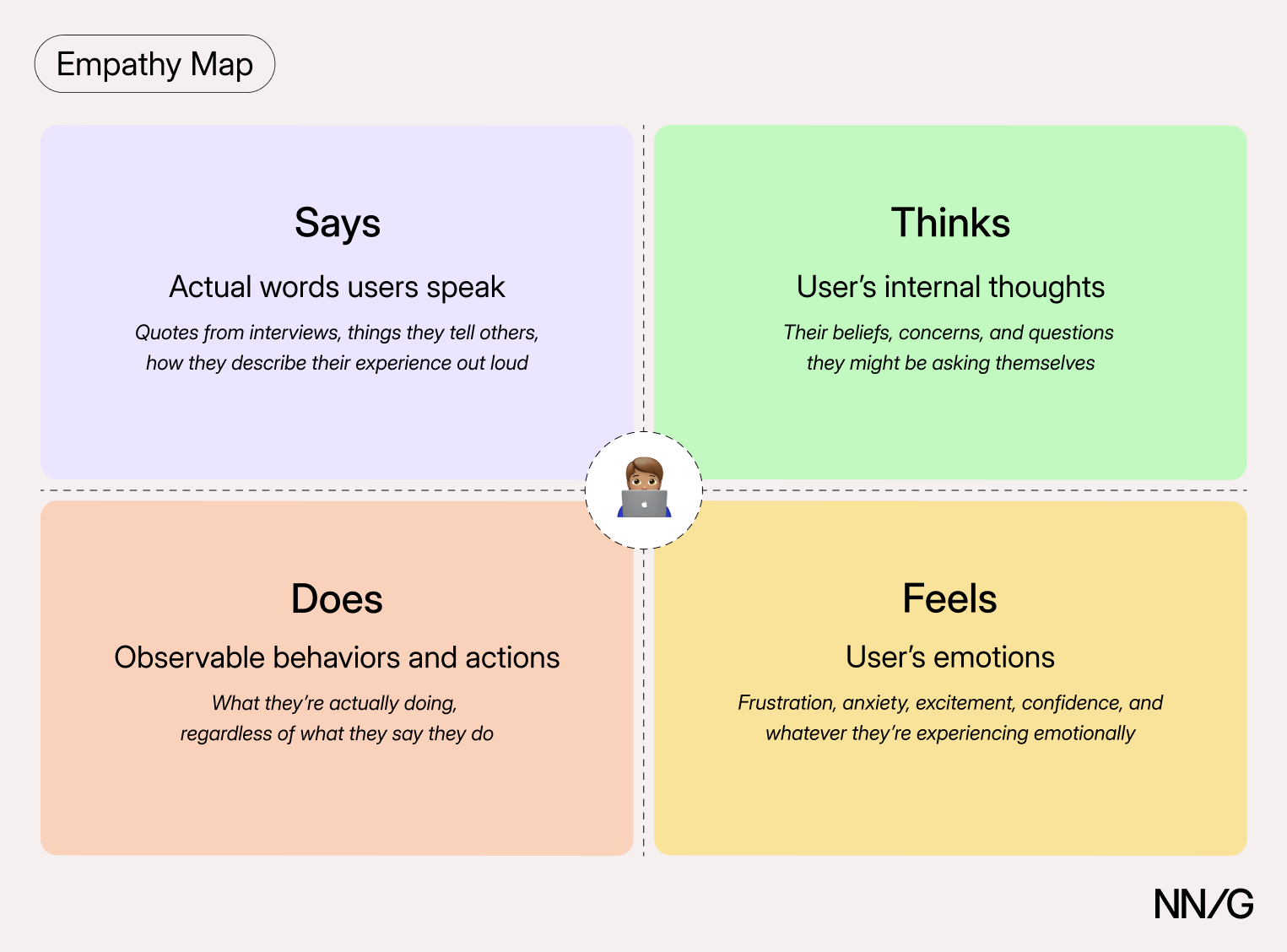
Empathy maps create a shared reference point for the whole team. They are typically built collaboratively in a workshop, using sticky notes sourced from real research such as:
- Usability sessions: What you watched someone do and struggle with
- User interviews: What someone told you in their own words
- Support tickets and call logs: What users complain about unprompted
- Field studies or contextual inquiry: What the environment reveals that users don’t explicitly mention
Empathy maps are especially useful for aligning a crossfunctional team around an experience.
Plausible AI-Generated User Content Isn’t User Research
When you ask an AI tool to play the role of a frustrated user, it synthesizes patterns across large amounts of text and produces something plausible. But plausible isn’t the same as real. It does not create the documented experience of a real, specific person.
AI doesn’t have access to your users, your product’s specific failure points, or the context someone was in when the product let them down. What it produces could describe a frustrated user of almost any product, which means it describes no one in particular.
Compare what AI generates against what real research typically surfaces.
|
Product |
AI-generated |
What real research might look like |
|---|---|---|
|
Grocery-delivery app |
“I wish the app would ask me before swapping out my items.” |
“It swapped out my oat milk for a gallon of whole milk and charged me before I even saw the notification.” |
|
Scheduling tool |
“It’s frustrating when the calendar doesn’t sync properly.” |
“I found out my 2 p.m. got double-booked because I was still looking at the version from before my coworker moved it and didn’t know there was a newer one.” |
|
Online banking |
“I want to feel confident that my money is secure.” |
“I always transfer $1 first to make sure I typed the account number right, then I send the rest.” |
|
Course registration |
“Registration is stressful and the system is slow.” |
“Four of us get on a group call at 6:59 a.m. and refresh the page together so someone can grab the spot if it opens.” |
The AI-generated quotes are safe. They’re generic enough to apply to almost any product in the category, whereas the real quotes are specific and detailed. The specificity is what makes an empathy map useful.
You might argue that AI could be prompted to invent more specific quotes. True. However, what makes real users’ quotes valuable goes beyond specificity — they are evidence of what these people actually said, did, or experienced. An invented observation is just an assumption, however plausible it may be.
Where AI Can Help in Empathy Mapping
Even though AI should not be used for generating user content in empathy maps, it can be helpful for synthesizing data produced from real-user research.
|
Legitimate uses |
Uses that compromise the map |
|---|---|
|
Organizing and clustering sticky notes from research you’ve already collected |
Generating quotes, behaviors, or emotions attributed to users who don’t exist |
|
Cleaning up language after insights are grounded in evidence |
Filling gaps in thin research with plausible-sounding filler |
|
Summarizing patterns across a large set of quotes |
Inventing a “typical user” to stand in for research you didn’t run |
|
Drafting first-pass groupings you’ll review and correct |
Producing an entire quadrant of sticky notes because nobody has data for it |
Before You Reach for AI
When using AI in the empathy-mapping process, ask yourself:
- Am I giving AI real data to organize, or asking it to generate data I don’t have?
- Can I trace this sticky note back to actual research evidence?
- If I’d come up with this myself without AI, would I call it a finding or an assumption?
If the answers to these questions are uncomfortable, that’s useful information. It usually means the map needs more research.
Conclusion
What makes an empathy map valuable is the specific, messy detail of real people. AI can help you process what you learned from those people, but it can’t manufacture them for you. AI-generated data is not evidence, no matter how specific or convincing it may be. And an empathy map needs to capture evidence.
Generating empathy-map data with AI looks like a shortcut. But it just moves the problem downstream: the team ends up building for users who don’t exist, based on a map that never required talking to anyone.