You’ve spent countless hours crafting the perfect design portfolio. Perhaps you’ve made some revisions to your resume, too. And your efforts are working! You’re receiving callbacks and getting interviews with UX team members and hiring managers.
But you haven’t landed that UX job yet. Why? Maybe during these interviews, you noticed perplexed looks on your interviewer’s faces. They ask multiple followup questions regarding basic details you thought you had already covered. Your interviewers appear prepared to take notes but write down very little of your answers.
These are clues to invest less time in your written communication and more in your verbal communication. Two celestial acronyms, STAR and METEOR, can help you organize your thoughts and overcome the past behavioral and situational questions frequently used in hiring interviews.
What Are Past Behavioral and Situational Interview Questions?
Past behavioral questions ask you to relate a previous experience relevant to the role. These questions are rooted in the principle of behavioral consistency — that how you’ve acted in the past is a reasonably good indicator of how you’ll perform in the future, as you will try to avoid internal cognitive dissonance or conform to external societal pressure.
Some examples of past behavioral questions:
- Tell me about a time when you had to compromise with the development team on the design of a feature. How did you resolve the issue?
- Discuss a situation where you presented research insights to stakeholders. How did you prepare and what were the results?
- Describe an experience where you had to plan and conduct a remote usability-testing study. What did you do to ensure its success?
Situational questions confront you with a hypothetical scenario and probe your default intentions and responses. These questions emphasize job knowledge and help prospective employers evaluate whether your problem-solving approach aligns with their expectations and preferences. Situational questions often pose a dilemma that, to be solved, will require tradeoffs, working within constraints, crafting plans, awareness of common business goals, or understanding people. Although situational questions and whiteboarding design exercises are not identical, situational questions are often the basis of whiteboarding exercises or case studies where the interviewer assesses your tactical thinking via a contextual challenge.
An example of a situational question:
You recently joined an Agile product team as a UX designer. Over the past several sprints, you’ve been surprised by being given design solutions from the product owner, asked to prototype and improve their visual fidelity, and then hand them off to development. You learn from colleagues that product management and engineering created these designs in meetings you were not invited to attend. What, if anything, would you do?
Do UX Teams Use These Questions? Why?
In our study of how UX teams hire and retain new team members, we found that 80% of respondents reported using behavioral interview questions to evaluate candidates and 63% reported using situational questions. You will likely encounter these questions if you’re applying to UX jobs.
Why are these question types used? Because they’re among the most effective tools available for evaluating candidates. A meta-analysis of research by Paul Taylor and Bruce Small found that situational and past behavioral questions are helpful predictors of job performance.
They’re also cheap to develop and easy to administer and — when UX teams define good or poor answers for such questions based on skills they consider critical to the job — they result in less-biased, more-consistent, and more-accurate evaluations from interviewers. Unlike job-knowledge trivia or brain teasers, these questions are perceived as fair (a type of validity called “face validity”) by candidates.
Answering Past Behavioral Questions Using STAR
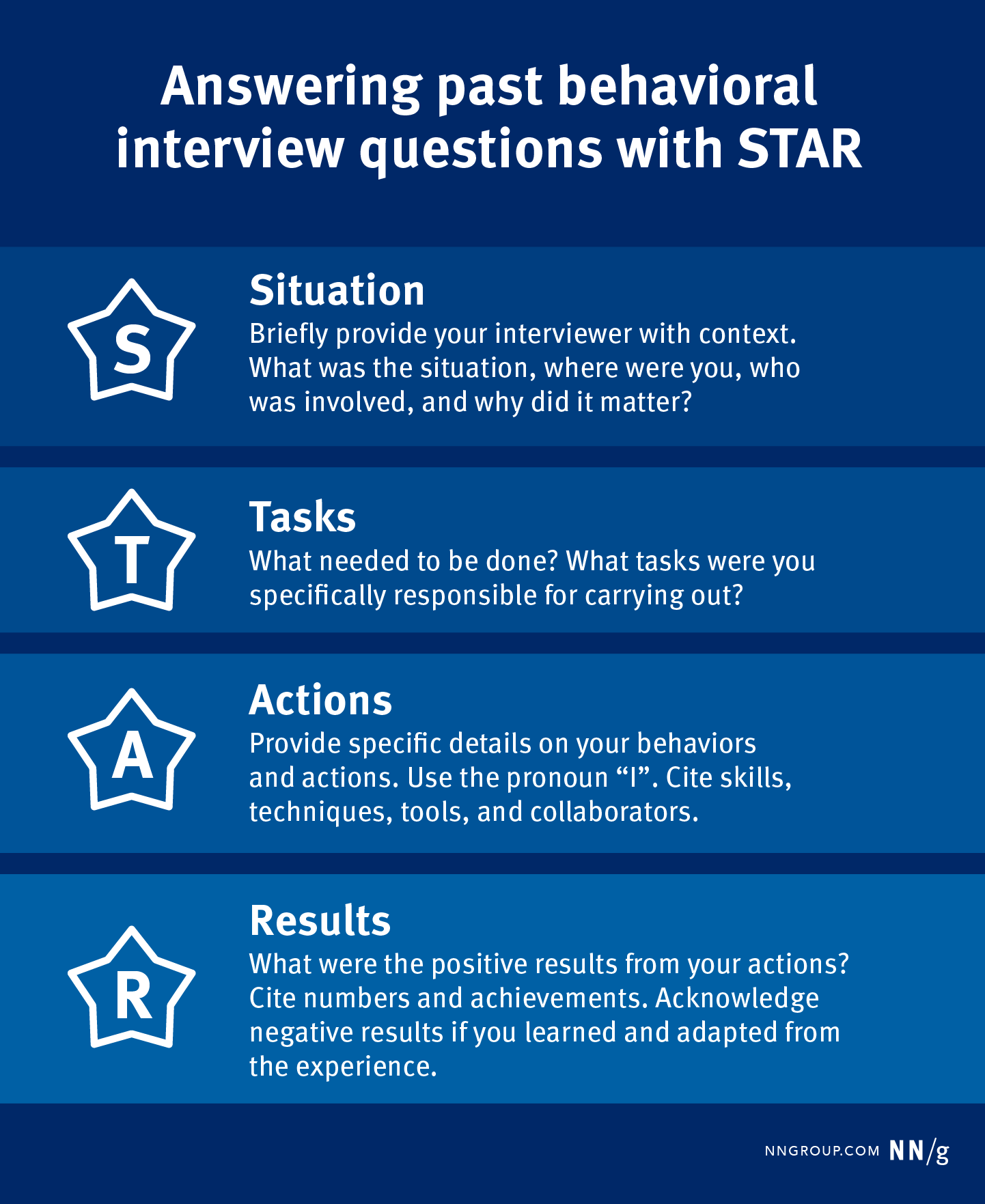
Past behavioral questions require you to share an experience. Remember the acronym STAR to give successful answers:
- Situation: Briefly give your interviewer some background about this experience. Who was your employer and what was your role? What were your constraints? Resist the temptation to describe this part in lengthy detail. Keep it brief.
- Tasks: Describe what parts of the problem you were responsible for completing. What was your objective and when did you need to accomplish it?
- Actions: In chronological order, describe what you did. Be specific — mention techniques, skills, and tools by name and avoid vague statements like “I worked really hard.”
- Results: Describe the consequences of your actions. Whenever possible, quantify your results to enhance your persuasiveness. Ask yourself: what evidence suggested your efforts were successful? Emphasize teamwork as well and credit support or contributions from teammates.
Here’s how you would apply STAR if asked the following past behavioral interview question in an interview:
Tell me about a time where you had to compromise with the development team on a feature’s design. How did you resolve the issue?
- Situation: At my last job, I was the UX designer on a product team. While developing a time-sensitive feature, my team's developers faced an unforeseen problem that made the tested design infeasible. Due to customer commitments, the team quickly needed a new approach with feasibility and usability.
- Task: I had to understand what was causing the problem while balancing business requirements and our previous user-research insights. I needed to deliver new designs in 2 weeks and monitor the impact of these changes.
- Action: I scheduled and facilitated a design workshop with the product owner and 2 front-end developers. I used the team’s new ideas and sketches to craft Figma wireframes and specifications. Since the untested design changes increased risk, I created a backlog item to usability test the implemented design.
- Result: I delivered the new design a few days early and helped the team complete the feature on time. The team was so relieved I was nominated for a spot bonus. Later, I tested it with several users and did not uncover any high-severity findings. I also started an early-stage feasibility review with the technical lead which caught similar issues on at least 3 subsequent features and avoided that kind of disruption.
What if you don’t have an excellent example to discuss? First, don’t panic! Request a moment to think from your interviewer and ask yourself these questions:
- Have I encountered this situation in a past UX job or internship, but the outcome wasn’t desirable? Did I learn and change from that experience?
- Have I encountered this situation in a nonUX job or internship?
- Have I encountered this situation in my home life or at school?
- Is there a somewhat similar situation that I could offer?
For example, maybe the question asks for an experience where you’ve managed a UX team’s research budget, but you’ve never done that before. You could give answers such as:
“I’ve never managed a UX team’s research budget before, but I did manage a $500,000 budget for a marketing team. Could I talk about how I managed that?
“I’ve never managed a UX team’s research budget before, but I actively manage my household budget. Could I discuss my process for that instead?”
It’s also understandable to want to share only anecdotes portraying you in a positive light. But this tactic reduces your number of shareable stories and does not make you stand out among the many candidates who use it. Consider sharing past experiences where you stumbled and made mistakes, so long as you analyzed, learned, and changed from those experiences. Your ability to convey self-awareness and progress is far more valuable than your ability to convey unrealistic perfection. It’s far easier for a UX manager to coach a new hire on tools and techniques than it is to coach them on personal responsibility, teamwork, or integrating constructive feedback.
Answering Situational Questions Using METEOR
Situational questions test your awareness and problem-solving ability. Remember the acronym METEOR to give successful answers:
- Muse: Push back against the urge to start talking immediately. Instead, request a moment to think. Take a deep breath and muse on the presented situation. What attributes does this question probe? Research by Janneke Oostrom and colleagues suggests that situational questions measure a candidate’s ability to decipher what the interviewer is trying to evaluate. Taking a moment to contemplate the point of the question may improve your answer.
- Enquire: Are there ambiguities or gaps in the question’s description? Enquire your interviewer for a few additional or clarifying details. Even if the interviewer cannot provide more information, your questions will inform them about how you approach the problem.
- Theorize: Based on facts provided, speculate and theorize on the contributing factors and make reasonable assumptions. Don’t let missing information prevent you from giving a complete answer. For example, if you believe a budget is a relevant factor but a budget number isn’t provided, state an assumptive number, why you think it’s reasonable, and move forward.
- Endeavor: Describe the endeavors you would personally undertake to resolve the situation. Refer to specific techniques or skills when possible.
- Outcome: Connect how your endeavors should achieve specific beneficial outcomes and how you would measure them. If difficult tradeoffs were necessary to resolve the situation, describe the need to mitigate potential adverse outcomes.
- Recap: now that you’ve explored the above areas, give your interviewer a recap of your answer. Since you likely performed some on-the-fly problem solving, a quick summary can aid your interviewer’s comprehension of your response.

Here’s an example of applying METEOR to a situational question in an interview:
You recently joined an Agile product team as a UX designer. Over the past several sprints, you’ve been surprised by being given design solutions from the product owner, asked to prototype and improve their visual fidelity, and then hand them off for development. You learn from colleagues that product management and engineering created these designs in meetings you were not invited to attend. What, if anything, would you do?
- Muse: May I have a few moments to think about the question? ...
- Enquire: Has this team collaborated with a UX designer before? Who schedules these meetings and who attends them? Do I have visibility of the team's backlog? ...
- Theorize: Let's assume this team is unfamiliar with working with a UX collaborator. They may be unaware of the benefits of testing designs. The product's visual design may be a weakness they want to remedy. Being new, I likely have underdeveloped relationships ...
- Endeavor: I want to build trust, so I won't demand radical changes upfront. I'd gently confirm if I'm invited to all the team's meetings. I’d focus on starting one-on-one sessions with product management and engineering leads. I'd also look ahead in the backlog and identify a high-risk feature that may benefit from usability testing. I'd introduce the technique to them over a lunch and learn session ...
- Outcome: By gaining trust with my colleagues, I'll have more opportunities and more time to contribute value. When the team experiences the impact of testing designs, it will see how it helps deliver better outcomes and be amenable to adjusting their workflow ...
- Recap: Let's quickly recap my theories, endeavors, and desired outcomes ...
Deliver Excellent Answers by Practicing Storytelling
Whereas STAR and METEOR help us focus on identifying valuable content, storytelling is how we combine and communicate it effectively to our interviewer. But skillful storytelling does not come naturally. Research by Adrian Bangerter, Paloma Corvalan, and Charlotte Cavin found that research participants who answered past behavioral questions with a story received better hiring recommendations from interviewers. However, their participants used stories only 23% of the time!
There is a technique that can help, though. A study by Serene Lin-Stephens and colleagues found that practicing, training, and referring to relevant images helped participants become more skillful storytellers during interviews.
Actual interviews are not the best setting for practicing interview skills: you’re unlikely to receive crucial feedback on your interview performance due to legal concerns or the hiring manager’s bandwidth. You can, however, practice storytelling in mock interviews with a friend or colleague.
Follow these 10 steps to practice applying STAR and METEOR and improve your storytelling skills:
- Ask a trusted mentor, colleague, friend, or family member to conduct an online mock interview with you. It’s helpful if they’re familiar with UX but not required.
- Schedule a 30-minute meeting with your interviewer using a video-conferencing app. Conclude your interview exactly at 30-minutes.
- Provide your interviewer with 5 past behavioral or situational interview questions. Peruse employer-review apps (like Glassdoor) to gather sample interview questions for their UX jobs. Recall questions from past UX interviews. You can also create your questions based on experiences common to many UX jobs:
- Coherently summarizing your educational and career achievements
- Being timely and accountable with your deliverables
- Achieving compromise within constraints
- Planning and conducting research
- Designing and iterating with user insights
- Influencing others and improving UX maturity
- Coping with low-UX maturity, disappointment, or failure
- Sharing and crediting success with teammates
- Monitoring and reporting UX metrics
- Allocating and staying within budget
- Record the call.
- Don’t prepare or reference notes. Attempt to answer the questions as if you’ve never heard them before, to simulate an actual UX-job interview. Answer all 5 questions within the allotted time. Ask your interviewer to prompt you for more information if they get confused and cannot follow your answer.
- Afterward, ask your interviewer for feedback on your delivery, nonverbal communication (gestures, facial expressions), and video experience (lighting, audio quality, background). Adjust accordingly.
- Transcribe the interview’s audio. Many AI transcription services will transcribe 30 minutes of audio for free with acceptable accuracy.
- Using the transcription, plug each of your answers into the STAR or METEOR format. Are you covering each section? Do your answers form a coherent narrative? Where do you run long? Restructure and rewrite your answers accordingly. Delete disfluencies (filler phrases such as ‘ums,’ ‘ahs,’ ‘you know’) and verbal stumbles. Also, check your portfolio or phone. Do you have images relevant to your answers that could refresh your memory and help you recall valuable details? Refer to them while editing.
- Repeat the above process yourself or with your interviewer if they feel generous. This time, freely reference your rewritten answers. Practice saying them aloud and as spontaneously as possible.
- Compare and contrast the videos of your 2 interviews. Share the new recording with your interviewer and ask for feedback. How have your answers and delivery changed? Don’t forget to thank your interviewer for their help.
Trying this even once can be an eye-opening experience and will provide valuable ideas for improving your interviewing skills. Most of your competition won’t put forth this effort. You’ll also have a prepared set of answers you can draw upon in future UX interviews.
Conclusion
A well-designed portfolio may get you more interviews, but that portfolio alone won’t secure a UX job. Great communication skills are the sun at the center of the UX solar system. Utilize STAR and METEOR — plus some practice — to organize your answers, tell persuasive stories, and impress your prospective colleagues with your stellar communication skills.
References
Paul J. Taylor and Bruce Small. 2002. Asking applicants what they would do versus what they did do: A meta-analytic comparison of situational and past behaviour employment interview questions. Journal of Occupational and Organizational Psychology 75, 3 (2002), 277–294. DOI:http://dx.doi.org/10.1348/096317902320369712
Janneke K. Oostrom, Klaus G. Melchers, Pia V. Ingold, and Martin Kleinmann. 2015. Why do situational interviews predict performance? is it saying how you would behave or knowing how you should behave? Journal of Business and Psychology 31, 2 (2015), 279–291. DOI:http://dx.doi.org/10.1007/s10869-015-9410-0
Adrian Bangerter, Paloma Corvalan, and Charlotte Cavin. 2014. Storytelling in the selection interview? how applicants respond to past behavior questions. Journal of Business and Psychology 29, 4 (2014), 593–604. DOI:http://dx.doi.org/10.1007/s10869-014-9350-0
Serene Lin-Stephens, Maurizio Manuguerra, Pei-Jung Tsai, and James A. Athanasou. 2022. Stories of employability: Improving interview narratives with image-supported past-behaviour storytelling training. Education + Training (2022). DOI:http://dx.doi.org/10.1108/et-08-2021-0320