From the user’s perspective, one of the benefits of ecommerce-site registration is being able to store credit card information for simpler and faster checkout on return visits. The saved payment information allows users to easily proceed through the purchase. When the payment information is accurate and up-to-date, the flow works well. But when a payment detail needs to change, some sites force long-time users to go through a redundant, tedious process.
While many sites support the addition of a new credit card number, making a change or removing a card is far less frequently supported. Some offer the option only in the Account section of the site, and not directly in the checkout flow. This detour causes additional work for the user and is not expected: users realize that they need to change their payment method while trying to use it, not as a separate account-related step.

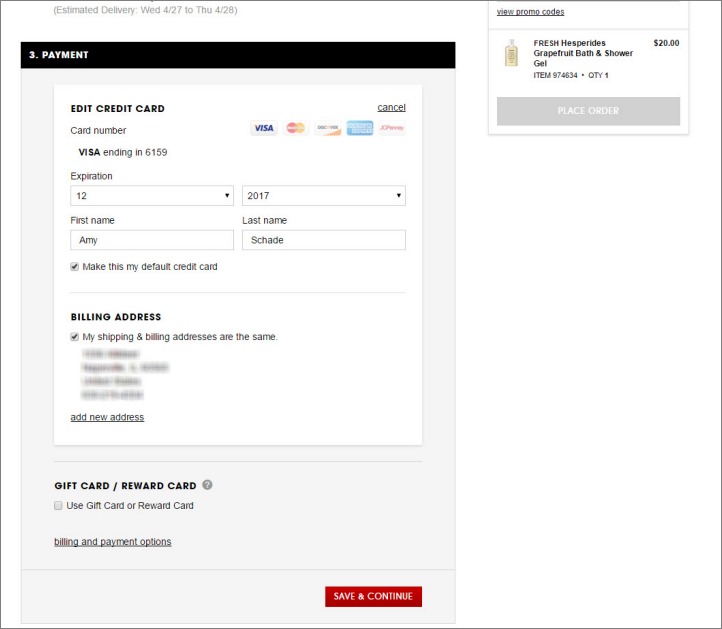
When a user’s credit card expires, many banks reissue a card with the same number, but an updated expiration date. Allowing the user to update only this information rather than create a new entry, is simpler for the user and better for the site. Out-of-date information is removed, and the update is quick and easy. (And less error-prone, especially on mobile devices where it’s a royal pain to enter a full credit card number supplemented with the owner’s name and other info that the site already knows, curse it.)
To support updates, provide links to Edit or Delete next to saved payment types. These links should lead to an area where users can update card information or confirm the removal of an old card. The credit card number itself should not be fully revealed, but enough information should be visible to allow the user to easily identify the card. Displayed information may include the last four digits of the card number together with the card type, or a name that the user has saved for the card, (e.g., “Amy’s Visa”).

Editable fields should allow a quick update of information. Users should not have to reenter the existing credit card information, but should be able to make a change to payment details in editable fields. This action should result in a newly accurate record, rather than a duplicate of a past record.
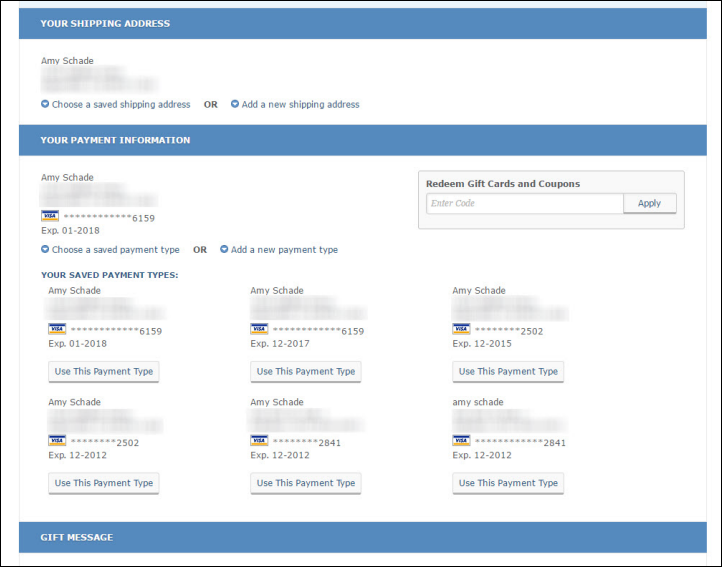
When sites don’t support edits to payment information, such as updating expiration dates, they create usability problems. Not only do users have to work harder to create a new entry rather than simply update an expiration date, but the system will also end up with two virtually identical entries, differing only in their expiration date. Even if the expiration date is displayed next to the payment option, users must now work harder to distinguish between several similar choices.

Shoppers also need to be able to delete old and unused payment options easily. Without such a spring-cleaning feature, over time, users will be left with accounts and interfaces that are cluttered with out-of-date information. The backend systems will also be polluted with unneeded information.
Summary
Users need to be able to update payment information as part of the checkout flow. When sites fail to make these changes possible, they force people to go through extra steps and make the task unnecessarily complex. They also clutter the interface and the site’s backend data with information that is out-of-date and unnecessary. While it’s never a good idea to frustrate any user, your long-time customers are not the ones you want to frustrate. Repeat sales are the most profitable, but too many hurdles to updating information can easily lose these sales. And too many frustrations caused by a confusing interface for selecting payment types can easily lose a customer — or at least turn them into less-frequent shoppers on your site. For more on supporting shoppers, see our E-Commerce User Experience report series.