Feeling a sense of ownership over your work seems like a necessary quality for any passionate design professional. Many organizations promote ownership cultures and encourage employees to solve problems proactively. Designers who feel ownership are more motivated, take greater initiative, and find more job satisfaction.
But psychological ownership has drawbacks. Getting attached to the wrong things won’t fuel your dedication or performance; it’ll fuel your underperformance instead. Organizations often don’t talk about ownership with nuance, so let’s discuss how to notice when your sense of ownership has attached to something you can't (or shouldn't) control, and how to redirect it to a better target.
- What Is Psychological Ownership?
- Sources of Psychological Ownership
- Perils of Psychological Ownership
- When You’d Rather Work Alone
- When It’s “My” Prototype
- When Feedback Feels Like an Attack
- When The Build Isn’t What You Designed
- What's Genuinely Yours to Own
- Growing into the Right Kind of Ownership
- Conclusion
- References
What Is Psychological Ownership?
Reflect on your career. Have you ever experienced:
- Relief when your colleagues leave all the project’s design work for you to decide?
- Pride when presenting your design work or your research insights?
- Defensiveness when receiving pushback from stakeholders?
- Anger when you see your designs derailed or poorly executed?
Moments like these are perfectly normal, and they don’t make you unprofessional if you’ve experienced them. But when left unexamined, they can make you susceptible to frustration, disillusionment, and eventually burnout. These are times where psychological ownership is at work.
Psychological ownership is the attachment an employee may develop towards their output, role, projects, or organization, where they consider the target to belong to them, regardless of actual ownership.
Sources of Psychological Ownership
Research by Linn Van Dyne and Jon Pierce shows that psychological ownership develops from three sources:
- Controlling something
- Knowing it deeply
- Investing your time and effort into it
Typical design work readily supplies all 3 of the psychological-ownership sources mentioned above. You conduct research and create deliverables, you know the details behind the design better than anyone else on the team, and you pour your judgment and taste into it. It’s why designers can experience strong feelings of ownership so readily (and why low-fidelity approaches, which keeps artifacts disposable and cheap to change, are still worth including into your process).
Perils of Psychological Ownership
According to the research, psychological ownership can have real job benefits: higher motivation, enhanced stewardship and initiative, and greater satisfaction. It also can create real problems when it misfires: territorial defensiveness and poor collaboration, resistance to feedback and change, and reluctance to share information (which worsens the common-knowledge effect and harms team decision making).
You can’t redirect psychological ownership in a healthy way by merely:
- Forcing yourself to feel differently about the job
- Acquiescing to opinionated colleagues
- Discarding your principles and work ethic (i.e., “I work for the income and not the outcome”)
Instead, redirect the inputs that fuel ownership, like where you invest your time, what knowledge you develop, and what you choose to control. Picking more realistic and rewarding targets is how you can turn psychological ownership into a strength.
When You’d Rather Work Alone
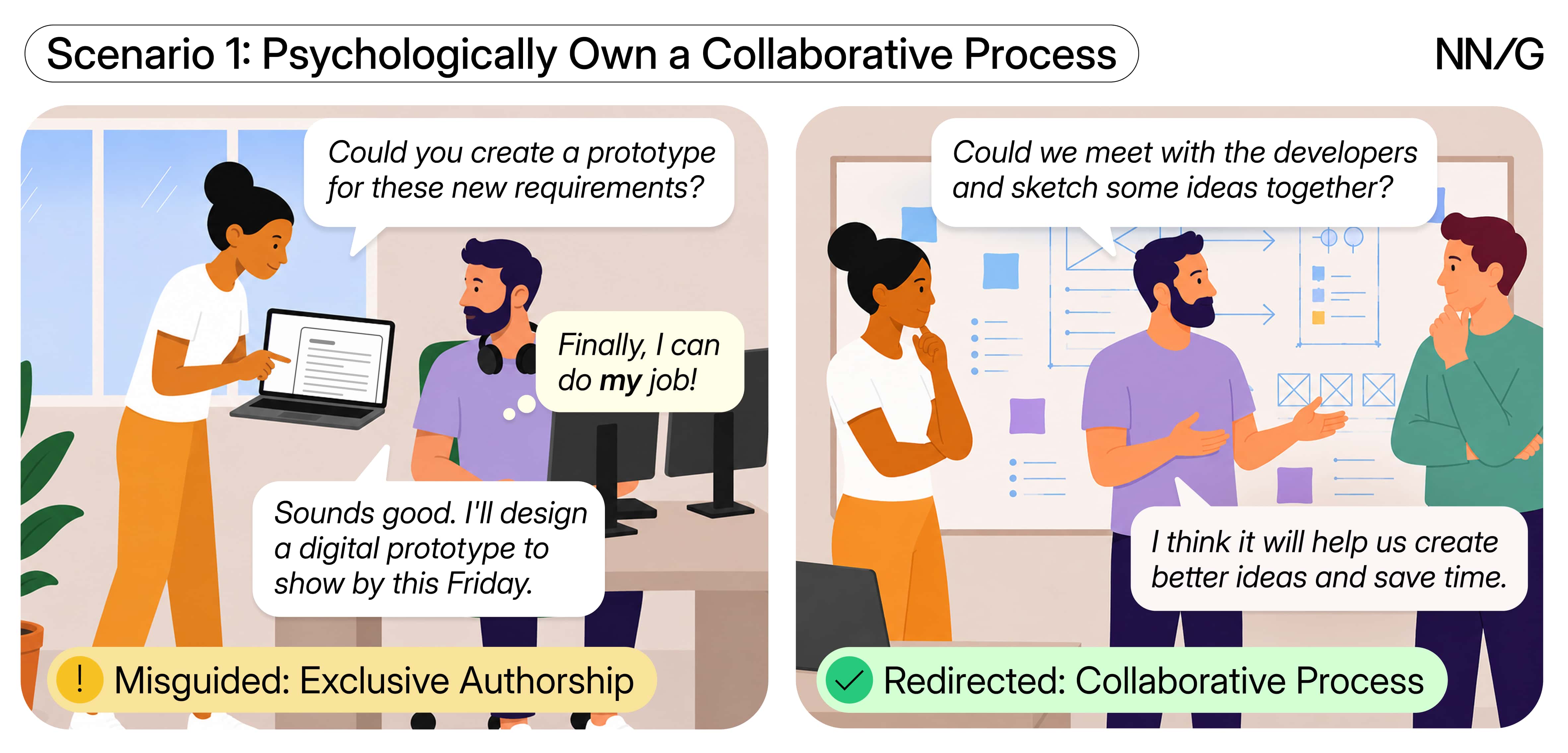
Have you felt the quiet relief when requirements land in your lap and your teammates leave you to design? Ownership of your creative process and its resulting ideas can feel gratifying. But research by Markus Baer and Graham Brown suggests that strong ownership of an idea makes us discount alternatives and undervalue collaborative input. Early solo concepts are usually the most assumptive (and often not very good).
Ask yourself:
- Who besides me decides whether this design ships?
- What knowledge do they have that would influence my decisions?
- Am I protecting time to think or protecting my ideas from challenge?
Focused solo time has legitimate uses and can be efficient for simple, low-risk tasks. But watch out for relief at the absence of other perspectives, because that's psychological ownership attaching to your authorship instead of the design's success.
Own a collaborative design process instead of exclusive authorship. Have a sketching session with your business or development colleagues before your concept hardens. Point out both the drawbacks and benefits of different approaches. Remember that good ideas can come from anyone, so be open to serving as a facilitator instead of contributing yourself. Identify positive aspects of others’ ideas and incorporate them into the solution whenever possible.
When It’s “My” Prototype
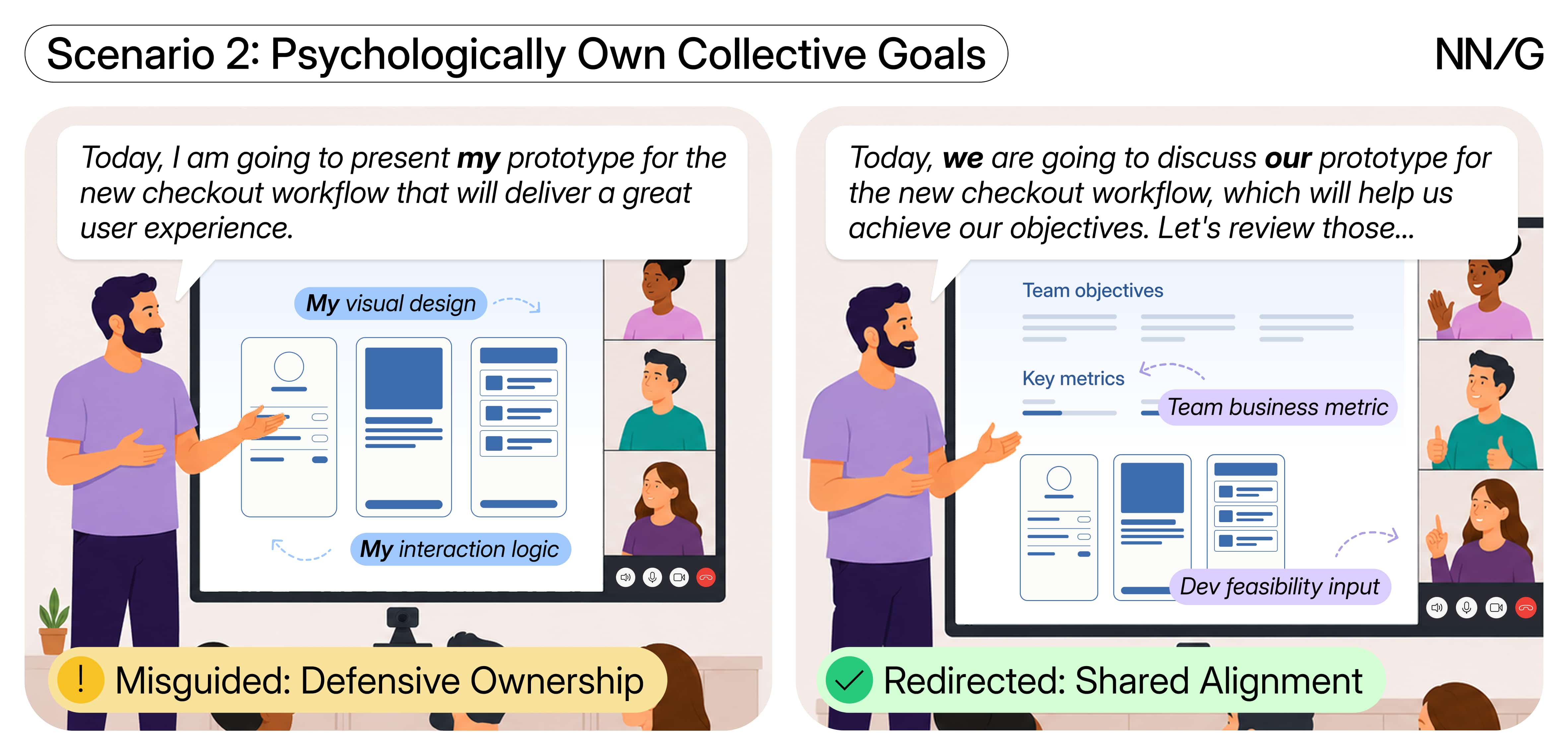
There's nothing wrong with saying "the prototype I put together" if you did the work. You may even feel a sense of accomplishment for its clever workflow or elegant visual design. Beware when you present the work for review, though. That's when psychological ownership tempts you to frame the deliverable into an extension of yourself. Then it becomes something for you to protect rather than something the team decides on together.
Remember that a prototype becomes real only through the team's combined efforts. It must be technically feasible, meet business objectives, and survive priorities beyond just optimizing for usability or quality.
Ask yourself:
- When I say "my design," do I mean "the work I contributed to address a need" or "my vision that I expect others to faithfully execute?"
- Would this design succeed if it can’t be built on time?
- Would this design succeed if it doesn’t contribute positive business impact?
Own collective team goals, not your design goals alone. In a study of creative teams, Steven Gray and colleagues found that when the person who originated an idea actively sought their teammates' input, rather than guarding the idea as their own, the team was less prone to clash over ownership. So, during reviews and decision moments, deliberately reframe the work as the team's, and think beyond just user-experience concerns. Adjust your language to use more first-person-plural pronouns like "we" and "our," and be careful with "my." Notice how a designer can voice nondesign questions with colleagues or subtly nudge them to own more of the user experience themselves:
- “How could we revise our design to handle the response delay from the API?”
- “What is our contractual deadline with the customer for releasing this feature?”
- “The prototype currently doesn’t explain the triggered error. How would our customers know where to get help?”
Language that acknowledges shared ownership and attention that reaches past the interface to the team's business and technical goals prompts investment that promotes more effective ownership from others as well as yourself.
When Feedback Feels Like an Attack
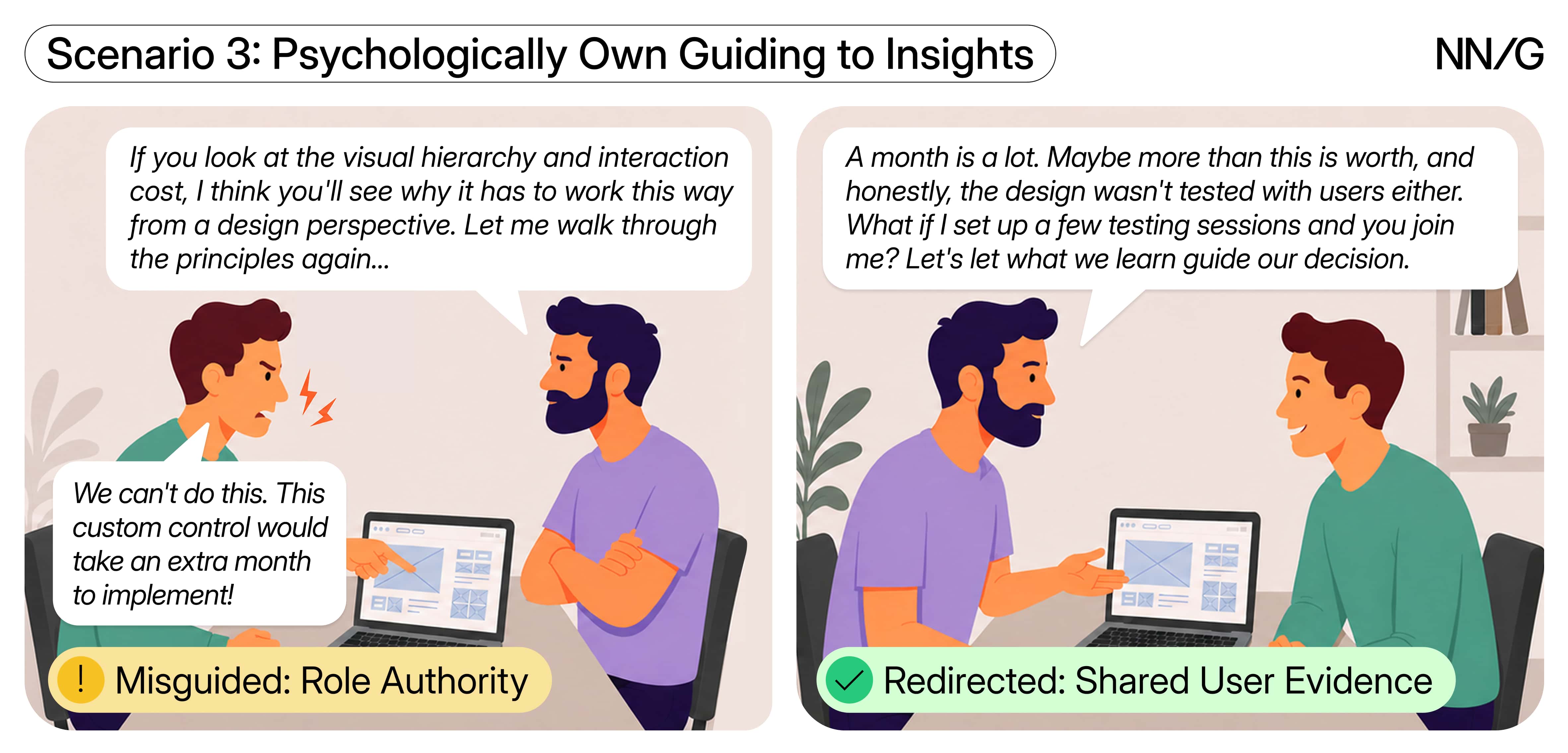
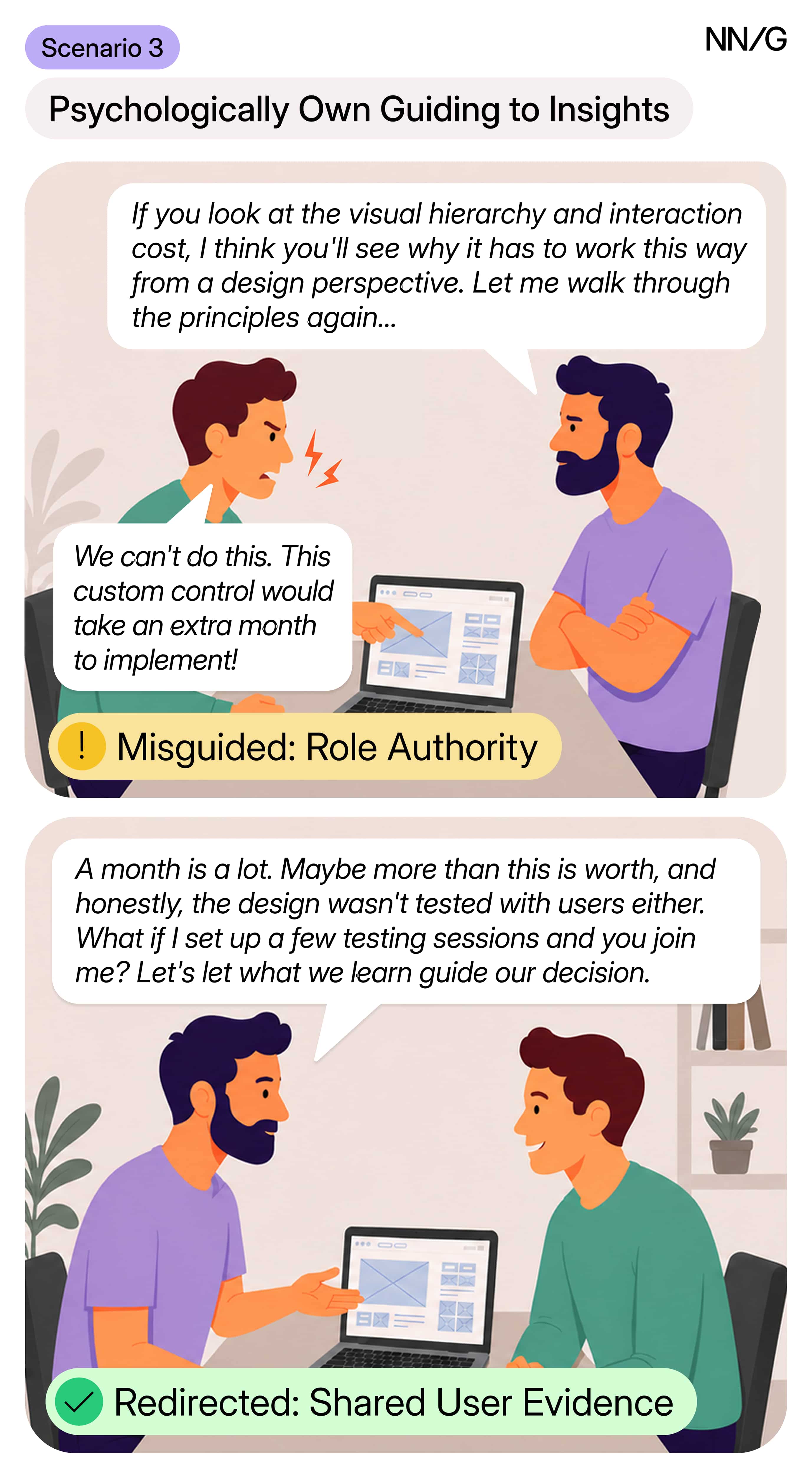
A developer pushes back on your design in a meeting. Before you've consciously decided anything, you're reexplaining your rationale with more and more detail, certain that if they just understood your reasoning or respected your expertise, they'd agree with you. The meeting quickly escalates into an argument as nobody feels heard.
Skepticism and opposition are challenges that all designers face in their career. When they happen unexpectedly, psychological ownership can make you feel threatened. Pause and consider:
- Is my objection justified in user evidence or is it my preference?
- Am I communicating understandably with my audience?
- Do I accurately understand the feedback’s rationale and what it’s trying to achieve?
- If a colleague had designed this exact experience, would I still be defending it this hard?
Sometimes strong ownership is what’s needed. For instance, when the change would harm users (like deceptive patterns), when accessibility would be cut for convenience, or when you have user evidence people are clearly ignoring. Don’t meekly yield for the sake of getting along. Thankfully, these are not common situations. When these feedback moments go poorly, they’re most often a symptom of the designer’s misplaced ownership in their artifacts or their perceived mandate as the “designer” that undermines their ability to listen, persuade, and educate.
Own guiding others to experience user insights instead of your authority over the design. Listen first and echo the concern back to confirm you understood it. Translate your reasoning into plain terms instead of design jargon meant to intimidate. When you and a colleague genuinely disagree and neither of you is sure, let the users settle it. Involve team members in discovery research, or put both approaches in front of real users and test them, instead of deciding by whoever argues the hardest. Admit when you don’t have the user evidence for your recommendation and gently help others realize there may be unknown consequences to their recommendation as well. Helping others directly witness tradeoffs' impact on users is a far more powerful form of influence than winning an argument. You stop trying to psychologically own the role and instead start owning the team's understanding of the users they are ostensibly trying to serve.
When The Build Isn’t What You Designed
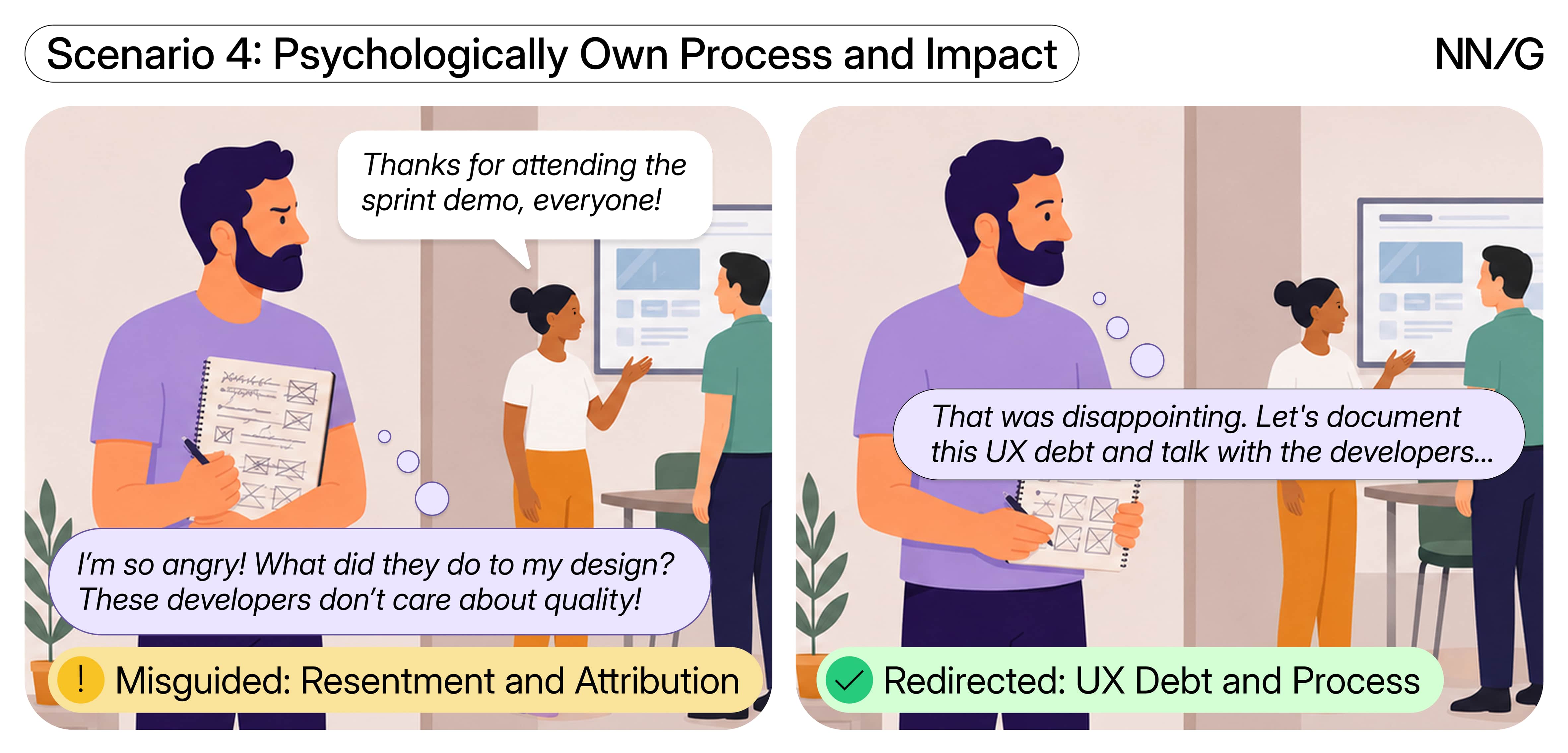
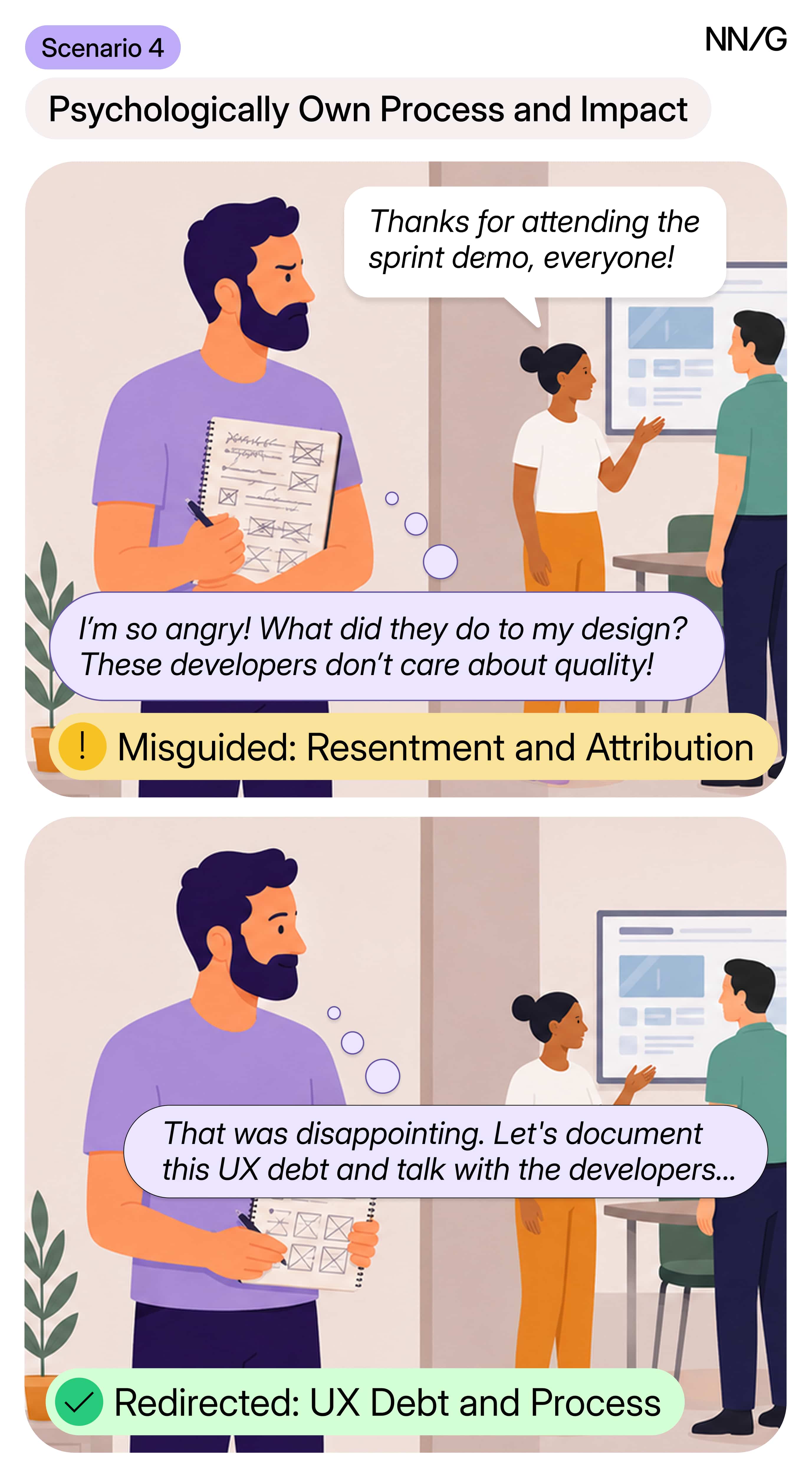
You sit down during the team’s sprint demo to review the most recently finished work. It soon dawns on you that the feature being demonstrated has substantially diverged from the designs you provided. The changes simplified the design, and many of the details you so carefully designed and documented were discarded. As you fume over why these developers don’t care about quality, you mourn the loss of what would have been a great portfolio case study.
Two things are happening here. First, you're claiming sole ownership of a collective effort, hoping for an impactful portfolio piece. Second, you're explaining the gap through the fundamental attribution error, a cognitive bias that assumes people's actions reflect their character (not caring about quality) rather than their situation, such as deadlines, constraints, competing priorities, or a crisis you don't know about. Unless you’re well connected with the team’s activity and its people, then you won’t have the full story in a meeting.
Ask yourself:
- What do I actually know about why the build diverged and what am I assuming?
- Was there anything in my control during the sprint that I didn't utilize, such as hosting checkins or performing design QA?
Own monitoring impact and improving your process instead of your emotional reactions and inferences. It's okay to be angry over a disappointing result, but treat it as a cue to think constructively. Document the gaps as UX debt so they're visible and actionable. Follow up with the developers to learn what happened during the sprint. Reflect on what was yours to control, like your presence during the sprint or the designs you provided. Owning what you can control beats ruminating over a disappointing build you may be unable to change.
What's Genuinely Yours to Own
Everything so far has been about loosening your grip on poor ownership targets, which raises a fair question: what's left? More than you might think. Some things are yours outright, because no one else can take them away from you:
- Your judgment: what you pay attention to, how you analyze it, and how you leverage your intuition
- Your actions: how you interpret and respond to situations, feedback, and your reactive emotions
- Your growth: the skills and craft you develop and continuously improve over a career
- Your values: the principles that guide your choices, and your integrity when holding to them is difficult
- Your boundaries: the limits you set on your time and effort, and your discipline maintaining them
- Your relationships: the professional connections you foster with others, the mentors you seek out, and the communities you associate with
Psychologically own these completely by taking personal responsibility for them, investing your time and effort in cultivating them, and mastering your ability to use them well. That’s far easier said than done. It can mean taking the initiative to:
- Hone your judgment with a deliberate reflective practice like inkthinking, instead of repeating the same mistakes.
- Take action to repair your relationship with a product manager after a heated disagreement, instead of quietly holding a grudge.
- Invest in your growth by delivering a conference talk, even when public speaking scares you.
- Hold to your values and push back on a deceptive or exploitative design, even when caving would be expedient.
- Establish a boundary by setting your work hours with your team and then honoring it.
- Nurture relationships by keeping in touch with the brilliant colleague who taught you everything you know about qualitative research.
Other things, like a shipped design or whether your advice is heeded, are shared with the team and beyond your complete control. Own those more lightly.
Growing into the Right Kind of Ownership
Misplaced psychological ownership is common, especially early in a career. Schools tend to teach idealized design processes without constraints, and often in a solo context where you can own everything in a project without consequence. But work life is a muddy mess of corporate politics, deadlines, technical realities, and business demands. Students are rarely given the advice they need to prepare for the transition.
Understanding the right kinds of psychological ownership requires learning what to hold on to and what to let go. The exhausting way is attempting to own things that employers own or that teams own, which leads to frustration and seeking a different job hoping that “this time it’ll be different.” It probably won’t be.
The wiser way is to thoughtfully reflect on this article’s questions and become more self-aware. Honestly consider these questions:
- What are the drawbacks and sacrifices of trying to own these things?
- How successful have I really been at trying to own them?
- Even if I think I’ve been successful, what will I do when my control inevitably ends because my company, team, or role change?
In addition to reflection, seek out mentorship, which can offer a seasoned outsider’s perspective on your choices. Good mentors can often candidly assess your approach in ways that your boss likely won’t.
And design leaders, take heed: don't thoughtlessly echo corporate culture slogans of "taking ownership" with design staff, especially in a lower UX-maturity environment. Your most passionate junior people are the most vulnerable to attaching ownership to the wrong targets and stressing themselves out defending them. Coach them on these distinctions, because it could be the difference between an ownership culture that energizes your team and one that quietly breeds cynicism and costly attrition.
Conclusion
Designers are often told that they own the user experience, but that’s not the reality. Very little of it is under any one person's control in this industry, and thinking otherwise will inevitably cause stress.
Redirect your psychological ownership fully toward what’s genuinely yours and lightly towards what’s shared. Own your judgment, your actions, your career growth, your values, your boundaries, and your relationships. You can’t switch the feeling off, but you can influence what it holds on to, so the same instinct that would have worn you down starts building you up instead. That choice is always yours to make.
References
Linn Van Dyne and Jon L. Pierce. 2004. Psychological ownership and feelings of possession: Three field studies predicting employee attitudes and organizational citizenship behavior. Journal of Organizational Behavior 25, 4 (April 2004), 439–459. DOI: https://dx.doi.org/10.1002/job.249
Lin Wang, Kenneth S. Law, Melody Jun Zhang, Yolanda Na Li, and Yongyi Liang. 2019. It’s mine! Psychological ownership of one’s job explains positive and negative workplace outcomes of job engagement. Journal of Applied Psychology 104, 2 (February 2019), 229–246. DOI: https://dx.doi.org/10.1037/apl0000337
Markus Baer and Graham Brown. 2012. Blind in one eye: How psychological ownership of ideas affects the types of suggestions people adopt. Organizational Behavior and Human Decision Processes 118, 1 (May 2012), 60–71. DOI: https://dx.doi.org/10.1016/j.obhdp.2012.01.003
Steven M. Gray, Andrew P. Knight, Markus Baer. 2019. On the Emergence of Collective Psychological Ownership in New Creative Teams. Organization Science 31(1):141-164. DOI: https://doi.org/10.1287/orsc.2019.1307