Users want digital content that is easy to consume. However, content written in a foreign language is not easy to consume — even if users are able to read that language. While many sites avoid this problem by using localization or by providing language- or country-specific site versions, these approaches sometimes overlook user-generated content.
When product reviews or comments are not translated, the user experience suffers. We observed this problem in two recent studies: ecommerce research with international shoppers and a study of the Korean-popular (K-Pop) culture in which participants used community-heavy apps.
Shoppers Need a Translation Tool
Online shoppers rely heavily on product reviews to make decisions. Sites that provide products or services to an international market and receive reviews in different languages should aim to make these reviews available to all customers — regardless of language.
Missing Translation Can Lead to Lost Sales
Some sites failed to offer any review-translation feature, meaning that shoppers were unable to read any reviews written in foreign languages. For instance, on the Nike China website, a participant tried to shop for a new pair of running shoes. He wanted to check the reviews before deciding which one to buy, but almost all reviews (6 out of 7) were in English, a language he did not speak. The Nike China site didn’t provide any translation tools, so he could not read them. Having no reviews to refer to, he abandoned the site to shop for shoes elsewhere.

Translating Individual Reviews
In our ecommerce study, as long as there were enough reviews in their own language, people generally skipped over reviews in a different language. However, when there were few reviews for a product or the product had a low rating, users were interested in reading the thoughts of international reviewers. In that context, the ability to translate those reviews became very important.
In contrast to Nike China, Etsy did offer a review-translation feature. Reviews in a language different than the user’s default setting included a link to translate the review. When users clicked the link, the newly translated text appeared below the original, underneath a label that explained it was Translated by Microsoft.
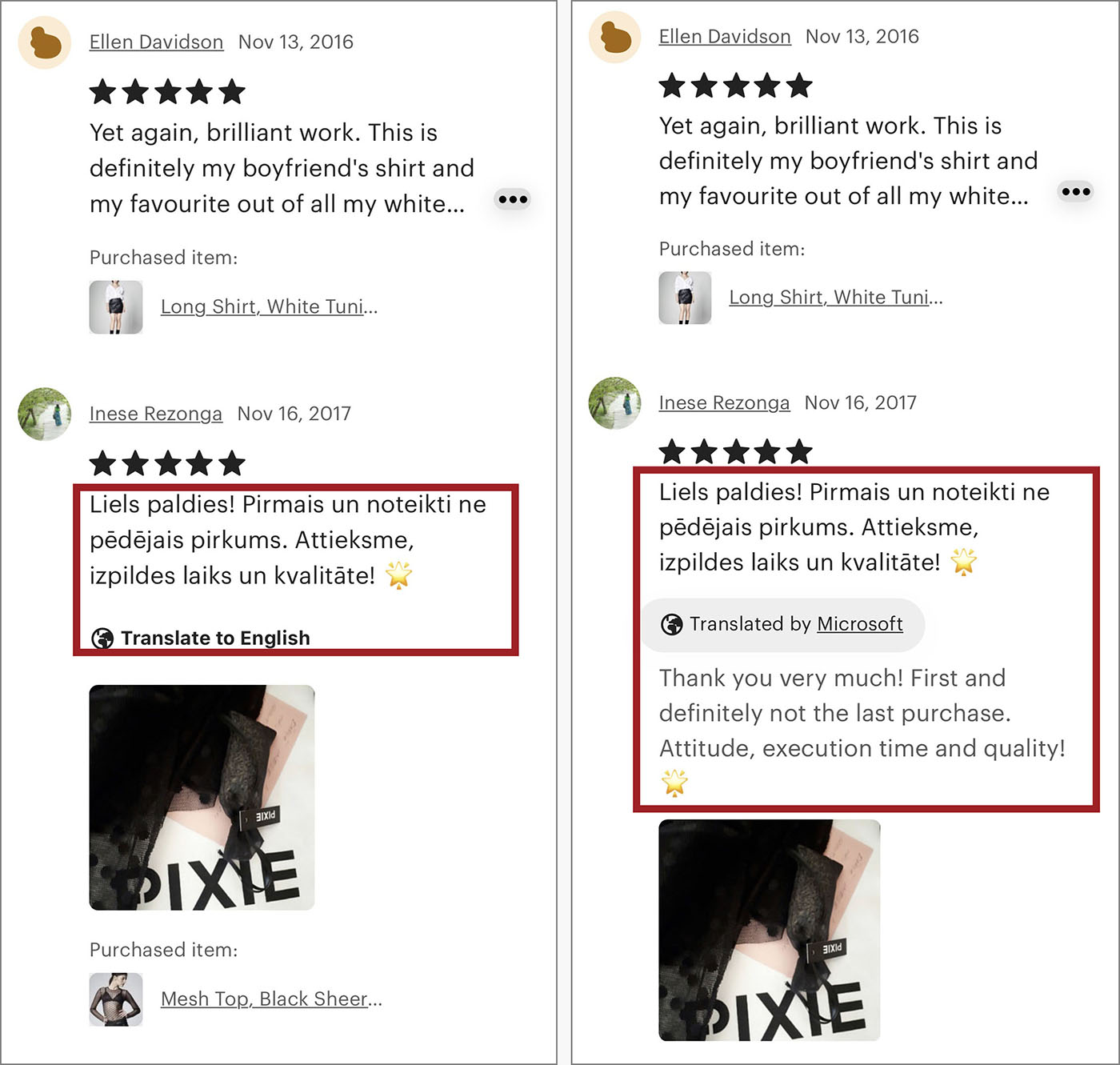
When sites opt to provide individual translation links like Etsy did, the Translate button should be provided only when the reviews are written in a language other than the default browser setting. In other words, they should not be included on every review.
SHEIN, a fast-fashion clothing retailer that supports shipping to over 220 countries and regions, offered a translation tool for its product reviews. While users appreciated this feature for global reviews, the site confusingly placed a Translate button under every review, even when it was written in the domestic language.

When a Simple Translate Button Isn’t Enough
The ability to translate reviews individually might work fine for some ecommerce situations, if international reviews are rare and users aren’t likely to read them all. However, in other situations, it would be too tedious and laborious for people to click Translate for each individual item if a significant part of the content is written in other languages.
In our recent K-Pop study, we studied how participants used Fan Networking Services (FNS) –- platforms where the global fans of Korean pop stars gathered in online communities and posted their own content. For instance, one of the most popular of these platforms, Weverse, positioned itself as an Official community for all fans in Apple’s App Store.
To our surprise, when asked to browse some fan-generated content, most South Korean participants in our study went to traditional social-media platforms like Twitter instead of heading to FNS apps. Even when they used these FNS apps, they spent much more time on content posted by their idols than on fan posts.
When asked why they didn’t look at content posted by fans, a handful of study participants said that these apps are “for foreigners” because they contain posts in different languages, and Korean fans would need to scroll to see content in Korean.
Actually, Weverse (and some other FNS apps) did provide a translation feature (the icon on the right side of each post) that allowed users to translate each post manually. However, that individual-translation approach didn’t work well in this context: domestic fans browse community posts to kill time, and they aren’t very motivated to click the Translate button for each foreign post as they won’t know if it’ll be interesting or relevant. But these foreign-language posts take up a lot of space and people need to scroll a lot in order to see a reasonable amount of content in their language. As a result, many Korean users tended to abandon these platforms and turn to Twitter, where there are curated idol-related news and videos in their domestic language.

In the example above, Weverse should consider automatically translating all posts or providing a Translate All button to reduce the interaction cost of translating each foreign post, since these posts make up most of the community content.
In the context of ecommerce, the same considerations apply: if there are too few product reviews in their own language compared with reviews in other languages, it’ll be tedious for people to click Translate for each review. In this case, we recommend automatically translating the reviews written in other languages with a note Translated from language X or Read the original review below each.
Booking.com, a hotel-booking service, did exactly that: it automatically translated featured reviews on its detail pages. It prioritized the featured reviews left by customers speaking the same language as the user. But, if there weren’t enough, it would also show reviews translated from other languages and noted Translated by Google below the review content, together with a Show original button. However, the app failed to provide a Translate all reviews button for those users who wanted to read other reviews beyond those few featured by the app. It displayed only a Show Translation button below each review. For the Sanbangsanae Resort on Jeju island, South Korea, out of the 94 reviews, 90 were in Korean and only 1 was in English. An English speaker would need to tap the Translate button for almost every review –- an extremely laborious task!
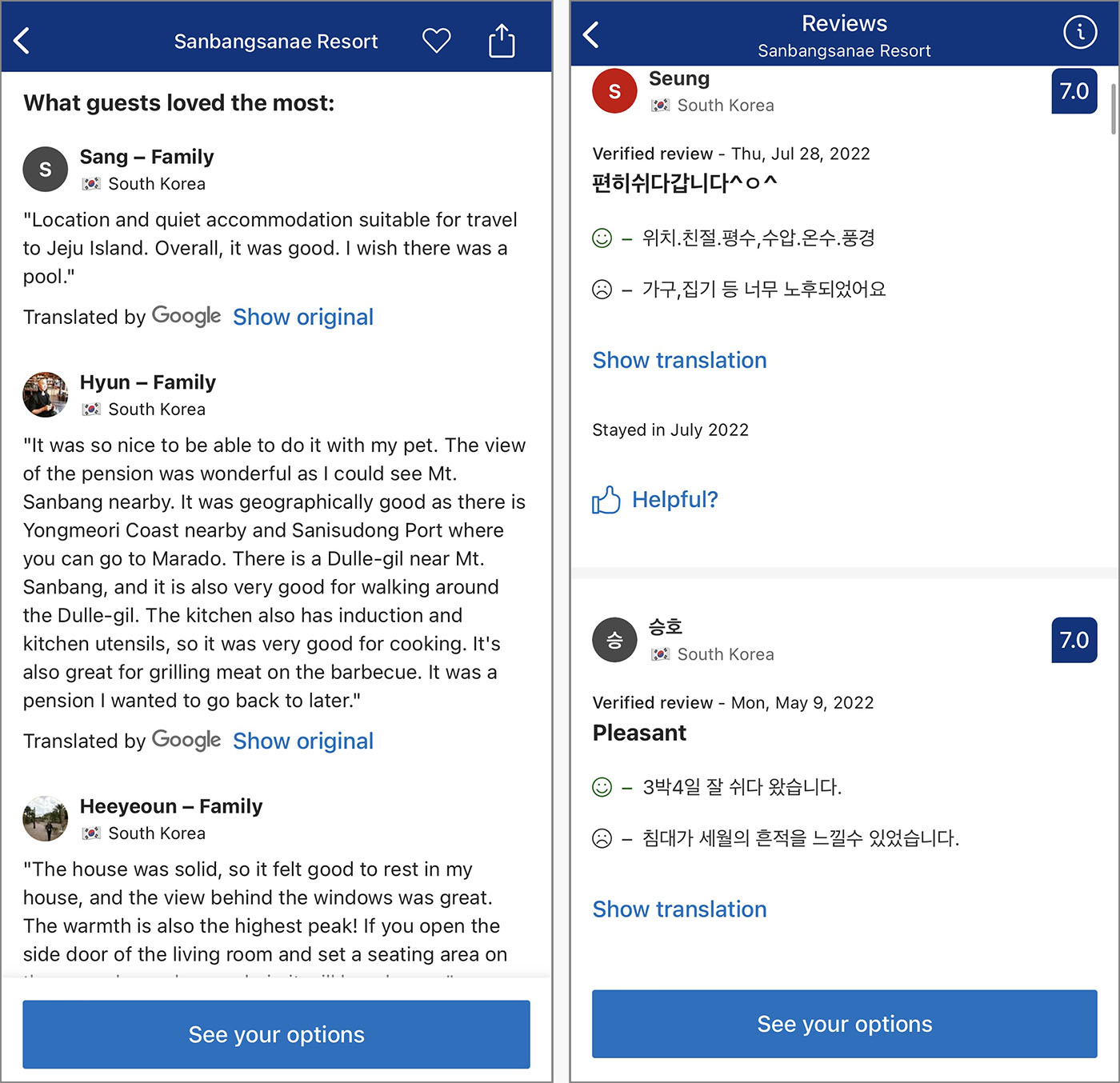
Very likely, companies don’t automatically translate all user-generated content because such an approach could be costly — translation services are not free and it would be wasteful to automatically translate content that users don’t end up reading. However, sites should allow users to translate all user-generated content with one click.
For example, Amazon allowed users to translate all foreign reviews into the language they spoke. A Translated all reviews to English button is shown right below the header Top reviews from other countries.

Provide a Language Filter
If your user-generated content is relatively uniformly distributed across different languages or if your users post local content that is unlikely to be interesting to others from different countries, an alternative approach is to provide a language filter.
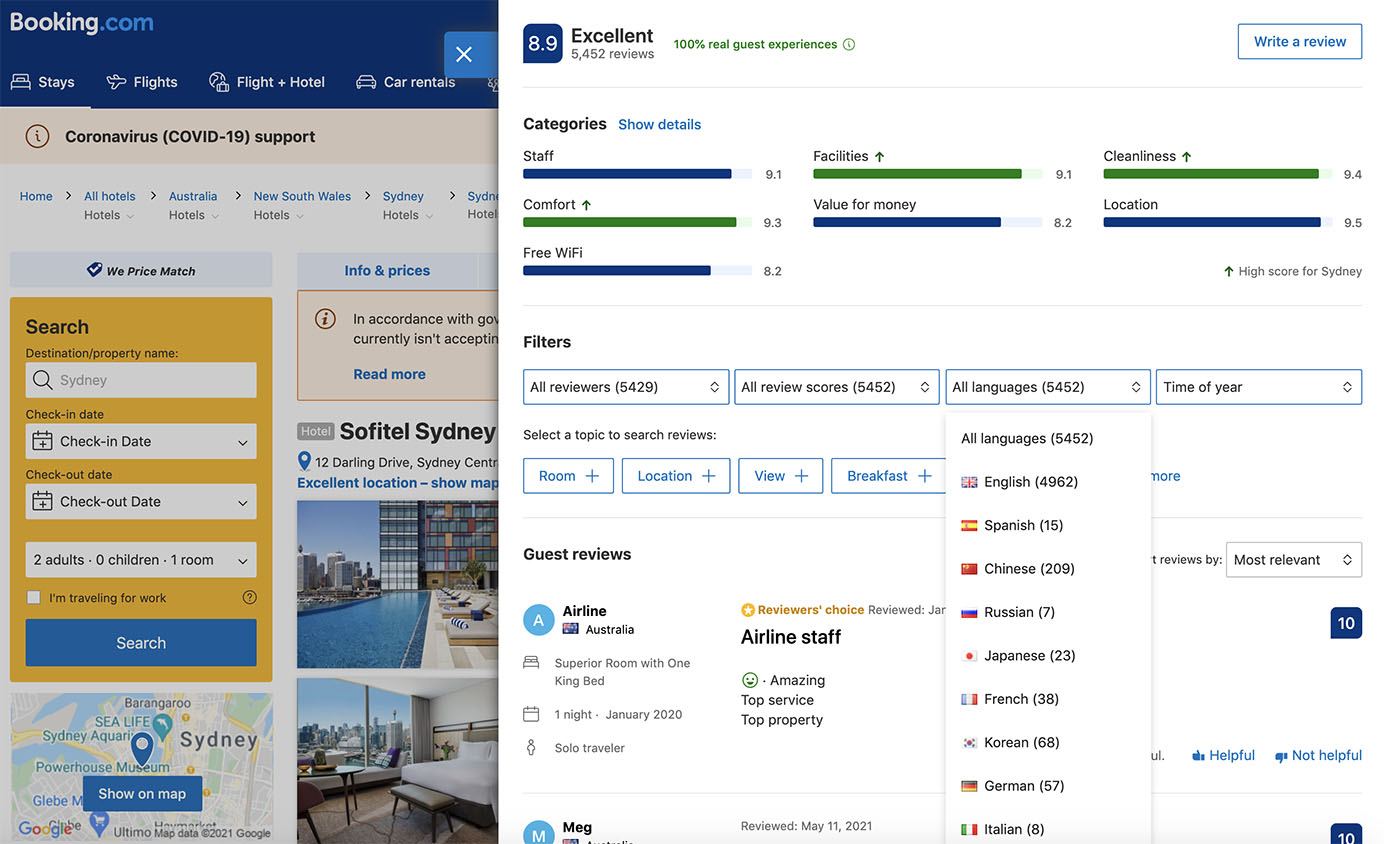
Booking.com allowed users to filter hotel reviews by language. It makes sense for the property shown in the screenshot, because there are more than 5000 reviews in total, with at least 5 reviews in each of the many languages it listed.
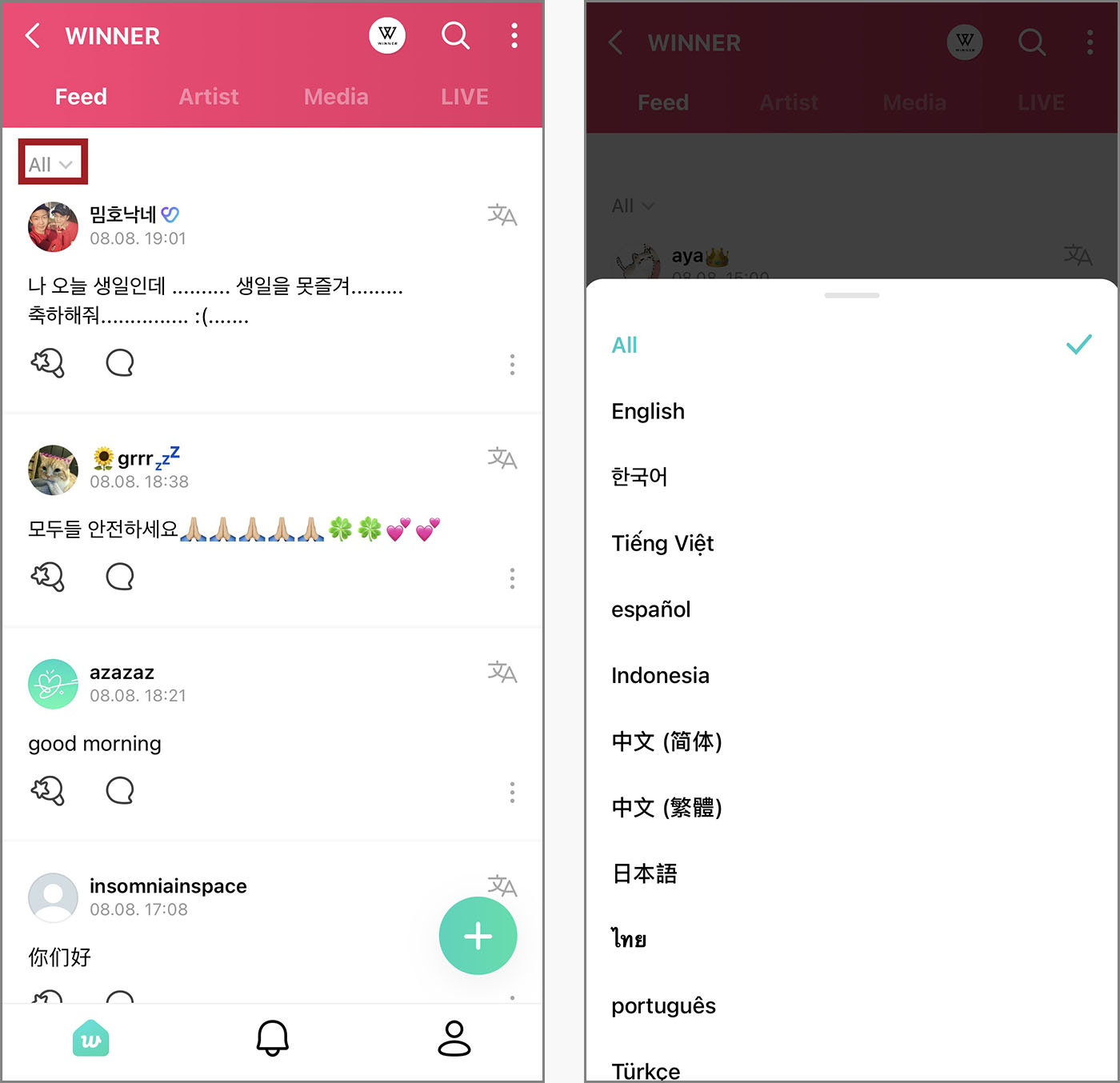
The Korean fan-community app Weverse also offered a language filter. The intention of the feature was great. But unfortunately, the label All used for this feature (the same as the most general option of seeing all languages) was too obscure, and none of the participants in our study discovered it. (Renaming it to All languages could increase its discoverability.)
Conclusion
If user-generated content in different languages is essential to your product or service, consider making it easily accessible to global audiences. Providing a translation tool is the first step. Depending on your context and budget, consider automatically translating foreign content or offering a Translate All option. Provide a language filter if users need to find content in a specific language.
For more relevant ecommerce examples, please check the International Purchasers volume of our recently updated ecommerce report series.