
Introduction
Nowadays, if you’re walking into a restaurant in Beijing during the lunchtime rush hours, most likely no waiter with a menu would show up to take your order. Instead, a server at the door would greet customers and remind them to order by scanning the QR code on their table. With the online-ordering system, customers can use their smartphones to easily complete actions like placing an order, making special requests, and paying and getting a receipt. Some restaurants are even using serving robots or tracks, thus making restaurant service fully unmanned.
Unmanned restaurants are popular not only in Beijing. According to a report published by Nayuki, a popular milk-tea chain with more than 800 stores all over China, in 2020, 71% of their in-store orders were placed via WeChat and Alipay mini programs. The widespread adoption of unmanned restaurant systems has been made possible by the broad use of WeChat mini programs and mobile payments among Chinese users.
In recent years, more and more restaurants have developed their own online self-ordering systems using WeChat mini programs, which are services within the WeChat application that do not need to be downloaded or installed to be used. Users must open the WeChat or Alipay app to use these mini programs. In restaurants offering self-ordering services, customers are instructed to scan the QR code on their table and use the WeChat mini program to order. In addition, after finishing their meals, customers can pay directly in the mini program using WeChat Pay or Alipay. (This integration of two otherwise separate features shows the benefits of the super-app approach popular in China.)
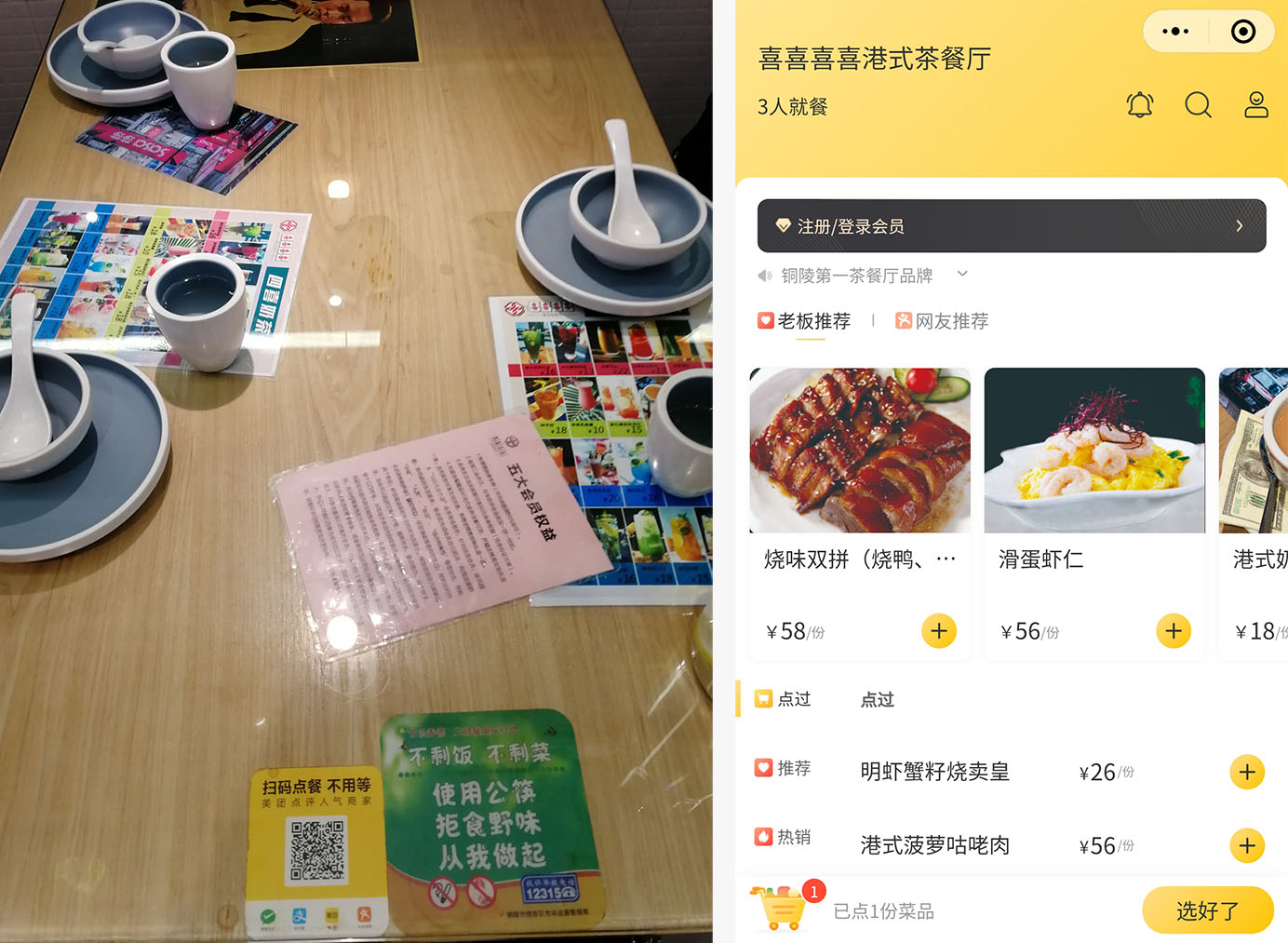
The unmanned-restaurant trend is also present in the US, due to the COVID-19 pandemic, but to a lesser extent. Many restaurants now allow customers to see the menu by scanning a QR code. In some restaurants, people can directly order using pretty much the same interface that they would use at home, if they were to order takeout.
Still, less human help does not necessarily translate into a good user experience.
This article reports on the user experience of unmanned restaurants. It is based on two data sources:
- A case study of eating in an unmanned restaurant in China
- Users’ thoughts on the unmanned-restaurant experience, as captured in a larger study on mobile payments in China
Different Degrees of Human Help
The degree of human help provided within restaurants varies. Most restaurants (but not all) that use unmanned facilities are fast-food restaurants, aiming to improve dining efficiency.
Some restaurants are completely free of waiters; others might support online ordering in store (for example, by providing a QR code or giving customers iPads), while still relying on waiters to do at least one of the typical restaurant activities: confirming the order, serving the food, taking the check to the customers, and helping them pay. At a minimum, many restaurants will have abandoned paper menus for sanitary reasons, in light of the COVID-19 pandemic.
However, human help is still present. Even some of the restaurants that are mostly unmanned may still have waiters around to support the elderly or others who have difficulty with the online interface.
An Unmanned Restaurant: Case Study
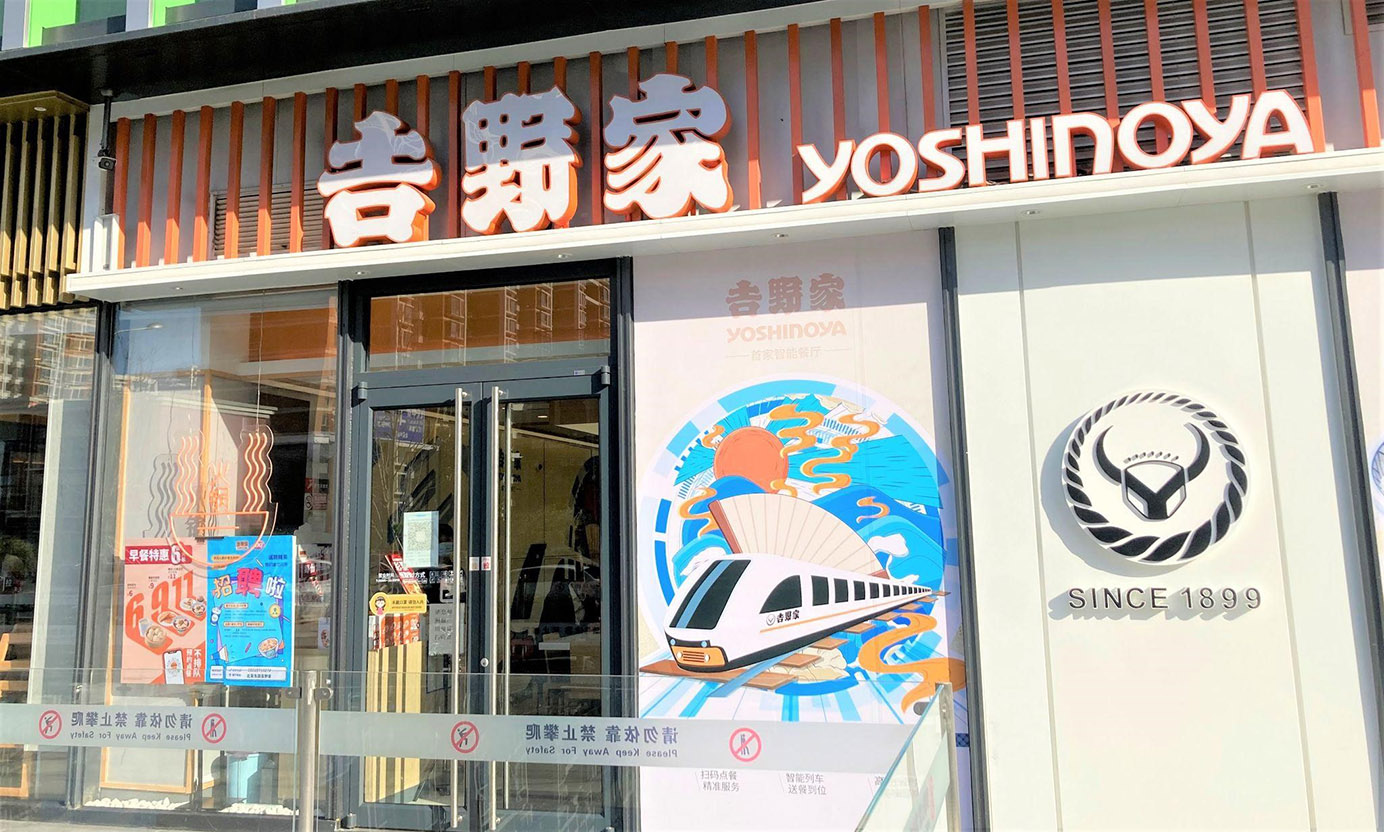
In November 2021, we went to Yoshinoya, an unmanned fast-food restaurant in Beijing, to sample the experience of eating in an unmanned restaurant.
Restaurant Setting
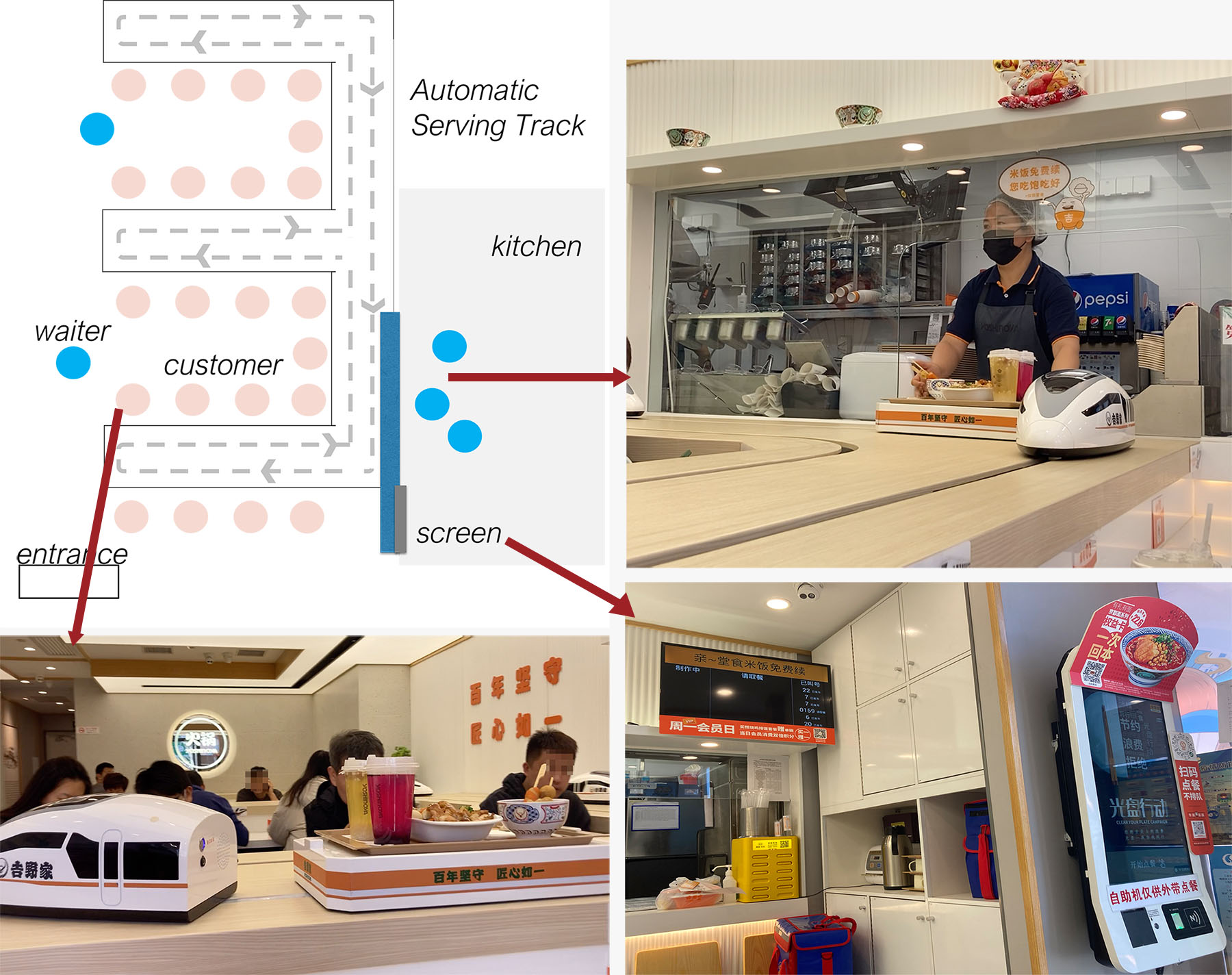
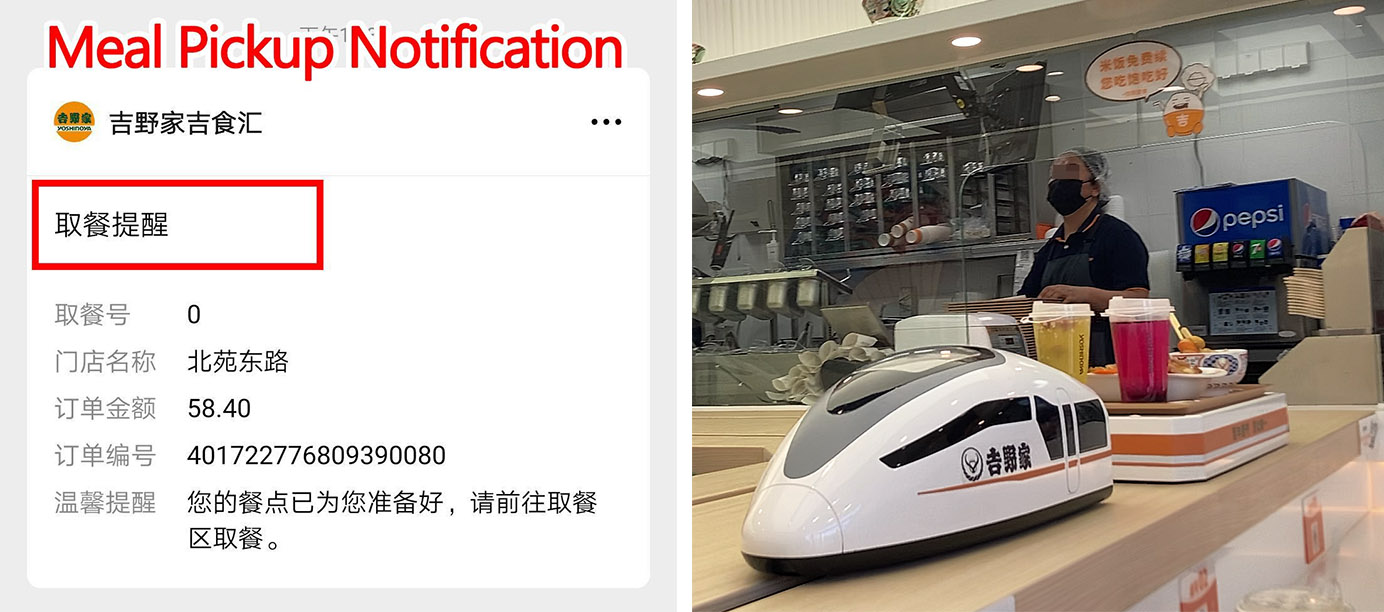
Yoshinoya offered mostly unmanned services: customers could browse the menu, place orders, pay and get receipts on their mobile phones; an automatic mini train was responsible for delivering the food. There were still a few waiters in the restaurant to clear tables and address any problems.
Ordering Food
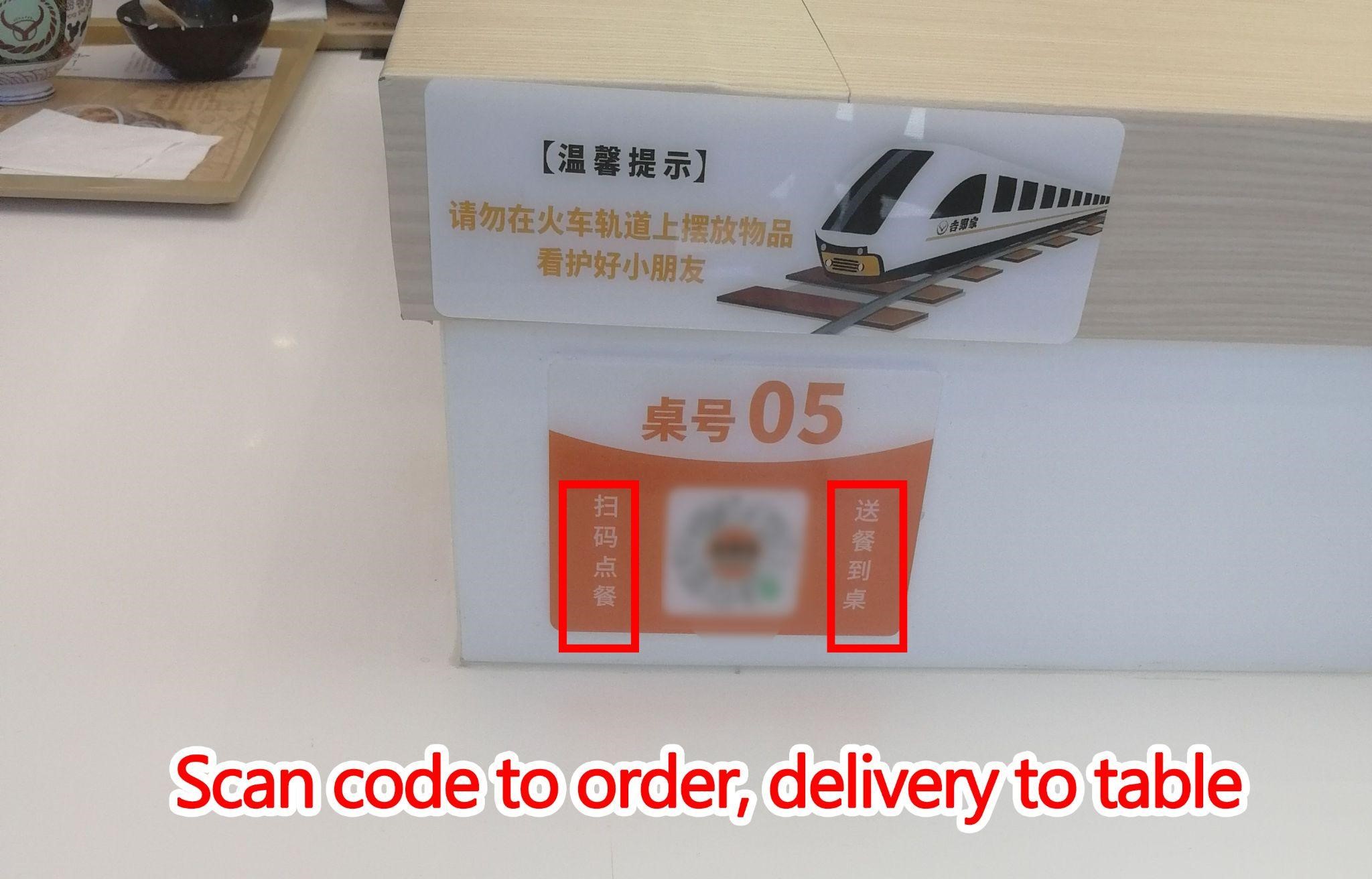
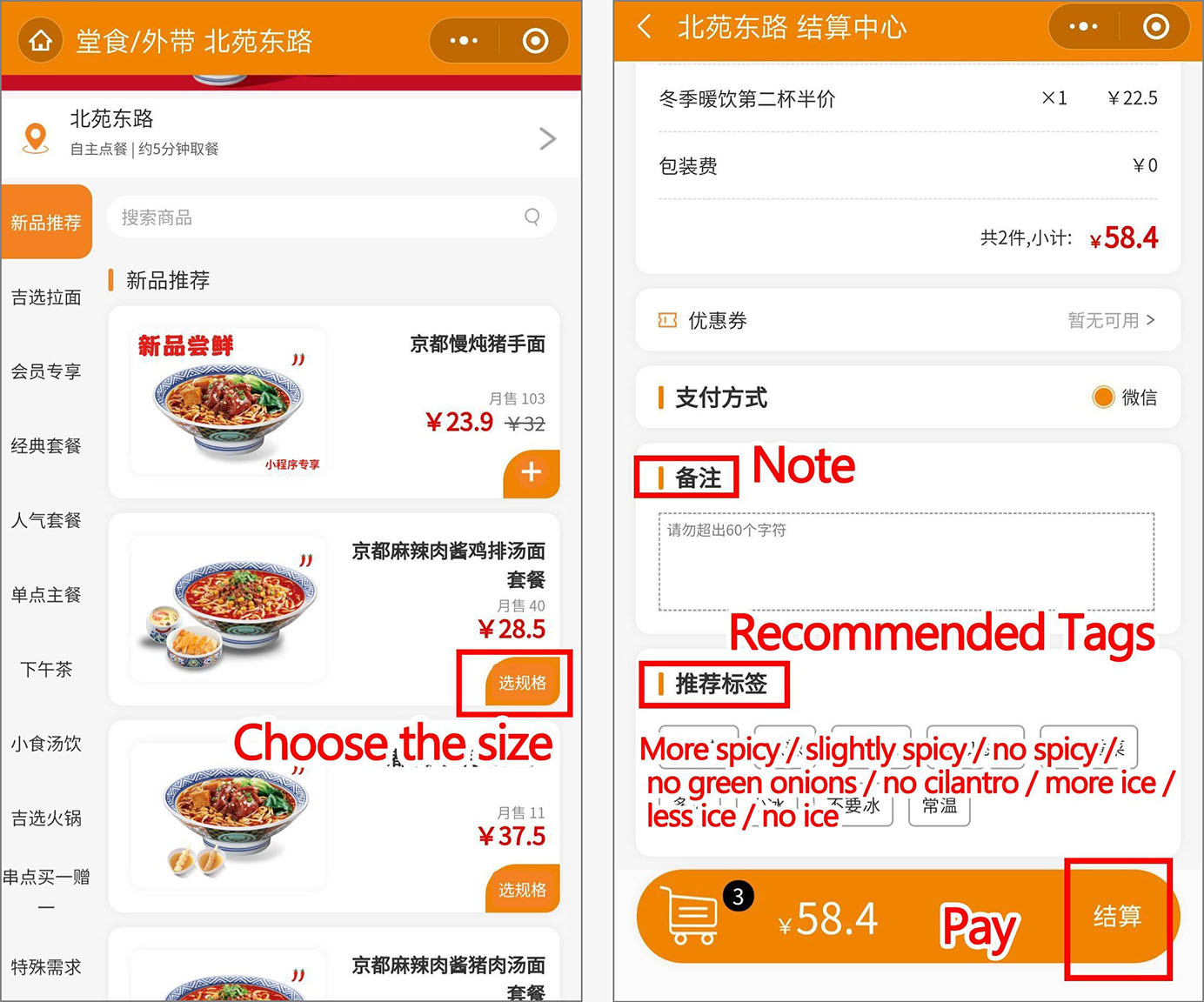
After the customer was seated, a waiter would instruct them to scan the QR code posted in front of their seats to access Yoshinoya's WeChat mini program for online ordering.
Making Payments
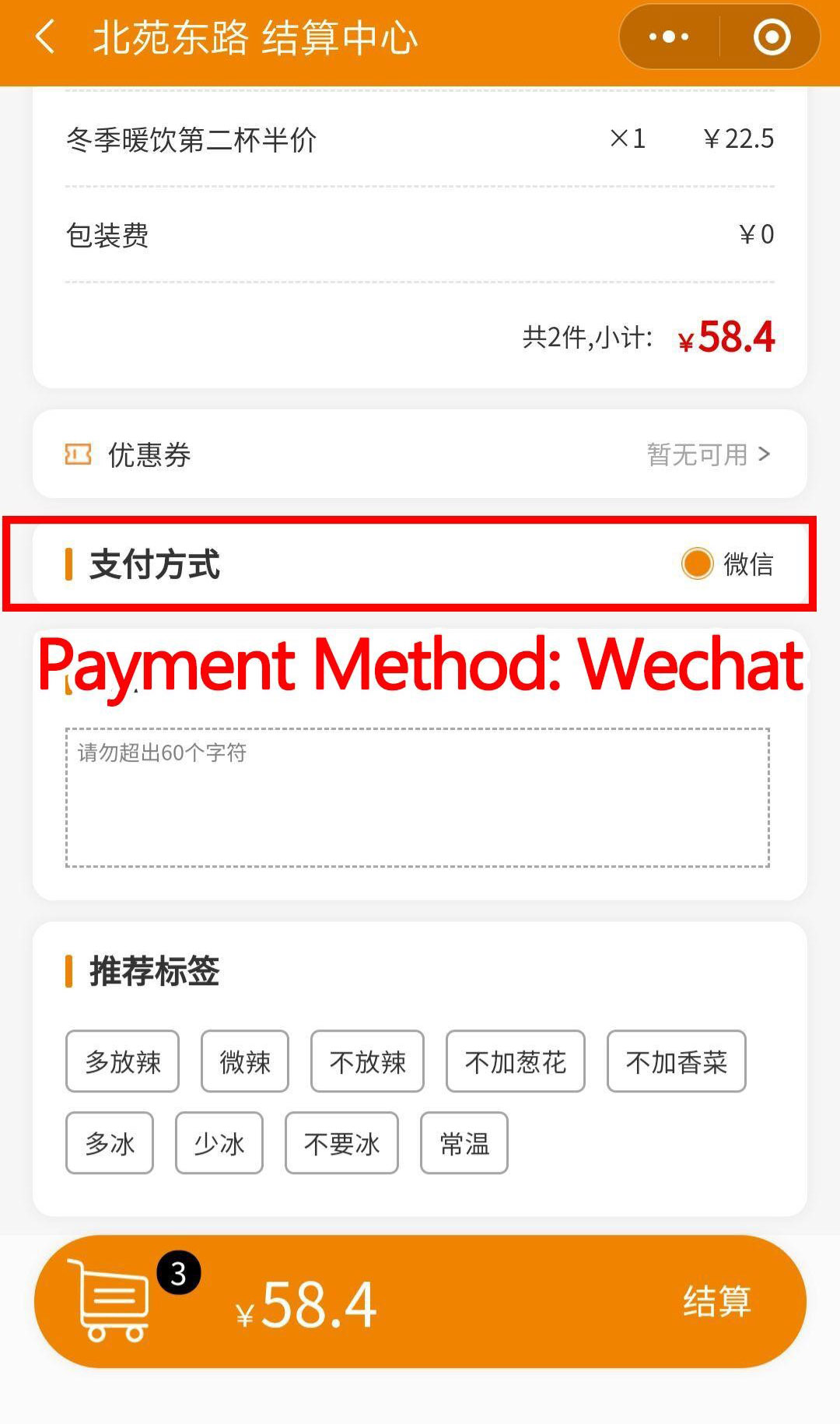
Upon users tapped the Pay button, the online system took them to a WeChat Pay page. (Since WeChat mini programs only support WeChat Pay, customers who needed to use a different payment method such as Alipay, Union Pay, or credit card had to ask the waiter for help.)
After confirming the payment amount and bank card used for the transaction, users completed the payment.
Getting the Meal
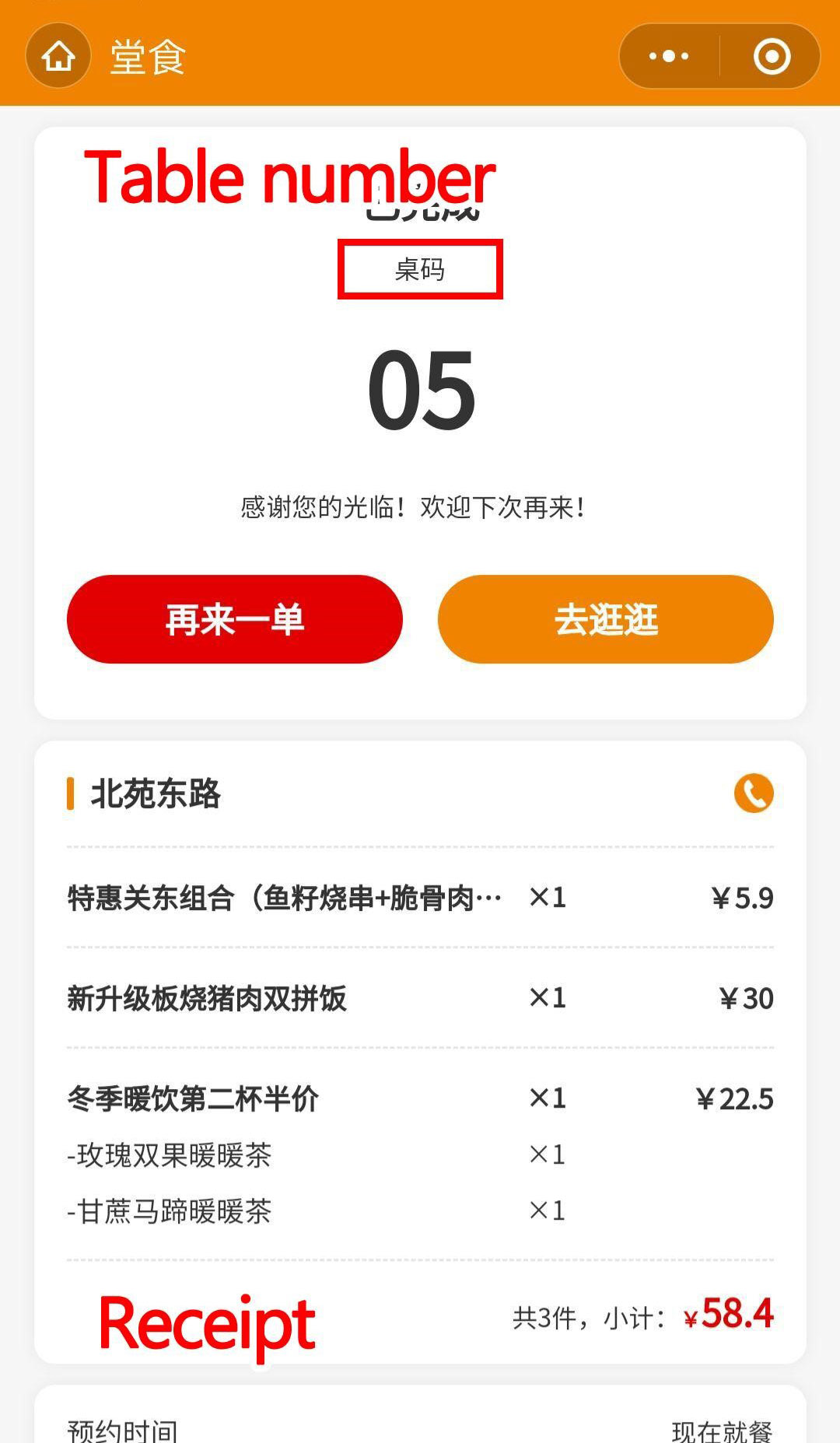
Upon payment completion, a confirmation page showed the table number (or the order number for takeout orders) and a detailed receipt.
When the meal was about to be delivered, the customer received a meal pickup notification in their WeChat. The mini train stopped in front of the customer who had ordered the food and would not leave until the customer picked up the tray.
Pros and Cons of Unmanned Restaurant Services
As mentioned before, in our last study on facial-recognition payment in China, we also asked the 6 participants about their past experiences and attitudes regarding unmanned restaurants. Users prefer unmanned restaurant services for two main reasons:
- Convenience and time saving: At lunch hour or other busy times during the day, service is usually slow. Unmanned restaurants makes it possible for customers to help themselves, thus improving dining efficiency.
- No social interaction: In an unmanned restaurant, the entire meal can be served without talking to the waiter. Some customers appreciate this aspect, as illustrated by the following quote from one of our study participants: “If the waiter helps place an order, I would feel embarrassed when she is standing next to me. I might feel pressured to tell her what I want quickly. It will be more comfortable to scan a QR code and self-order.”
Still, unmanned restaurants are far from perfect. Based on the interview data and our observations, issues fell into two categories: problems with the online system and irreplaceable human services.
Glitches in the Online Ordering System
- Insufficient customization. Unlike Yoshinoya, many restaurant pages did not support customer notes for each dish. One participant mentioned that she liked less sugar and less salt in her food, but many online systems were unable to handle this requirement, so she usually needed to interact with a waiter to communicate her request. And sometimes, even if a note was made, the chef didn’t see it (or the customer was afraid that the chef wouldn’t see it), so the customer had to call the waiter.
- Lack of support for parties of several people. Most of the time, people do not dine alone. But in many restaurants, there was only one QR code for a table — corresponding to the order for the whole table. That meant that people in the same parties had to have one person scan the code to view the menu and then pass the phone around to add dishes.
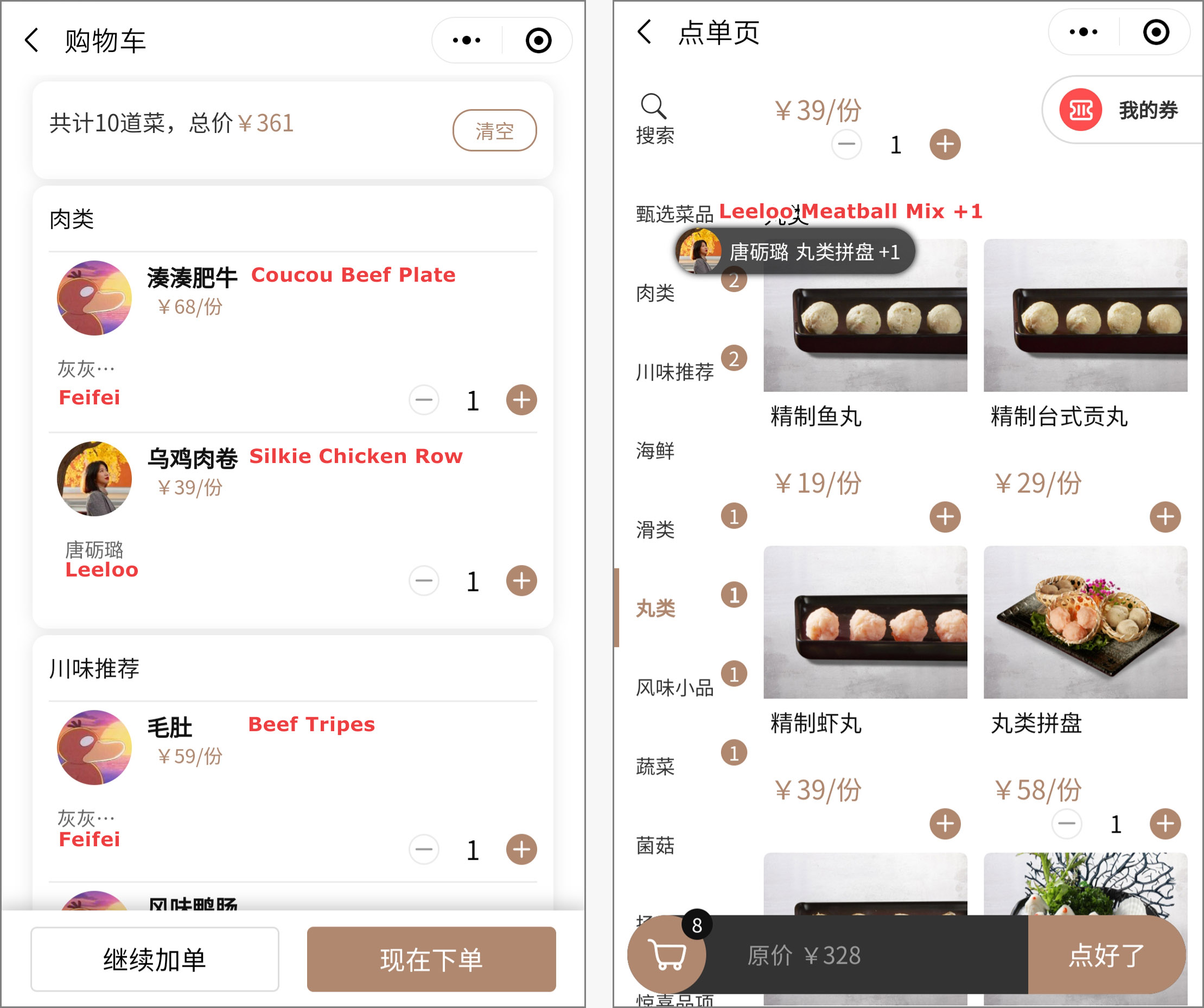
Still, some restaurants handled this situation successfully. In Coucou, a hotpot restaurant, several people at the same table could scan the same QR code and order at the same time. As one person added a dish, a message was sent to the other people at the same table. The message showed that person’s WeChat avatar and nickname, followed by the dish that they ordered. On the checkout page, users could also review who ordered each dish.
- Failure to synchronize with the kitchen. At Yoshinoya, a few minutes after we placed an order for kantodaki, a waiter came to tell us that it was out of stock and we would need to cancel the original order and place a new one. A study participant mentioned the same issue and commented, "I understand that using online ordering is supposed to minimize the need for servers, so isn't it ridiculous that these systems create additional need for servers to address issues with the system?"
- Limited payment methods. One study participant mentioned that some online ordering systems supported only one payment method, such as WeChat Pay (like Yoshinoya's WeChat mini program). (This is due to the competition between the two main payment providers in China, WeChat Pay and AliPay and the fact that each can dictate the payment method used in its own mini programs.) The participant said that, if she wanted to use a different payment method, she would have to call the waiter.
- Users may be forced to subscribe to the restaurant's WeChat public account to place orders. Several participants were annoyed that many restaurants required them to subscribe to their' WeChat public accounts before they could order. The restaurants would later hassle users with promotional articles. In fact, shortly after our research, WeChat issued an official notice asking developers to stop “forcing users to follow public accounts before ordering.” This development is a step in the right direction.
Irreplaceable Human Services
- Accessibility assistance. Waiters play an important role in serving people who may need extra care. Since customers may have a wide range of accessibility issues, waiters are obviously better equipped to respond to these issues than robots. For example, customers in wheelchairs may not be able to sit in a restaurant seat on their own and may need the assistance of a server; some may not be able to lift a fully loaded tray from the automatic serving track (an issue that we witnessed). In these situations, waiters are irreplaceable.
- Response to personalized questions. A study participant mentioned that sometimes she needed to ask the waiter what kind of meat was used in the dish since the information wasn’t available online in the mini program. Another user remembered that he had asked the waiter if he could order something that was not on the menu. (He was a frequent customer and knew some “secret dishes” that weren’t listed on the menu.) Users have a broad variety of needs when it comes to dining, and even the most advanced conversational bots today may not be able to respond flexibly enough to these questions. Hence, waiters play an influential role in handling users' special requests.
- Formal dining experience. Eating isn't work, and efficiency isn't everything. A waiter can not only recommend dishes from the menu based on guest’s preferences and restrictions, but can also, more importantly, make people feel special and cared for. One participant mentioned that there is always a lack of "atmosphere" when dining with friends in unmanned restaurants. Whereas robots strive behave rigidly but predictably and in an efficient manner, they lack the warmth and personalization that human contact can provide.
Takeaways
Users like the convenience of unmanned restaurants and the lack of social interaction, especially when they want to get a quick meal. Restaurant owners can also reduce their operating costs by hiring fewer waiters. But the waiters are still indispensable, as they act as an escape hatch for any issues that may arise — whether nonstandard customer needs or failures in the back end.
In other words, unmanned restaurants are not yet truly unmanned. Nevertheless, we can still draw some insights:
- Consider the context in which users will use the system. It’s ironic that, even though most users dine in a restaurant with others, in many online ordering systems, people from the same party can't make their selections at the same time. It’s a reminder of how important field studies, task analysis, and discovery research are whenever a new technology is introduced.
- Service design is crucial. It’s not enough to provide the ability to order food, you also need to ensure that the orders can be correctly read and fulfilled at the back end. Many unmanned restaurant systems currently do not synchronize the dishes on the menu with the available resources in the kitchen. Ordering an item that is out of stock wastes both customer time and waiter time, since the latter must interact with the customer to help them recover from the issue. A special request that the chef cannot easily see causes small delays at best and unhappy customers who send their food back at worst. Thoughtful service design is needed in order to address these inconsistencies and optimize efficiency for both customers and restaurant staff.
Do not ask before you give. People should be given access to the online-ordering service without having to subscribe to the restaurant’s WeChat account. This approach is a deceptive pattern that not only forces users to spend unnecessary time with the interface but also annoys users and ultimately diminishes trust in the brand. The secret to getting quality subscriptions is making customers happy by providing a great service and a great experience.