The Miro board template (first download) is provided as an uploadable .rtb file. To use it, you’ll need to import the file into your paid Miro account.
This article introduces a practical, collaborative workshop format designed to realign UX metrics with organizational goals and equip teams with a focused, meaningful set of metrics that connect user experience with organizational impact.
- The Problem: Disconnected Metrics that Miss the Mark
- The Fix: A Collaborative UX-Metrics Workshop
- Start with the Why: UX’s Role in the Organization
- Map to Goals, Not Just Metrics
- Identify UX Contributions and Gaps
- Define and Prioritize Metrics That Matter
- Embed Metrics Where They’ll Be Used
- Wrapping Up the Workshop
The Problem: Disconnected Metrics that Miss the Mark
Many UX teams are stuck reporting metrics that don’t matter, at least not to decision makers. They may have inherited standard metrics like CSAT or net-promoter score. Maybe they track SUS out of habit, thinking it's the default or expected UX metric, even if it doesn't provide actionable insight for their specific context.
Or, perhaps they collect dozens of data points that never get used. Metrics disconnected from organizational goals leave UX work undervalued or misunderstood. Misaligned metrics create a false sense of progress and guide teams toward local optimizations rather than strategic impact.
To avoid this, we need to step back and ask: Are we measuring what matters?
The 3 UX Metric Traps
When UX metrics don’t connect to broad strategic business goals, they tend to fall into one of three traps:
- The vanity trap: Metrics that look good but offer little insight (e.g., high NPS with high churn)
- The silo trap: Metrics chosen in isolation by the UX team with no stakeholder buy-in
- The noise trap: Metrics that nobody uses
Teams fall into these traps usually because of a lack of crossfunctional alignment on what UX success actually looks like and how it relates to the organization’s goals. Numbers that are difficult to relate to UX make it hard to know where to focus additional research efforts or specific design changes, which turns UX measurement into an academic exercise rather than a tool for decision making and improvement.
The Fix: A Collaborative UX-Metrics Workshop
Why Run This Workshop
The workshop is designed to help teams align UX metrics with real organizational goals. It builds shared understanding, surfaces misalignments, and allows stakeholders to cocreate a purposeful measurement strategy.
Who to Invite
Invite people from UX, product, analytics, customer support, and leadership to participate; it’s best if they all work in the same product or experience area.
When scheduling, plan 3–4 hours for the workshop.
Before the Workshop: Uncovering the Disconnect
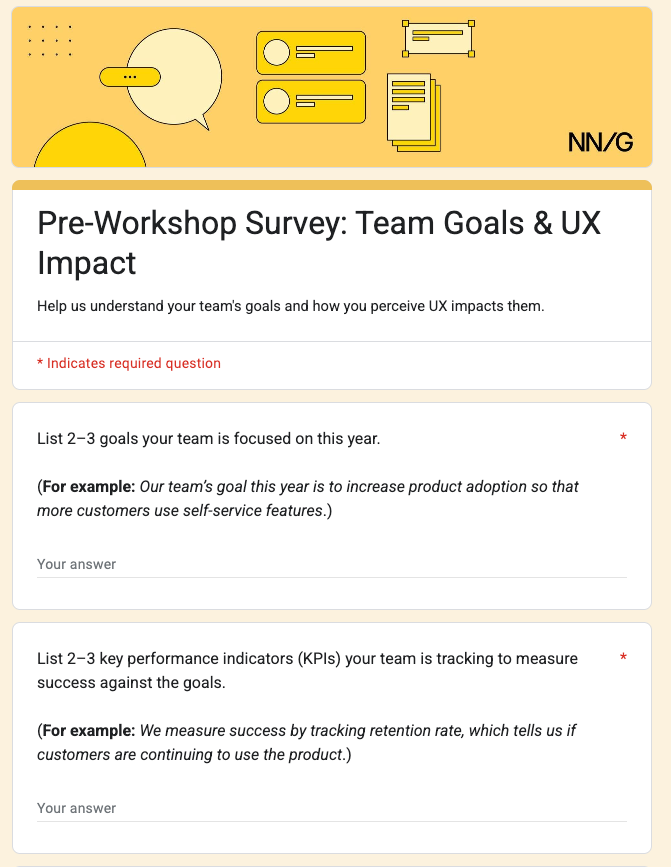
Have participants complete a short pre-workshop survey to capture:
- Their team’s goals and KPIs
- Their view on how UX contributes to those goals
- Any challenges in measuring UX’s impact
- Wish-list metrics they’d like to track, if possible
The answers to the prompts in the pre-workshop survey reveal the kinds of gaps that often go unnoticed: teams optimizing for different outcomes, misunderstandings about UX’s role, or uncertainty about what’s relevant or measurable.
Start with the Why: UX’s Role in the Organization
As the facilitator, open the workshop by naming the problem: UX metrics are often disconnected from organizational strategy.
Share a few examples, such as when usability ratings go up but conversion drops, or satisfaction scores improve while support costs remain flat.
Use the participants’ survey responses to discuss:
- Where does the group believe that UX has the most impact?
- Is that impact currently measured in a way that others in the organization recognize or value?
Map to Goals, Not Just Metrics
Next, have participants share the goals and KPIs their teams are focused on (answers from survey questions one and two). The group will work together to:
- Cluster-related goals (and objectives) into groups (e.g., revenue, retention)
- Cluster-related KPIs and connect those to the goals (e.g., units sold, repeat customers)
- Highlight mismatches in focus
- Identify UX metrics that are currently collected, but not related to goals and KPIs
This exercise shows whether any current UX metrics align with shared priorities or are disconnected, irrelevant, or conflicting.
Identify UX Contributions and Gaps
Using the clusters of goals, KPIs, and current measurement efforts, have the group discuss:
- How does UX specifically contribute to each goal? For example, if a goal is to reduce support costs, UX may contribute by iteratively improving the self-service flows and redesigning the help center so users can find answers without contacting support.
- What UX evidence exists to show the impact? For example, quantitative usability testing may show that after improving the information architecture of the help center, 70% of participants found answers without needing live support, compared to 40% before the redesign.
- What gaps exist in current metrics? For example, while support-ticket volume is tracked, there may not be a metric that measures whether users attempted self-service first, so it's unclear if UX changes dependency on support.
- Which metrics are collected but not used? For example, customer-satisfaction survey ratings may be gathered after every support interaction, but the data is rarely segmented by issue type or tied back to changes in the help-center design. Scores sit in dashboards but aren’t analyzed to understand whether UX improvements reduced frustration for specific tasks.
Next, reintroduce the challenges that workshop participants noted in their survey responses to highlight any other gaps or needs.
- What’s difficult about measuring UX impact today?
- Where does UX lack visibility?
Discussing UX’s contributions and gaps helps the team differentiate between what is essential but not measured and what is measured but not important.
Define and Prioritize Metrics That Matter
Next, have the group generate possible UX metrics tied to the organizational goals and KPIs discussed. Give the group a printed or digital version of our UX metrics flashcards to spark ideas and clarify definitions.

Guide the group in evaluating whether the metric reflects UX’s real influence on the goal and whether it can be realistically tracked. Discuss whether stakeholders will recognize the metrics as evidence of progress or informants for prioritization, further research, or design decisions. The goal isn’t to find the perfect or many metrics, but to define a purposeful, actionable few that truly show how UX contributes to the organization’s priorities.
What to Do When Participants Push for the Wrong Metrics
Workshop participants or stakeholders may still push for easy-to-measure or familiar metrics even though they don’t meaningfully reflect UX quality or support strategic goals.
Instead of dismissing these suggestions, ask probing questions such as:
- What would this metric tell us about people’s experiences?
- Can this metric help us identify what needs to be improved?
- Does this metric reflect an outcome we can influence through more research or a design change?
You can also offer alternative metrics that capture the same or similar intent. For example, if a stakeholder insists on collecting a net-promoter score, suggest supplementing it with success and satisfaction rates for essential tasks. If all else fails, invite a metric test drive: suggest temporarily tracking the proposed metric alongside a better-aligned one to see which is more useful for research planning, prioritization, design decisions, and quantifying and communicating UX impact.
You should also have a workshop participant with quantitative expertise (such as a data analyst or quantitative UX researcher familiar with statistics) review the final metrics to check whether they are well-defined and measurable, and to validate that they align with organizational goals and KPIs.
Embed Metrics Where They’ll Be Used
The final step is about ensuring that metrics aren’t just documented, they’re tracked and used.
Facilitate a brief planning activity where teams decide:
- How to gather and track each metric and how often
- Where the metrics will be reviewed (e.g., sprint reviews, roadmap planning)
- How they’ll influence decisions (e.g., prioritizing backlog items or OKRs)
- Who owns tracking and followup to ensure that the metrics remain connected to organizational goals or evolve to reflect shifting priorities and user needs
Planning for the practical use of the metrics helps the group look ahead to ensure the metrics stay visible and relevant, rather than buried in a spreadsheet or forgotten after having been discussed in a fun workshop once.
Wrapping Up the Workshop
Close the session by recapping:
- What metrics were selected and why
- Where misalignments were surfaced and resolved, or remain outstanding
- How the new set of UX metrics will be integrated into ongoing work
Remind participants that they just cocreated a living measurement plan. UX metrics should evolve as goals and product strategies evolve.
Conclusion
UX metrics are more than usability stats or customer-satisfaction scores; they should reflect and connect to the value that UX brings to the organization. Without collaboration, it’s easy to measure the wrong things and lose sight of what matters most. The workshop format gives teams a chance to reset. It replaces disjointed measurement with alignment, clarity, and purpose. It also helps ensure that UX is recognized as a design function and a strategic contributor to organizational success.