Course Curriculum

7 Sections
00

The Bulletproof Framework for Requesting Resources

3 Lessons 18 min
  • Course Overview and Introduction 3 min
  • The 5 Things All Organizations Care About 10 min
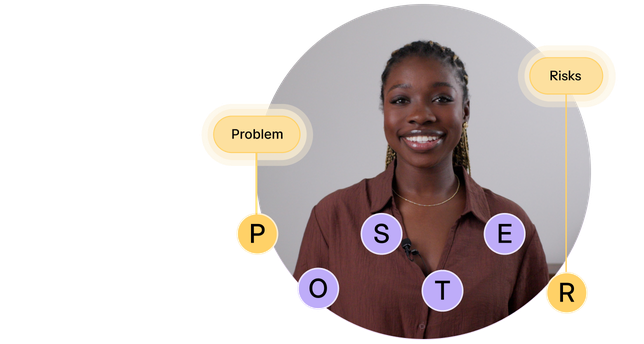
  • The POSTER Framework 5 min

Resources Provided

  • 0.1_CheatSheet_Advocating-for-UX-Resources (PDF)
01

Connect UX Problems to Business Priorities

3 Lessons 36 min
  • Why UX Is Seen as a Cost Center 6 min
  • Don’t Be Naïve About Organizational Constraints 5 min
  • Problem Formula: How to Get the Business’s Attention 3 min

Practice Activities

  • Create Your Own Problem Statement (Instructions) 19 min
  • Good and Bad Problem Statement Examples (Walkthrough) 3 min
02

Make the Outcome Clear and Enticing

3 Lessons 41 min
  • Three Rules for Defining UX Outcomes for Stakeholders 5 min
  • Short-Term vs. Long-Term Outcomes 7 min
  • Outcomes Formula: Crafting the Message 6 min

Practice Activities

  • Frame Your Outcome Statement (Instructions) 18 min
  • Good and Bad Outcome Statement Examples (Walkthrough) 5 min
03

Sell the Solution as the Logical Next Step

3 Lessons 47 min
  • Positioning UX as the Solution through Organizational Priorities 10 min
  • Aligning Solutions with Business Metrics 8 min
  • Solution Formula: Presenting the Logical Next Step 7 min

Practice Activities

  • Selling Your Solution (Instructions) 17 min
  • Good and Bad Solution Statement Examples (Walkthrough) 5 min
04

Outline a Tactical Plan

3 Lessons 46 min
  • The 4 Types of UX Resources 11 min
  • Your Tactical Timeline Is a Trust-Building Device 6 min
  • Tactics Formula: How to Outline your Plan 4 min

Practice Activities

  • Critique a Tactical Plan (Instructions) 21 min
  • Critique a Tactical Plan (Walkthrough) 4 min

Resources Provided

  • 4.3_Worksheet_Tactics-Statement-Reference-Sheet (PDF)
05

Support Your Proposal with Evidence

4 Lessons 41 min
  • Metrics and Measurement: Only Track What Actually Matters 3 min
  • How a 2% Drop-Off Becomes a $3 Million Story 4 min
  • Three Keys to Making Evidence Persuasive 4 min
  • Evidence Formula: Clarity, Honesty, and Confidence 6 min

Practice Activities

  • Critique an Evidence Argument (Instructions) 19 min
  • Critique an Evidence Argument (Walkthrough) 5 min

Resources Provided

  • 5.4_Worksheet_Evidence-Statement-Reference-Sheet (PDF)
06

Anticipate and Address Risks

4 Lessons 37 min
  • Risks of Action and Inaction 6 min
  • A True Risk Mitigation Story 3 min
  • Risk Formula: Framing and Managing Uncertainty 6 min
  • Putting It All Together 2 min

Practice Activities

  • Critique a Risk Argument (Instructions) 17 min
  • Critique a Risk Argument (Walkthrough) 3 min

Resources Provided

  • 6.3_Worksheet_Risk-Statement-Reference-Sheet (PDF)

Learning Outcomes

  • Build ROI-oriented arguments for executives that tie UX investment to measurable business outcomes
  • Structure resource proposals around 6 main points: Problems, Outcomes, Solutions, Tactics, Evidence, and Risks
  • Anticipate and address stakeholder objections by presenting data, balanced evidence and risk analysis
  • Align resource requests with organizational priorities, budget cycles, and planning horizons

Course Preview

Tools Used in This Course

All resources can be accessed through a standard PDF reader.

Turn Problems Into Solutions

Know exactly where to start when creating a resource proposal

  • Use a step-by-step framework for any type of resource request
  • Gather the data you need before you build your case
  • Turn "we need more" into a concrete, scoped proposal you can actually pitch

Build a logical and compelling case for resources leaders can’t dismiss

  • Demonstrate how a UX investment solves business problems leaders are already trying to fix
  • Make requests easy to follow and remember, so leaders can champion them
  • Reduce perceived risk with phased rollouts and small-scale pilots that drive leader confidence

Shift stakeholders' view of UX from a cost center to a strategic investment

  • Surface the hidden business risks of under-resourcing UX
  • Translate UX metrics into the language of executive KPIs
  • Build a successful track record that strengthens your credibility and makes future requests easier

Frequently Asked Questions

How long will I have access to this course?
Once purchased, your access will never expire. This ensures you can learn at your own pace and return to review content as often as you'd like, whenever you need.
Will I get personalized instructor feedback on course activities?
No, personalized feedback is not provided for activities completed during the course. Most courses provide answer keys to activities that help learners reflect on their progress and understanding of course materials and examples.
What content can I download?
You can download a variety of resources provided with each course, including templates, how-to guides, cheat sheets, posters, reading lists, and more. Video lessons provided in all courses will not be available for download.
Can I access this course offline or on a mobile device?
Offline access isn't available yet, although we plan to add it. Most courses offer downloadable resources for offline reference.

For the best experience, mobile devices are not recommended.
Is this course eligible for the NNGroup UX Certification Program?
Unfortunately, self-paced courses do not count toward UX Certification. However, learners who complete the final exam will receive a “Recognition of Completion” to demonstrate their achievement.

See our Live Online courses for options that count toward UX Certification.
What can I share with my employer to show I’ve completed the training?
Upon completing a course’s final assessment, you will receive a “Recognition of Completion” showcasing your dedication to learning the topic. This document can be shared with your employer or professional network to demonstrate your new skills and commitment to professional development.