

Here’s a list of NN/g’s most useful introductory articles and videos about ResearchOps and related topics. Within each section, the resources are in recommended reading order.
For hands-on training, check out our full-day course, ResearchOps: Scaling User Research.
ResearchOps: An Overview
ResearchOps refers to the orchestration and optimization of people, processes, and craft in order to amplify the value and impact of research at scale.
ResearchOps is a specialized area of DesignOps focused specifically on components concerning user-research practices. It’s a collective term for efforts aimed at supporting researchers in planning, conducting, and applying quality user research. Common focus areas of ResearchOps practices include:
- Participants: Recruiting, screening, scheduling, and compensating participants
- Governance: Processes and guidelines for consent, privacy, and information storage
- Knowledge: Processes and platforms for collecting, synthesizing, and sharing research insights
- Tools: Enabling efficiencies in research through consistent toolsets and platforms
- Competency: Enabling, educating, and onboarding others to perform research activities
- Advocacy: Defining, sharing, and socializing the value of user research throughout the organization
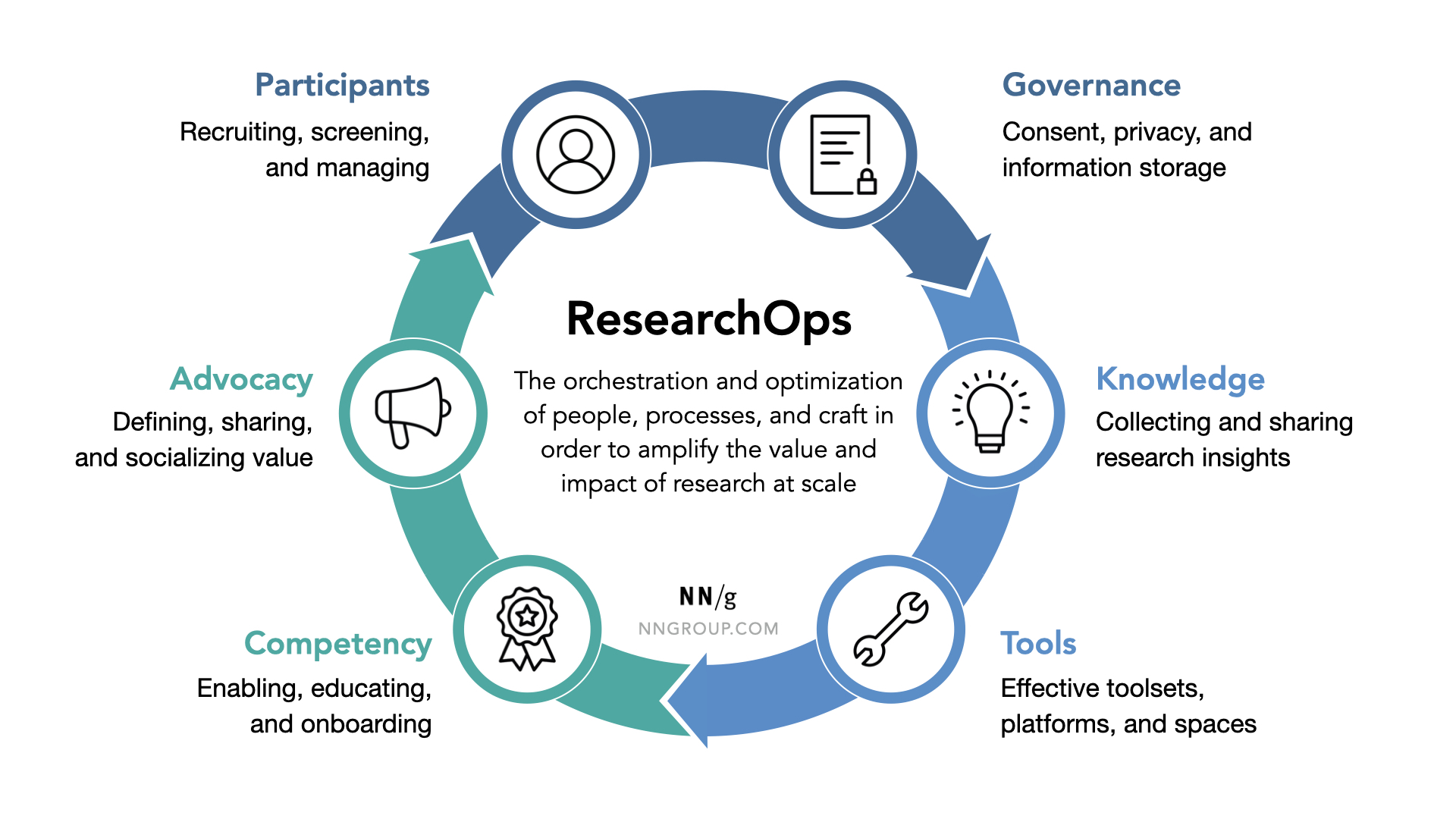
If you’re new to ResearchOps, start with the introductory resources below and then move on to the more advanced content included in this study guide.
- 4-minute video: ResearchOps 101
- Overview of ResearchOps and its components: ResearchOps 101
- Summary of the ReOps field today: The State of ResearchOps
Research Methods
These resources provide guidance on understanding and using the right research methods at the right time in the design process.
|
Number |
Link |
Format |
Description |
|
1 |
Article |
20 research methods mapped across 3 dimensions and over time within a typical product-development process |
|
|
2 |
Video |
||
|
3 |
Video |
5 criteria to determine the most effective UX-research method to use for your situation | |
|
4 |
Article |
How to gather prior research findings and other relevant information related to a new project to focus the scope and save money |
|
|
5 |
Video |
Tips for creating shareable documentation for each UX design or research method employed |
|
|
6 |
Article |
Overview of the most popular types of quantitative UX methods |
|
|
7 |
Article |
When to use formative vs. summative evaluation methods |
|
|
8 |
Triangulation: Get Better Research Results by Using Multiple UX Methods |
Article |
How to diversify user research methods for more reliable, valid results |
|
9 |
Triangulation: Combine Findings from Multiple User Research Methods |
Video |
The following study guides offer more in-depth collections for creating protocols for specific types of UX-research methods:
- Qualitative Usability Testing: Study Guide
- Quantitative Research: Study Guide
- Context Methods: Study Guide
Participant Management
These resources provide guidance on recruiting, screening, and managing research participants.
|
Number |
Link |
Format |
Description |
|
1 |
How Many Participants for Quantitative Usability Studies: A Summary of Sample-Size Recommendations |
Article |
Recommendations for choosing an appropriate number of participants for quantitative usability tests |
|
2 |
Why 5 Participants Are Okay in a Qualitative Study, but Not in a Quantitative One |
Article |
Rationale for the 5-participant guideline for qualitative usability testing |
|
3 |
Recruiting and Screening Candidates for User Research |
Article |
Options for recruiting participants and recommendations for unbiased sampling |
|
4 |
How to use Screening Questions to Select the Right Participants for User Research |
Article |
How to assess people’s characteristics without giving away the purpose of the study |
|
5 |
How and Why to Recruit Backup Participants (aka “Floaters”) in User Research |
Article |
Why and how to intentionally overrecruit test participants for one-on-one user-research studies |
|
6 |
Article |
A comparison of the costs associated with outsourced and in-house recruiting |
|
|
7 |
Video |
Tips for deciding between monetary and nonmonetary incentives for test participants |
|
|
8 |
Video |
Issues related to using the same participant in usability tests multiple times |
|
|
9 |
Video |
5 tips for recruiting expert users for domain-specific application testing |
|
|
10 |
Article |
The risks of using internal employees as test participants |
|
| 11 | Catching Problem Participants in Remote Unmoderated Studies | Article | How to identify outliers, cheaters, and professional participants and remove their data from your analysis |
| 12 | Catching Cheaters and Outliers in Remote Unmoderated Studies | Video | |
|
13 |
Best Practices for Building and Maintaining Your Own Research-Participant Database |
Article |
Tips for creating a research panel to quickly recruit target users for new studies |
For more in-depth guidance on recruiting usability-testing participants, check out our free report: How to Recruit Participants for Usability Studies.
Governance
These resources provide guidance on how user research should be conducted to ensure it’s ethical and performed in line with data-protection best practices and regulation.
|
Number |
Link |
Format |
Description |
|
1 |
Article |
Identifying how ethically mature your research practice is and where to improve | |
|
2 |
Article |
What informed consent means and key components of a consent form | |
|
3 |
Video |
||
|
4 |
Maintaining the Privacy and Security of Research Participants’ Data |
Article |
Best practices for protecting participant data collected during research studies |
|
5 |
Video |
Knowledge Management
Articles and videos for collecting, tracking, sharing, and enabling wider access to user research findings.
|
Number |
Link |
Format |
Description |
|
1 |
Article |
Definition, common components and types of research repositories, and how to create one |
|
|
2 |
Video |
||
|
3 |
Article |
Common mistakes made when creating research repositories and advice from UX and ReOps practitioners | |
|
4 |
Video |
The benefits of exchanging data with the nonUX teams in your company who are collecting other forms of customer data |
|
|
5 |
Tracking Research Questions, Assumptions, and Facts in Agile |
Article |
How to use a knowledge board to document research questions and assumptions |
Tools
These resources provide guidance on selecting and setting up research tools and platforms so that research can be conducted effectively.
|
Number |
Link |
Format |
Description |
|
1 |
Article |
Overview of platforms for unmoderated test sessions and how to choose the right one |
|
|
2 |
Article |
How to select the most useful and appropriate tools for various types of remote workshop activities |
|
|
3 |
Video |
||
|
4 |
Article |
UX tools and tips to support remote collaboration |
|
|
5 |
Tool Abundance in the Digital Workplace: Trendy or Troublesome? |
Article |
Using tool curation to preserve employee productivity and workplace experience |
|
6 |
Supercharge UX Research by Automating Workflows and Repetitive Tasks |
Article |
How to streamline workflows and automate tasks through scripting |
|
7 |
Video |
||
|
8 |
Article |
Tips for creating a research panel to quickly recruit target users for new studies |
Socialization and Advocacy
These resources help teams define, share, and socialize the value of UX research.
|
Number |
Link |
Format |
Description |
|
1 |
Article |
Inviting stakeholders to research sessions to increase buy-in and empathy |
|
|
2 |
Tips for Motivating Stakeholders to Participate in User Research |
Video |
|
|
3 |
Video |
Applying UX methods to clearly explain UX work and value
|
|
|
4 |
Article |
Guidance for collaborating with stakeholders in UX research to increase understanding and buy-in
|
|
|
5 |
Video |
Related Study Guides
For a broader understanding of DesignOps, of which ResearchOps is a specialized area, see our article, DesignOps: Study Guide.