
What Is a Retrospective?
A retrospective is a regular meeting during which the team reflects on how team members work together and considers ways to improve that process based on lessons from recently completed work.
A retrospective takes the format of a facilitated meeting. They are typically practiced within an Agile or Scrum process, but they can benefit any team, regardless of the design or development methodology it employs.
Planning Effective Retrospectives
Retrospectives are usually held at the end of every sprint, between the sprint review and planning of the next sprint. Teams that don’t work in sprints can conduct a retrospective on a consistent schedule — every two weeks, monthly, or quarterly — to check in on project progress and identify opportunities for improvement.
When preparing for retrospectives, include all team members in the meeting. Even if a role is only partially dedicated to a team, it should still be included, as every team member brings unique insights and experiences.
1. Set Expectations Early
Productive meetings have clear expectations and goals prior to their start. Send a calendar invitation that includes an agenda and a desired meeting outcome. For Scrum teams, include your sprint goal to keep the discussion focused on the specific increment of work.
Once the meeting begins, follow these ground rules:
- Don’t play the blame game. Keep the focus away from personal attacks or blaming a specific person or role. Instead of saying, “You caused…” use inclusive language such as “We fell short” or “This activity slowed us down.”
- Focus on continuous improvement for the team. The goal of the retrospective is to improve as a team. Think about what could help the team work better together, not the shortcomings of specific individuals.
- Keep an open mind. Not everyone on the team may have experienced what one person has identified as a talking point. Don’t immediately dismiss someone else’s thoughts; help the team pursue new ideas, even if they don’t personally affect you.
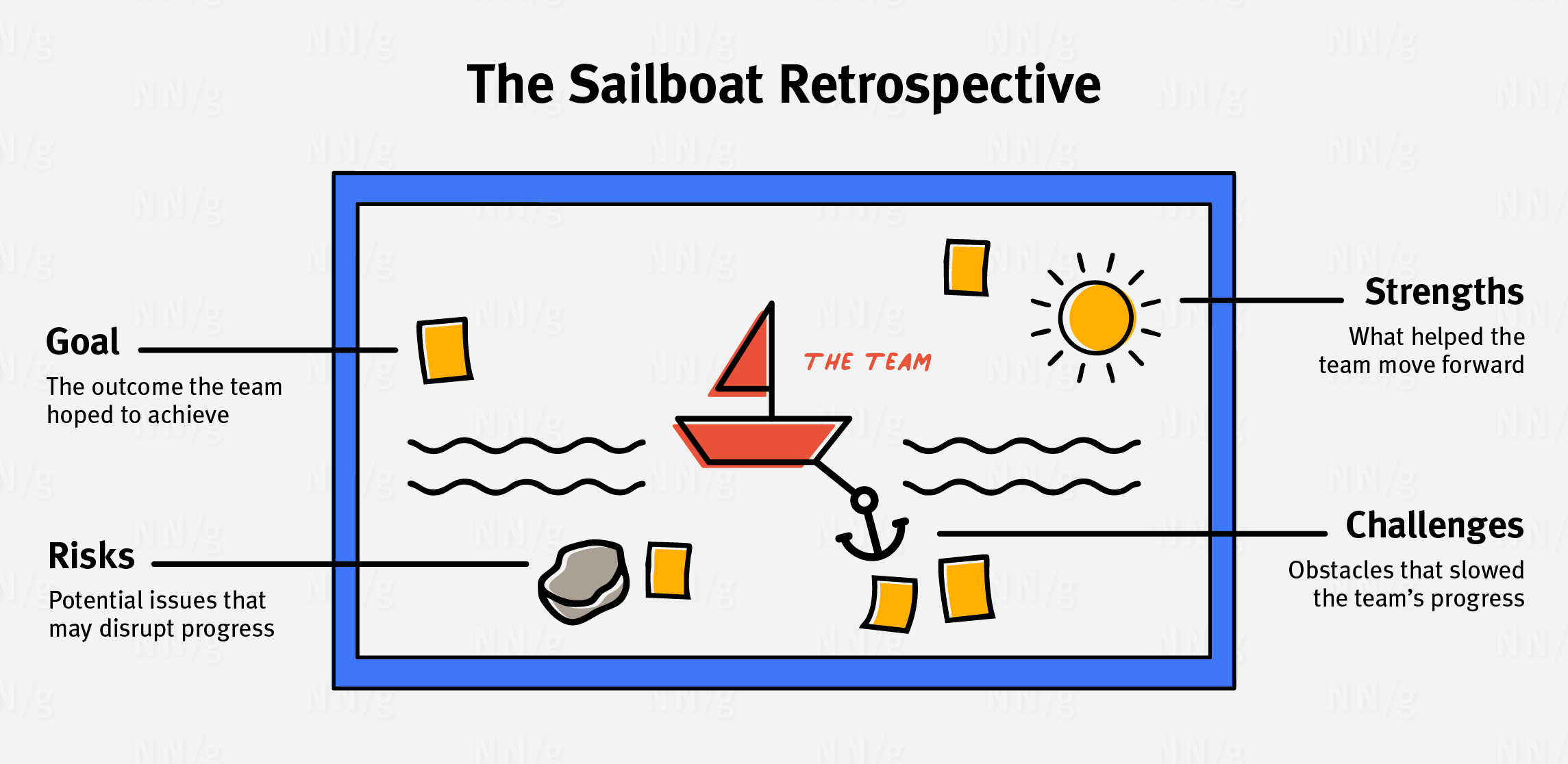
Determine how the team will exchange ideas and information during the meeting. For in-person retrospectives, give everyone sticky notes to write their ideas anonymously — one idea per note. Then, categorize the stickies on a whiteboard and review them as a group. For virtual retrospectives, use digital whiteboards or shared documents to replicate this process.
If your team prefers open discussion, go around the room (or virtual meeting) person by person. Alternatively, combine video meetings with live-editing software to collaborate in real time. Regardless of the approach, prioritize tools and methods that are familiar and comfortable for the team. Avoid overly complex or highly specialized tools that are unfamiliar to most of the team, even if they offer advanced features. The goal is to create an inclusive and straightforward process that encourages engagement and honest feedback.
2. Discuss What Went Well
Once ground rules are set, discuss what went well. Think about what propelled the team forward. Acknowledge the accomplishments of team members, but be genuine and brief. The focus of the meeting should be on the accomplishments of the team as a whole rather than on those of specific individuals. Prompt your team with questions such as:
- What accomplishments are we proud of?
- What did we do particularly well that helped us complete our goals?
- How well did we work together as a team?
- Did any experiments in our process lead to positive results?
- What helped us resolve issues?
- What did we learn that will help us in the future?
3. Discuss What Needs Improvement
Next, shift the discussion to what could be improved next time. Remember the ground rules — avoid personal attacks or the blame game. To keep the conversation productive, prompt your team with questions such as:
- What didn’t go as planned?
- Were there any goals or deliverables that we struggled to meet?
- Were there any miscommunications or misunderstandings?
- Were there moments where collaboration could have been stronger?
- Were decisions delayed or made without enough input?
- Were there moments of frustration or low morale that we could address?
4. Create an Action Plan
Without a solid plan for the future, improvements are not addressed, and the retrospective becomes repetitive and unproductive.
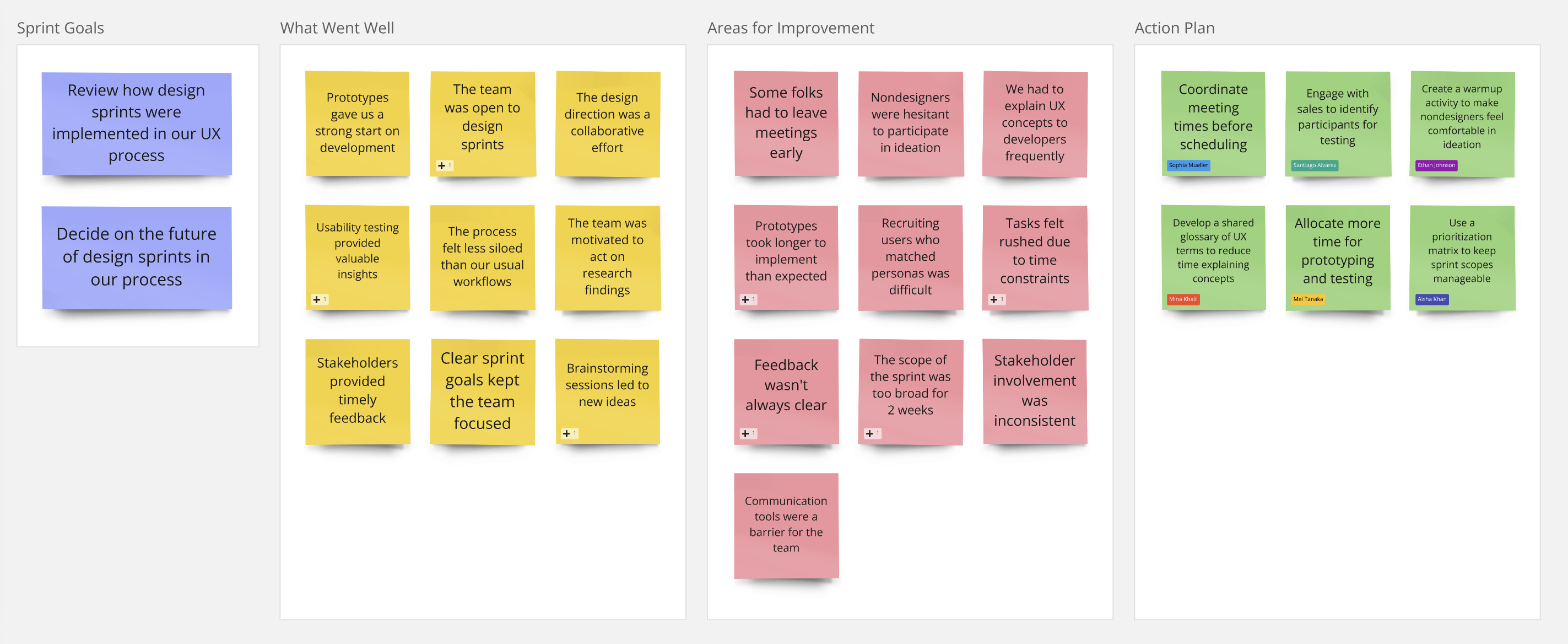
Based on the discussion of improvements, create a list of action items that can realistically be completed before the next retrospective. If an action item is too large to be completed, break it down into smaller action items and complete it over multiple iterations. If further prioritizing is needed, use a prioritization matrix to determine which items are most important.
Once you have your list of action items, assign each one a due date and an owner for accountability. Record your action items in a place that everyone on the team can access for easy follow-up.
5. After the Retrospective
Once the retrospective is over, make sure the team follows up on the action items. Check in on progress before your next retrospective. At your next retrospective, start by determining which action items have been completed since the last meeting. Carry over any outstanding action items to your next retrospective’s action plan.
Tips for Effective Retrospectives
- Share the facilitator role. Don’t always rely on the same person to lead the meeting. Having another individual facilitate will help keep team members engaged over time.
- Track patterns over time. Revisit patterns at the end of a project or milestone to show how the team has improved. Tracking action items can also help onboard a new team member (by providing context) and can make that member comfortable with contributing new ideas.
- Avoid discussion that is dominated by one or two people. Encourage the entire team to contribute to the discussion. Using the diverge-and-converge technique allows more introverted team members to contribute so their ideas are still heard.
- Start with a warmup activity. Use an icebreaker or quick activity to encourage participation and set a positive tone for the meeting.
Retrospective Variations
For Product Teams
Product teams are the obvious choice for conducting retrospectives, as team members work together daily. As team members trust each other over time, retrospectives become more productive and lead to deeper insights.
Some meetings may be more focused on what went well than others, but if your team is meeting regularly and no issues ever come up, there is a good chance that the team doesn’t feel comfortable enough to discuss them. If this is the case, reevaluate who is in the room. Are team members afraid to contribute because a superior monitors what issues are brought up? Make the retrospective a safe space to bring up issues without fear of retaliation. Every team will have areas for improvement, and it should be clear to those in the meeting that bringing up issues for discussion should not be seen as negative.
For UX Teams
Retrospectives can be useful tools among UX teams, especially if these teams aren’t embedded in product teams. They can help UX professionals focus on specific processes or evaluation methods. For example, if a UX team just started implementing a new process, a retrospective meeting would allow the team to discuss what worked and what to change next time.
For Leadership Teams
When implementing a new company initiative or strategic plan, retrospectives provide a platform for discussing how successfully the team worked together. Leadership teams also benefit from monthly, quarterly, or yearly retrospectives to check in on leadership goals.
Retrospective Health Check
Occasionally — maybe once a year — conduct a retrospective health check to reflect on the effectiveness of your retrospectives. Are your retrospectives structured and facilitated in a way that drives meaningful change? Do they lead to improvements in subsequent projects? Most importantly, do you see regular improvements in your design process, or are you playing a game of whack-a-mole where every time you knock down one weakness, another pops up to take its place? This higher-level reflection can refine your retrospective process to ensure they are actually impactful.
Conclusion
A retrospective is a powerful tool to collaboratively improve your team’s process. It strengthens communication, builds trust among team members, and creates actionable plans for moving forward.
By regularly refining your team’s processes, retrospectives can become a catalyst for ongoing success.
Resources
Atlassian.com: How to Conduct a Successful Sprint Retrospective, https://www.atlassian.com/team-playbook/plays/retrospective
AgileAlliance.org: Heartbeat Retrospective, https://www.agilealliance.org/glossary/heartbeat-retrospective/
Scrum.org: Introduction to the Sprint Retrospective, https://www.scrum.org/learning-series/sprint-retrospective/