In our course on product and UX partnerships, people from both UX and product roles often ask, “Who does what between UX and product management?” and “How can we better define roles and responsibilities?”
In this article, we outline how to set UX roles and responsibilities throughout product development, while considering other partners’ participation. Because Agile product development is collaborative and iterative, a flexible RACI matrix, also known as a responsibility-assignment matrix, serves as a useful framework for planning how the work will get done.
What Is a RACI?
Role involvement in product development varies by organization and across teams. UX professionals may often find themselves questioning who does what and when to involve other roles such as product management and engineering. The RACI helps teams zoom out from the work to see where other roles should be involved.
Definition: A RACI, also known as a responsibility-assignment matrix, outlines how individuals with different specializations will participate in tasks such as work phases (e.g., discovery), activities (e.g., usability testing), and creation of deliverables (e.g., writing a screener or designing a prototype).
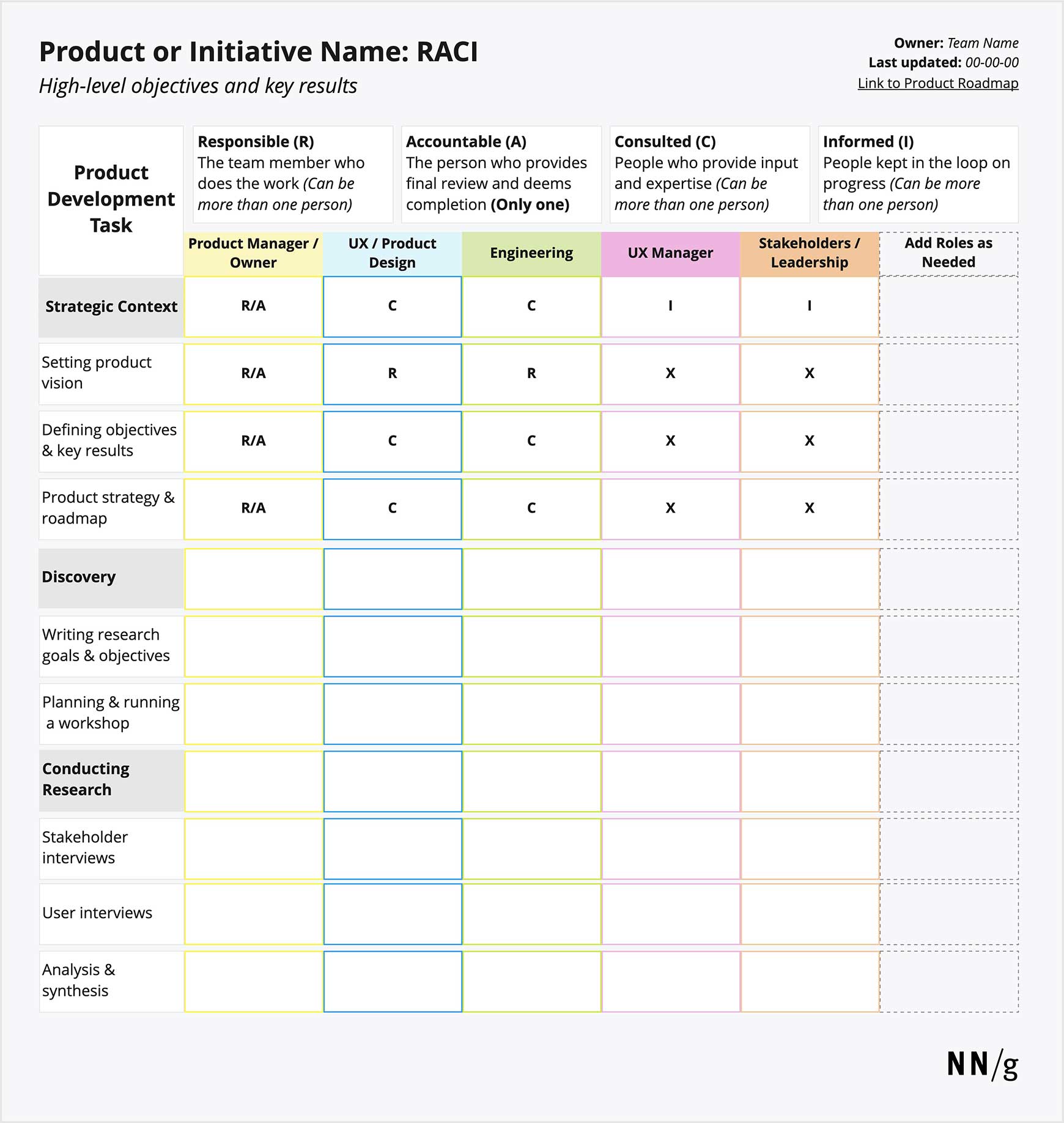
Each person or role has its own column and each phase, activity, or deliverable has an individual row. Each cell in the matrix specifies the involvement of the corresponding party with the task. The involvement is specified through one of the four letters R (Responsible), A (Accountable), C (Consulted), and I (Informed) — hence the acronym RACI. For example, in the RACI above, the product manager is responsible and accountable for the task of defining objectives and key results, whereas the UX/product designer and the engineering teams should be consulted. Overall role involvement at the phase level is based on the type of participation that appears most for activities and deliverables therein.
The four levels of role involvement for any given task (whether a product-development phase, an activity, or the creation of a deliverable) are defined as follows:
- R= Responsible: The role(s) or team member completes the task. There can be more than one person responsible for any task in product development. For example, a user researcher might be responsible for running a quantitative usability test, as part of the iteration and optimization phase of product development.
- A= Accountable: The person provides final review and determines whether and when the task is completed. For each task, there should be only one accountable person. Accountability is essential for an organization and team. Without it, it’s difficult to get people to take ownership and get things done. In some cases, the accountable person is also responsible for completing the work or deliverable. For example, when running a usability test, a UX lead or researcher might be accountable for the overall completion of the study, while also responsible for recruitment, preparing the study protocol, facilitating sessions, and analyzing results. During each testing session, a product manager and engineer might share responsibility for taking notes.
- C= Consulted: The role(s) provides input and expertise on the task. There are usually multiple people from various disciplines and levels marked with a C in the RACI, depending on the phase of product development and activities involved. In our example usability test, a UX manager might be consulted by the UX lead to get feedback on the study protocol and understand if there are any other peers on the UX team who would benefit from the research findings.
- I= Informed: The role(s) are kept aware of progress as the task is worked on. Like the responsible and consulted roles, there are often many roles kept informed, including stakeholders, leadership, and other product teams who may be impacted by the work. Informed parties could also include people from customer support, legal, operations, marketing, human resources, and in smaller organizations, the CEO.
RACIs are flexible: you can define your own roles and tasks to address your team’s needs.
Examples of UX roles to include in the RACI:
- Product designers (doing both UX research and design)
- UX researchers
- UX designers
- Content and copy writers
- Information architects
- Customer-experience roles
- UX managers
Examples of key partner roles to include in the RACI:
- Product managers
- Product owners
- Engineers
- Scrum masters
- Business analysts
Examples of tasks to include in the RACI (grouped by product-development phase)
- Setting strategic context:
- Discovery:
- Interviewing users
- Stakeholder interviews
- Contextual observations
- Mapping
- Design:
- Ideation
- Prototyping
- Usability testing
- Delivery:
- Release planning
- QA testing
- Demos
Even though RACIs are typically used in project management (task completion), which is different from product management (value delivery), they work well in both contexts to assess whether the right roles are involved and contribute where necessary. The goal in using the RACI isn’t to plan out a big, waterfall-style project, but to support efficient delivery of value to end users.
Why and When to Use a RACI
Failing to consider and openly discuss what’s happening in product development and who’s doing what is a recipe for chaos, confusion, unhealthy work overlap, and other issues such as:
- Leaving necessary roles out
- Involving people too late
- Forgetting to communicate impact of an activity to others
- Incorrectly assuming who is (or isn’t) working on what
These behaviors, while usually unintended, do happen and waste time as teams must realign later. There are 2 opportune times to introduce a RACI into your product development:
- After any retrospectives where people discussed roles or individuals being left out or brought in too late
- At the beginning of a new Scrum sprint, product increment, or project
The entire team should fill out the RACI together, whether through a virtual workshop or in-person meeting. UXers could initiate the idea of trying the RACI as an experiment and advocate for its use.
From our research with product teams, the RACI is particularly helpful while teams set strategic context and plan discovery research. During these phases in product development, it’s very common that roles are left out and responsibilities are unclear. The RACI can clarify common questions such as:
- Who’s involved in setting the vision, goals, strategy, and roadmap?
- How can we weigh in on prioritization and sequencing?
- Can we be involved in product planning?
- Who’s responsible for user or stakeholder interviews?
- Who should be involved in competitive analysis and usability testing?
- Who’s running this workshop or ideation session? Who else should be involved?
- Who’s making final design decisions? Who needs to weigh in?
Role Considerations in Responsibilities and Accountability
Assigning a level of involvement to a particular task involves more than looking at job descriptions or titles alone. In general, UX contributors should be Responsible and Accountable for phases, activities, and deliverables related to user research and design. UX managers often are Consulted in such activities. Other factors that help determine how a role participates throughout product development include skillsets, relationships with others, historical knowledge of the product or organization, time available, and levels of ambition and interest.
For example, a product manager who understands good interviewing techniques may be Responsible and Accountable for user or stakeholder interviews at various points throughout product development. However, in such a case, a UX lead could still be considered either Responsible, if they collaborate to conduct the interviews with the product manager, or Consulted, if they give advice on interview questions.
If UX is unable to participate in the interviews due to time constraints, at the very least some UX team members should be marked as Informed in the RACI, to ensure that the product manager shares findings and insights from the interviews, since these will impact UX work.
How to Know When to Partner
Roles that are Responsible and Accountable for a given task need to work together in collaborative partnership to get the work done. The accountable person should ensure how and when any Consulted and Informed roles are brought into the process.
For example, a UX lead who is Responsible and Accountable for running discovery research decides when to consult their UX manager and when to speak to stakeholders and leaders about progress. Even though UX can and should collaborate on this task with product and engineering since they’re sharing responsibility, the primary accountability would fall on UX.
Once roles and responsibilities are set, it doesn’t mean you can ignore each other completely until it’s time to review the outputs or launch the design. Check in with each other along the way. Visualizing the work to be done with a RACI prevents handoffs of deliverables from one team to the next and fosters a design-as-process culture instead of design-as-service one.

Conclusion
Taking time to openly discuss what’s happening and who’s doing what in product development enables teams to identify gaps in their processes and avoid common misalignments that impair product outcomes. The RACI can act as training wheels for an open conversation about roles and responsibilities.
As your team establishes common ground, you might eventually graduate from the RACI. Working together often, over time helps team members understand when and how to involve other roles and makes obvious who should be responsible, accountable, consulted, and informed throughout product development. The collaboration won’t always be perfect but using tools like the RACI can point teams towards improving both partnerships and product outcomes. Use our template linked below to get started with your team.