


Since 2001, NN/g has selected the 10 best intranets of the year. For 2022, the 10 winning organizations are:
- Banner Health (US), one of the largest nonprofit healthcare systems in the US
- BNY Mellon (US), a global investments company
- DBS Bank (Singapore), a leading financial-services group
- The Estée Lauder Companies Inc. (US), one of the world’s leading manufacturers and marketers of quality skin-care, makeup, fragrance, and hair-care products
- International Business Machines Corporation (IBM) (US), a technology leader for over 100 years, currently focusing on AI and hybrid cloud technology
- Massachusetts Mutual Life Insurance Company (MassMutual) (US), a leading financial-services company that provides financial solutions, guidance, and education
- Princeton University (US), a global research university with a distinctive commitment to undergraduate teaching
- Publicis Sapient (US), a digital business-transformation company
- Sorigué (Spain), a leading business group working in the fields of construction services, water, energy, and materials
- Webuild S.p.A. (Italy), a global company that specializes in complex, sustainable infrastructure construction, including projects for mobility, hydro energy, clean water, and green buildings
Eight industries Represented
These winners, from eight different industries, show that teams from any industry can produce award-winning intranets. This year’s Intranet Design Annual winners are in:
- consumer packaged goods
- education
- engineering and construction
- finance
- insurance
- nonprofit
- professional services
- technology
The utilities and natural resources, finance, and technology industries have long created some of the world’s best intranets. This year, finance continues to be solidly represented, boasting two winners: BNY Mellon and DBS Bank. Finance is the second-most–winning industry in the history of the contest, with 32 winners (15%). Insurance, a subset of finance that is counted as its own industry, has eight total winners, including this year’s winner, Massachusetts Mutual Life Insurance Company.
While utilities and natural resources remains the industry with most winners in this contest, there are no winners in this category this year.
The education and consumer-packaged-goods industries have been underrepresented in our winners’ set over the years, with three and two winners, respectively. Princeton University and the Estée Lauder Companies Inc. claimed a prize for each this year. Also, Estée Lauder is the first-ever beauty company to be recognized among our winning companies. These organizations, once again, prove that any organization with a strong commitment to prioritizing the employee user experience can win.

Continued Rapid Development Amid the Pandemic
Organizations continue to experience changes in this third year of the pandemic. As organizations and intranet teams search for a cadence in how to support remote, in-person, and hybrid work, we expect to witness some fluctuation in the amount of time taken to create great intranets.
This year, teams took between 6and 45 months to create their winning designs, with the average time to complete clocking in at 22.7 months (standard deviation = 12.8 months), similar to the averages from recent years. This average is higher than last year’s average of 17 months.

Since the start of the Intranet Design Annual, teams have been taking less and less time to create winning intranets. Because we have been running this contest for more than 20 years, we are able to evaluate historical data by dividing the winners into two sets, each comprising at least 100 winners. In looking at the data, there’s significant downward trend in design-and-development times used to create winning intranets. When we compared how long it took winning teams across two 10-year periods to create their intranets, we found that in the last 10 years, the time taken to complete is (~2 and a half years) lower than it was in the previous decade. From 2003 to 2012, winning teams typically required an average of 4.1 years to create their intranets, and from 2013 to 2022, the average creation time dropped to 1.5 years and has remained about constant since then.
Some of the factors contributing to the much shorter design-and-development time include larger teams, more outside-agency help, and using an Agile development process.
Winners have been using Agile for about 10 years now, and the process has a strong foothold among winning intranet teams. Nine of this year’s 10 winners employed an Agile Development process, and the job of 5 of IBM’s intranet team members was to manage Agile well.
Four-Time Winner: IBM
It’s unusual for the same organization to win our contest more than once, but it’s incredible and unprecedented for an organization to win four times. Yet this is exactly what IBM has done, as the quest for a better employee experience is not just a set of projects at IBM. It’s a culture. A very special congratulations to IBM, its leaders, and the various teams that have graced the pages of our report in 2006, 2017, 2019, and now, again, in 2022.
Organization Size
The 220 winning intranets we have recognized since 2001 have come from organizations ranging from just 12 employees to as many as 1,400,000.
This year’s winners are large, small, and everything in between, as the wonderful intranets featured in this report include the smallest winning organization ever at 4,000 employees (Sorigué S.A.) and the largest at 250,000 (IBM).
Larger Core Teams
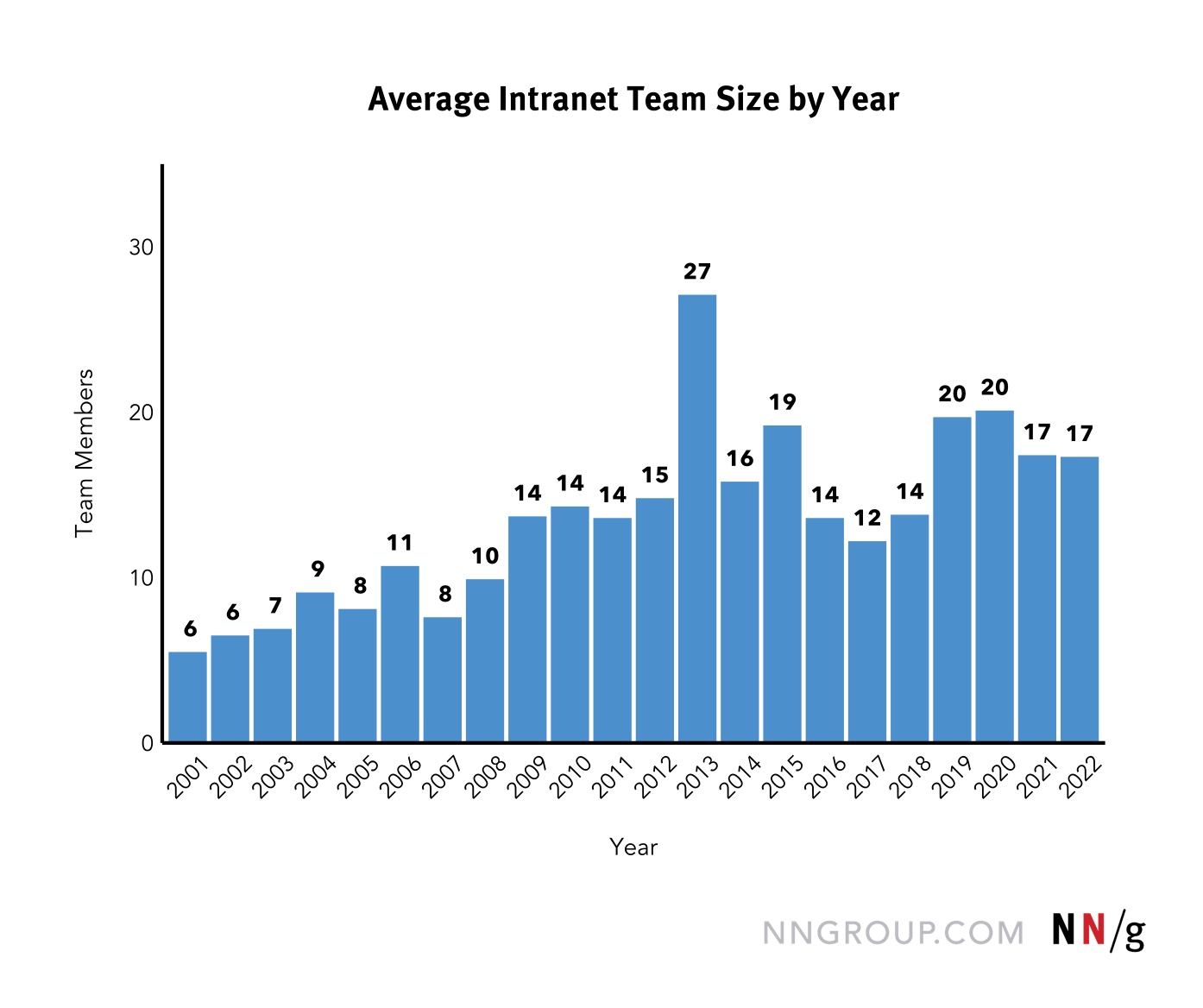
The average intranet-team size for this year’s winners was 17 members, ranging from as few as 3 (at Publicis Sapient) to as many as 55 (at IBM). These numbers reflect the size of the core intranet team, which is comprised of internal and external staff and full- and part-time employees. The numbers do not include extended team members, such as content authors or people working on short-term projects.
Organizations may have devoted more resources to intranet teams in recent years — a positive development — and certainly, in the last few years, there have been more core team members on intranets than there were in the past. When we compared the average team size across three 7-year periods, we found that between 2001 and 2007, teams tended to be small and understaffed, with an average of 8 people. The average team size doubled to 16 members in the 2008–2014 period and remained at a similar level, 17 people, between 2015 and 2022. The hope is that core teams will continue at this average size or increase.
Consulting Partners
While every winner in our last Intranet Design Annual brought in outside help, this year, only 6 winners partnered with consultants and outside agencies to create their winning designs. These teams are:
- Banner Health with Sogeti/Capgemini
- BNY Mellon with an offshore team of eight developers located primarily in India
- MassMutual with Veracity, Accenture, Digital Workplace Group, Genuine Interactive
- Publicis Sapient with LumApps
- Sorigué S.A. with Roca Salvatella and Raona
- Webuild S.p.A. with Relay
Four teams — DBS Bank, ELC, IBM, and Princeton — worked only with internal employees to create their winning design.
As evidenced by this year’s winners, there is no one recommended formula for how much work should be done internally versus by consultants. Some great teams have all the expertise and resources they already need in house. And, if they are missing skills, they choose to hire or shore up their internal staff, keeping knowledge in house. Other organizations look outside to cover a resource gap, expedite work, or supercharge their ideas and see their goals through an outsider’s lens. For temporary tasks, it makes more sense to hire a consultant than to hire a full-time employee. Additionally, an external perspective can help teams notice or better understand issues they may be too close to and expand their vision beyond day-to-day thinking.
The presence of outside vendors also speaks to the complexities faced by today’s intranet teams. It’s difficult for a small team to provide the full array of expert skills needed to put forth the time required to make an excellent design. The intranet platform also sometimes plays a role in whether a team chooses to enlist outside experts.
The most significant outside help was provided in the following areas:
- Content management and strategy
- User research
- Program management
- Platform support
- Engineering and integration
- Design
More details on the collaboration between in-house teams and outside firms can be found in each company’s case study.
2022 Regions and countries represented
The US made another strong showing this year, with 7 Intranet Design Annual winners. Singapore came up with its first win, and Spain and Italy also each had one winner this year.
|
Country |
Number of Winners |
|
United States |
7 |
|
Italy |
1 |
|
Singapore |
1 |
|
Spain |
1 |
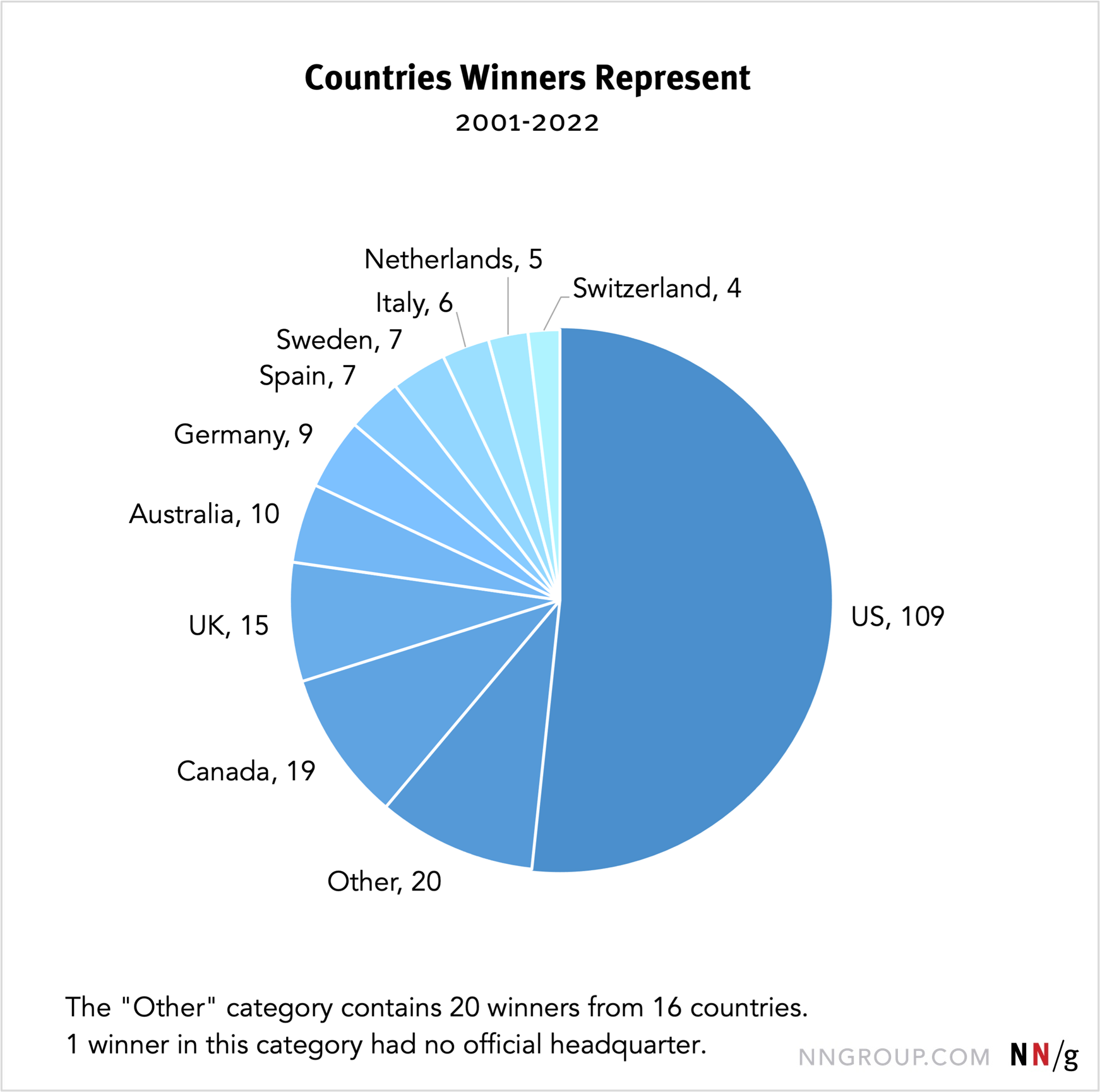
The world regions and respective percentages of winning organizations across the Intranet Design Annual’s history are:
- North America (57%)
- Europe, including the UK (31%)
- Asia/Pacific, including the Middle East (10%)
- South America (0.5%)
- Africa (0.5%)
To date, only one of the winning organizations has considered itself global and not located in a specific country.
Details on each of the 10 case studies, design screenshots, and lessons learned by the winning designers can be found in the 2022 Intranet Design Annual Report.
Submit Your Intranet to Win the Next Design Annual!
Have a great intranet? Large or small, your site could win next year’s Intranet Design Annual competition. But you must enter to win. Please check http://www.nngroup.com/intranet-call-for-entries/ for the exact dates and submission guidelines.