We surveyed 30 UX professionals in a variety of roles, to learn about the challenges they face in setting direction and planning the execution of mid- to long-term user-experience work. Thematic analysis of the responses revealed the following common issues:
- Lack of UX vision and strategy
- Misunderstanding of what a UX strategy is and can do
- Overemphasis on business needs and underemphasis on users in the UX vision and strategy
UX practitioners often prioritize mastering practical skills such as UI design, prototyping and wireframing, journey mapping, running user research, and reporting findings. While these skills are important, in order for UX to lead and influence at a higher level, practitioners must also grow their strategic skills. Many practitioners’ strategic skills aren’t as strong as their practical skills, as they involve triangulating many inputs and sources of information to create a high-level plan for an improved user experience.
In this article, we’ll define what a user-experience strategy is, its components, and the risks of having no strategy at all.
What Is a UX Strategy?
UX strategy: A plan of actions designed to reach an improved future state of the organization’s user experience over an established period of time.
Scopes for a UX strategy can range to cover a single product, service, or feature; multiple products and services; or entire organizations. Regardless, a strong UX strategy ensures that user-centered insights are integrated with the business strategy.
However, having a UX strategy is not enough; practitioners must also be able to clearly articulate how executing the strategy will make the business more successful.

UX Strategy: Primary Components
There are 3 primary components that make up a UX strategy:
- Vision or statement(s) of intent
- Goals and measures
- Plan
Research informs each component to reflect the real needs, constraints, and concerns of both users and the organization to make the strategy plausible and drive priority.
1. Vision or statement(s) of intent: In order to craft a plan for how to get somewhere, you first have to know where you’re going and why. As part of the overall strategy, a user-centered vision or a mission statement, sometimes in conjunction with other guiding principles such as key-value propositions, differentiation or positioning statements, communicate these aspirations and ideal outcomes. Think of your vision as the summary of your product or service in its ideal form and of the value it provides.
This vision or end-goal state must be strategically positioned — meaning research-based and viable in the market. Strategic intent and positioning emerge from either:
- Solving a few key problems for many users
- Supporting the broader needs of many customers in a narrow market
The vision contextualizes the work the team will eventually do with a higher-level, user-centered purpose. The work needed to reach the vision won’t happen all at once; the strategy guides how this work should be deployed over time.
|
Vision Example: Deliver a caring and convenient digital healthcare experience for patients and providers. |
2. Goals and measures: Once you know where you’re going and why, you need a way to measure progress. Goals, along with metrics and key performance indicators (KPIs), should directly connect UX improvements with business goals.
It’s important for UX to understand how an organization makes and spends money and what it cares about. Otherwise, your user-experience goals and metrics will seem irrelevant and disconnected from the business priorities. Without knowledge of how the business works, UX will be unable to find opportunities that impact the current business model, let alone imagine new ones.
Strategic goals and measures establish and communicate:
- Why the business will succeed by becoming user-centered
- Actions with the highest business impact
- Prioritization, tradeoff, and deferral decisions
Goals are typically set by leadership, while key results are established in various ways: some teams set their own, using past performance as a baseline, while others inherit results expectations from leadership. Every vision breaks down into multiple goals that should tie directly back to end-user needs. Without goals, it’s impossible to prioritize or report any meaningful progress and results along the way. For example, the above vision may break down into three goals (with corresponding key results):
Vision Example: Deliver a caring and convenient digital healthcare experience for patients and providers.
|
Example Goals: |
Example Key Results: |
|
User: Increase healthcare access and convenience. Business: Grow/maintain patient and provider populations. |
Growth: 20% increase in new patients Usage: 30% increase in telehealth usage Retention: Flat for providers and patients |
|
User: Provide superior support to patients and providers. Business: Reduce the need for and volume of support inquiries. |
Satisfaction: Decrease wait times by 60% Cost Savings: $0.50 cost per interaction |
|
User: Reduce the stress and uncertainty in managing health. Business: Improve patient and employee satisfaction. |
Satisfaction and Cost Savings: 85% share of positive feedback from patients and providers |
3. Plan: A plan is needed to achieve each goal and every goal breaks down into multiple objectives. Objectives describe the actions or steps to take to reach the goal over time. Objectives may focus on solving a known problem in the user experience, exploring new ideas and opportunities, or additional user research and knowledge needed.
Completing objectives enables the team to show incremental progress for key results and the vision. In addition to objectives, the plan should also include:
- Focus areas in the user experience
- Approximate timing
- Prerequisites and dependencies
- Constituents to include
The plan helps to prioritize activities and address uncertainties. While plans must include the above components, there’s flexibility in the formats they can take. Some teams track plans in a project-management tool, while others create and share UX roadmaps.
Plans should describe, not prescribe. The plan broadly communicates what needs to be considered and when, while working on the objectives. However, it isn’t perfectly linear and rigid, nor does it dictate how to conduct research or which solutions to execute — that’s for the teams doing the user-experience work to decide once the plan is in place.
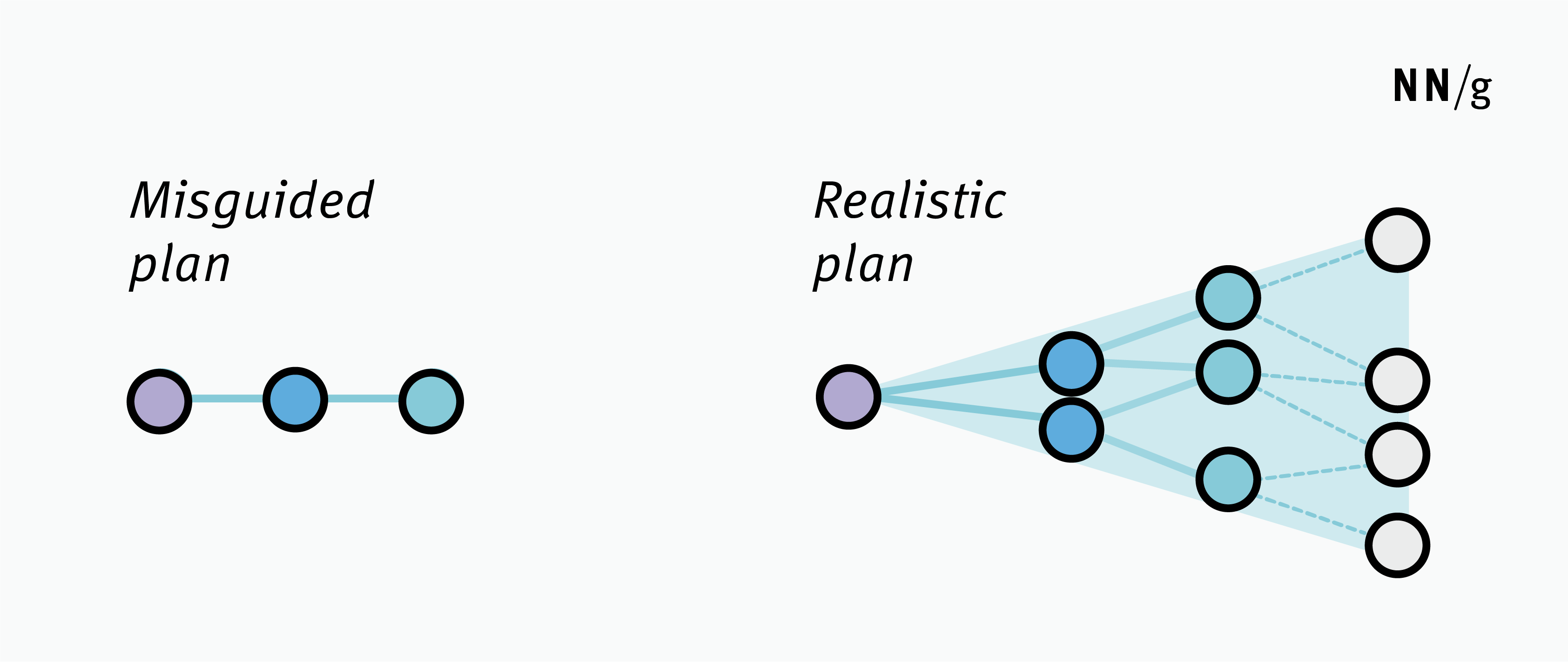
The plan’s time horizon should mirror the scope of the vision. Stakeholders and individual contributors should work on identifying, diagnosing, prioritizing, and addressing the work outlined in the plan. Depending on the scope of the vision, the plan’s time horizon can be as narrow as the next three months or as wide as the next two years.
Vision Example: Deliver a caring and convenient digital healthcare experience for patients and providers.
| Example Goals: |
User: Provide superior support to patients and providers. Business: Reduce the need for and volume of support inquiries. |
| Example Q2 Plan: |
Focus areas and objectives: 1. Appointment scheduling:
2. Personalized-care plans: User research to gauge desirability 3. Online counseling: Business research to gauge viability |
Because the plan packages up the UX strategy, team members need to be able to refer to and update it as needed — it shouldn’t sit on a shelf in a dusty binder or an obscure server that no one accesses. To gain momentum for the UX strategy, prioritize quick wins in the plan with revenue-growing potential — these will have a real business and user impact.
Executing the UX Strategy: Supporting Factors
After establishing the primary components of the UX strategy, it’s easier to identify and organize the supporting factors needed to execute it efficiently and effectively. These factors include:
People:
- How people and roles are allocated to form teams
- How teams are assigned to goals and results
- How crossfunctional teams interact across lines or units of business
- Budget for recruiting, compensation, education, and rewards
Process:
- Consistent research, ideation, design, and development practices
- Content-management models and service-design processes
- Milestones and governance standards
- How leadership is informed and kept aware
- How the strategy adapts and evolves over time
- Budget for ongoing research, recruiting, and participant compensation
Tools and standards:
- Content standards and design systems
- How the brand is reflected in the experience
- How to set up backlogs, track tasks, and plan releases
- Budget for tools
People, processes, and tools are key supporting factors in UX strategy. However, collaboration and coordination across each of these factors, and intentionally designing how they work together, is equally vital. This practice is called DesignOps. DesignOps is the orchestration and optimization of people, processes, and craft in order to amplify design’s value and impact at scale.
Risks of Having a Weak or No UX Strategy
A UX strategy is a business strategy — end-users pay for products and services that make organizations profitable. Unfortunately, even in 2022, many organizations still feel that they know best and don’t need to conduct user research to seek a deeper understanding of user needs. With the experience economy growing ever more important for long-term competitive advantage, these companies are sure to see declines in the coming years.
Moreover, some teams and organizations make important strategic experience decisions without any planning at all. Other teams plan, but then fail to execute on that plan. Without a UX strategy, organizations risk weak results, diminished opportunities for growth, and misguided research, thus wasting design and development time.
Other risks of not having a UX strategy include:
At the company, product, and service level: Detachment from user needs and problems can result in top-down decision-making based solely on business value instead of user and business needs. Sweeping misconceptions about how UX works and why it matters are also likely to arise. Those less familiar with UX may assume it focuses only on graphic design or that gathering data after quickly launching solutions will suffice to reach goals. These kinds of misconceptions lead to:
- Experiences and features that fail
- UX being left out and only brought in to clean up experiences after the fact
- Inability to increase organizational UX maturity long term
With leadership and stakeholders: A lack of UX strategy can hold UX back from influencing the organization’s path and making a noticeable impact at a high level. It also reduces the likelihood of having UX represented at the executive level in the future. Without business intelligence from leadership and stakeholders, UX is:
- Unable to synthesize and translate user-research findings into business value
- Forced to wrangle UX feedback from various stakeholders, voices, and opinions
- At the mercy of uneducated stakeholders making key decisions without user research
- Subject to lots of “stuck in-the-weeds” discussions
With prioritization: Instead of working on relevant and timely objectives to reach goals, UX may chase design trends and focus on implementing new technologies or competitor features instead of driving real user and business value. Teams may also:
- Use arbitrary or irrelevant prioritization criteria
- Take baseless or unfocused approaches
- Constantly move targets and lose productivity
At the team level: Without a UX strategy, it’s unclear what research or design work is happening and why, who’s conducting it and how, what’s coming next, when to share findings, and when to celebrate accomplishments. This lack of clarity and purpose can lead to duplicate UX work and low team morale, as individuals may question the importance of being user-centered, how their work fits into the bigger picture, and whether it makes a difference in the organization. Other impacts include:
- No direction in which to ground research, design, processes, and guidelines
- Disorganization among the team and unhealthy competition with other teams/roles
- Inconsistencies with agency/vendor work
With resources: Weak UX strategies make it increasingly difficult to advocate for and onboard additional UX people as it won’t be clear why and where they’re needed and what they’ll contribute. With existing UX people, managers may:
- Blindly optimize or reallocate resources
- Encounter challenges with navigating and triaging competing requests and priorities
- Lose top talent to more strategic teams or organizations
Where to Start with UX Strategy
A good UX strategy is one that optimizes for growth and development, while keeping user needs at the center of it. UX leads are often great catalysts for setting a UX vision and strategy.
To get started with UX strategy, ask yourself the following:
- Why do we need a UX strategy? Focus on building your expertise on the organization's user data. Continually watch your organization’s competitive landscape from a user’s point of view.
- What actions will bring the highest value? Understand your organization’s business and revenue models. Practice articulating problems and solutions that are relevant to both customers and the organization.
- Who needs to be involved? Bring others along and help them succeed by taking a user-centered approach.
- How will we know when we’re successful? Understand how your organization measures its success (KPIs) and stay up to date on this data. Communicate the value of UX in business terms so executives can relate.
Download our UX strategy poster to help align your team around the definition and components.