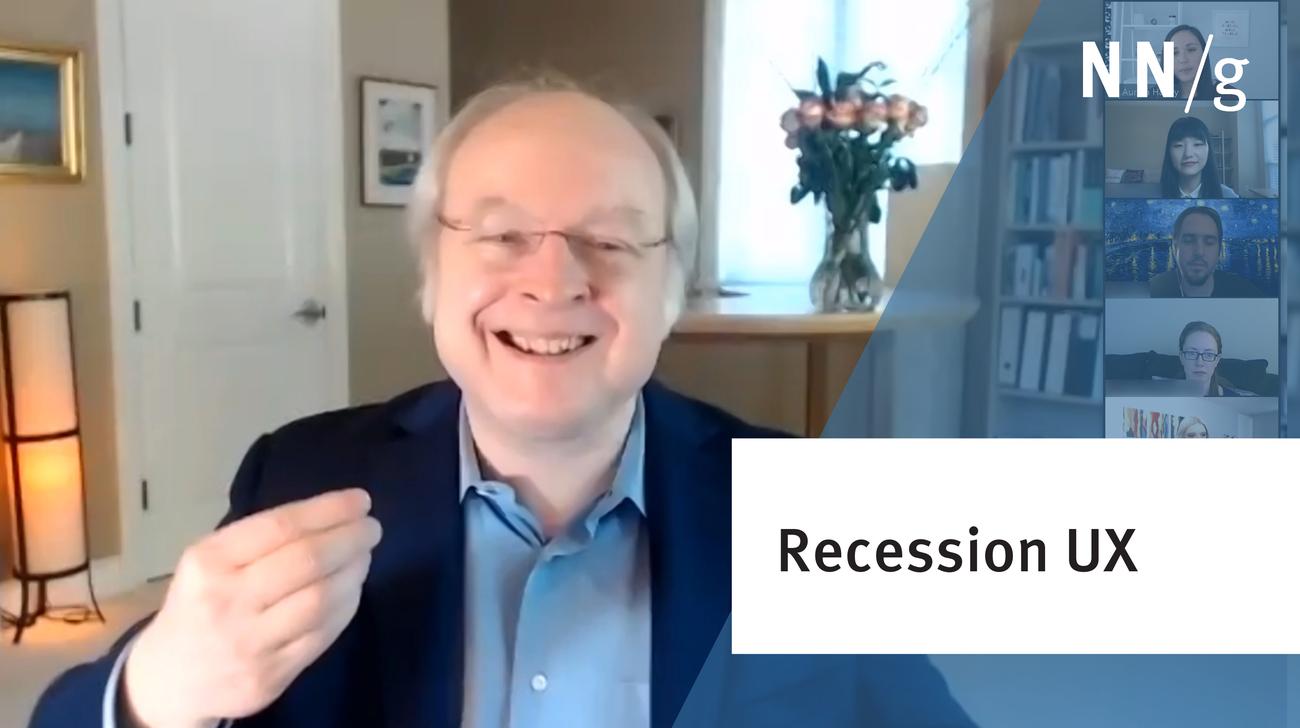
At the Virtual UX Conference, Jakob Nielsen answered audience questions on how UX changes with the downturn in the world economy and what new industries will benefit from UX.
Build out social features on your own website, or avail yourself of existing (but external) social media platforms where you don't own the user experience? User research can help determine which strategy is best for reaching your specific audience and serving their special needs.
When emergency situations impact retail operations, stores must inform customers of resulting changes to services with salient communications across all channels.
Before beginning any journey-mapping initiative, teams must decide between (1) a current-state or future-state map, and (2) an assumption-first or research-first approach. A hybrid approach for each decision works well for most teams.
How has the field of user experience changed over the last 30 years, how will it continue to change, and what can we expect for the uptake of technology innovations?
If users don't notice a navigation menu, they won't use it, and website usage will plummet. Here are 5 design guidelines to increase the visibility of navigation menus.
In a survey of 557 design and UX practitioners, organizations only did 22% of recommended DesignOps efforts, did not have DesignOps-dedicated roles, and had low DesignOps maturity overall.
Likert and semantic differential are instruments used to determine attitudes to products, services, and experiences, but depending on your situation, one may work better than the other.
Human-centered design has 4 principles: understand the problem, the people, and the system, and do iterative design. But what if you don't have time to do all 4 steps?
Usability studies with children and teenagers are as valuable as any other user research but require special attention to both participant recruiting and study facilitation. You can't act the same with kids as you would with adults.
Jakob Nielsen's 10 general principles for interaction design. They are called "heuristics" because they are broad rules of thumb for UX and not specific usability guidelines.
Empathy maps help UX teams visualize user attitudes and behaviors, building a shared understanding of end users while highlighting gaps in existing user data.
Modern day UX research methods answer a wide range of questions. To know when to use which method, each of 20 methods is mapped across 3 dimensions and over time within a typical product-development process.
User interviews have become a popular technique for getting user feedback, mainly because they are fast and easy. Use them to learn about users’ perceptions of your design, not about its usability.
User journeys and user flows both describe processes users go through in order to accomplish their goals, but they differ in scope, purpose, and format.
iOS 26’s visual language obscures content instead of letting it take the spotlight. New (but not always better) design patterns replace established conventions.
Elaborate usability tests are a waste of resources. The best results come from testing no more than 5 users and running as many small tests as you can afford.
In a card-sorting study, users organize topics into groups. Use this research method to create an information architecture that suits your users' expectations.