Information Architecture Articles & Videos

  • Context Libraries: How AI Power Users Manage Context Engineering

    Claude power users rarely edit their context files and often can’t find them. Your AI agent is only as powerful as its context library.

  • Analyzing Good Designs: Ritual.com

    A close look at how complementary colors, visual hierarchy, and clean imagery come together to make Ritual.com's UI feel effortless.

  • Context Architecture

    Context architecture applies information architecture principles to AI systems, helping agents interpret information and produce better, user aligned responses.

  • Explicit Decisions: Help Your Users Choose Correctly

    Make sure your users make the correct decisions the first time by making distinctions between options clear by highlighting key differences.

  • Organize Information with "LATCH"

    The LATCH framework organizes information based on location, alphabet, time, category, and hierarchy. This method helps transform complex datasets into meaningful structures, facilitating effective navigation.

  • Explicitly State the Difference Between Options

    When the key differences between choices are implied or buried, users often select the wrong option or misunderstand the features.

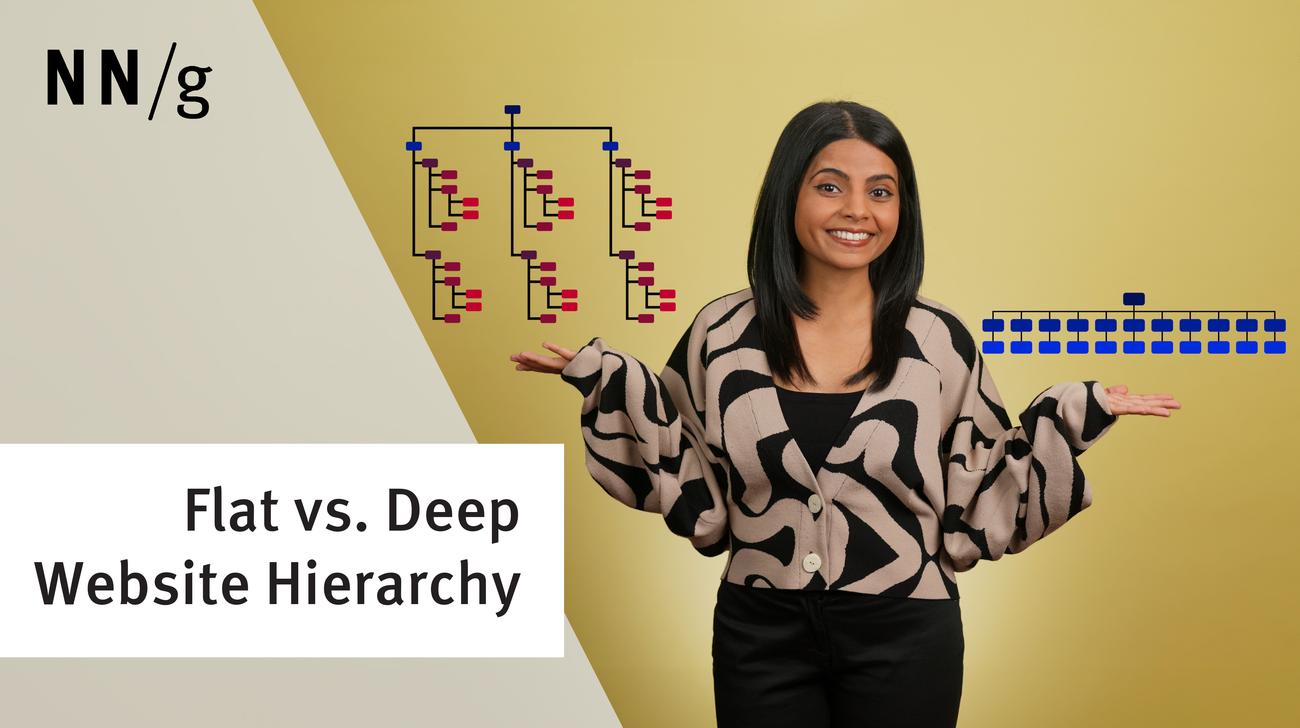
  • Flat vs. Deep Hierarchies in Information Architecture (IA)

    Information can be structured in flat or deep hierarchies, each with their own set of benefits and drawbacks.

  • Card Sorting: Pushing Users Beyond Terminology Matches

    Labels in a card sorting study must be neutral to prevent keyword matching and encourage careful, conceptual groupings from users.

  • Card Sorting: Why & When

    Card sorting studies help understand how users naturally categorize information. This information can help with creating a product's information architecture (IA) that matches users' mental models.

  • Card Sorting vs. Tree Testing

    Card sort studies help shape information architectures; tree-testing studies evaluate them.

  • Card Sorting: Uncover Users' Mental Models for Better Information Architecture

    In a card-sorting study, users organize topics into groups. Use this research method to create an information architecture that suits your users' expectations.

  • Tree Testing Part 2: Interpreting the Results

    Analyze tree-testing results including success, first click, and directness to improve information architecture and navigation labels.

  • Information Architecture vs. Sitemaps

    Information architecture is the practice of structuring and organizing content on your site. Sitemaps are visualization tools used predominantly for planning.

  • Tree Testing: Evaluate Menu Labels and Categories

    Follow these tips to effectively evaluate a site’s navigation hierarchy and to avoid common design mistakes.

  • 3 Common IA Mistakes (that Are All Due to Low Information Scent)

    Vague call-to-action verbs, unnecessary parallel language, and conversational tone of voice used in links and navigation labels are confusing. Use labels with strong information scent instead.

  • Information Architecture: 3 Key Models

    Navigation, taxonomies, and the full IA structure are different ways of modeling a product's structure. We review the differences and similarities between these three different IA models.

  • Vertical Navigation

    Websites with many categories can benefit from showing navigation menu options in a vertical list: vertical menus allow for easy expansion, are easy to scan, plus users are familiar with this design pattern.

  • Audience-Based Website Navigation

    Segmenting a website's navigation by audience categories will often degrade usability, either because users belong in multiple categories, or because they feel the need to look at content targeted at several segments.

  • The UX of Phone-Tree Systems: 16 Usability Guidelines

    Phone trees are often frustrating. Badly designed interactive voice-response (IVR) systems violate many of the 10 usability heuristics.

  • Polyhierarchy in Information Architecture

    Polyhierarchy is used to place a single item in more than one IA category. This can support users with different mental models but should be used judiciously.