The user experience field will see dramatic changes over the next 3 decades, driven by trends in demographics and the world economy. We will end up like the Little Mermaid. (This was Jakob Nielsen's UX Conference keynote.)
User testing in different countries helps identify culturally specific usability issues. Testing correctly and at the right time will help you thrive in a new market.
UX professionals often work hard to convince stakeholders to support UX research and design efforts. Recognizing who your key stakeholders are and how they impact your work is the first step to building fruitful stakeholder relationships.
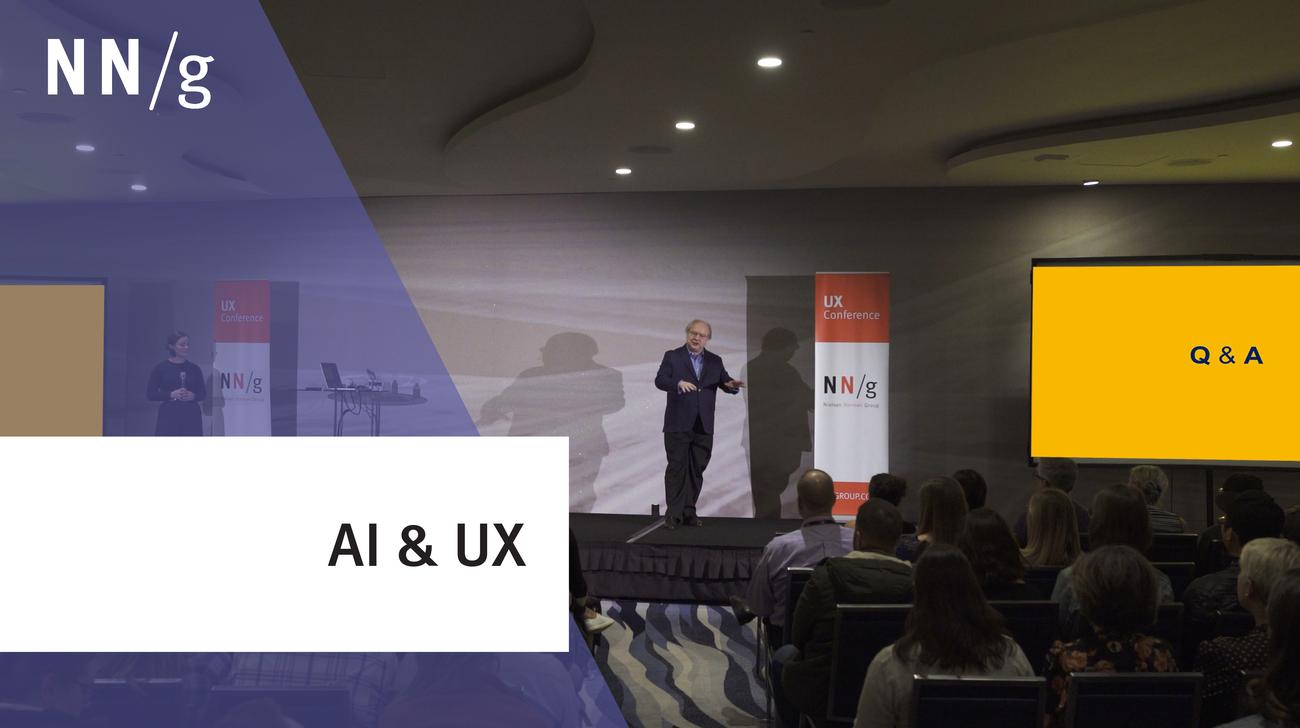
Do AI products have good user experience? Only partly, and to get better, we need to focus AI more on human needs than on what's technically possible. But AI can also help UX professionals do their job better, which will improve usability more widely.
When visual design elements appear clearly different (for example, have contrasting colors) users easily deduce that the contrasting item is different or special in some way. So if it actually is different, this enhances usability.
A design system is a set of standards for managing design at scale, reducing redundancy and creating a shared language and visual consistency across channels.
Usability testing can yield valuable insights about your content. Make sure you test with the correct users, carefully craft the tasks, and ask the right follow-up questions.
With experience, UX teams have evolved techniques for better collaboration and design practices to involve and engage remote and distributed team members. With participants at the Virtual UX Conference.
Jakob Nielsen's 10 general principles for interaction design. They are called "heuristics" because they are broad rules of thumb for UX and not specific usability guidelines.
Empathy maps help UX teams visualize user attitudes and behaviors, building a shared understanding of end users while highlighting gaps in existing user data.
Modern day UX research methods answer a wide range of questions. To know when to use which method, each of 20 methods is mapped across 3 dimensions and over time within a typical product-development process.
User interviews have become a popular technique for getting user feedback, mainly because they are fast and easy. Use them to learn about users’ perceptions of your design, not about its usability.
User journeys and user flows both describe processes users go through in order to accomplish their goals, but they differ in scope, purpose, and format.
iOS 26’s visual language obscures content instead of letting it take the spotlight. New (but not always better) design patterns replace established conventions.
Elaborate usability tests are a waste of resources. The best results come from testing no more than 5 users and running as many small tests as you can afford.
In a card-sorting study, users organize topics into groups. Use this research method to create an information architecture that suits your users' expectations.