Uncover the story within extensive UX-research data by following a process of revisiting original research objectives and organizing findings into themes.
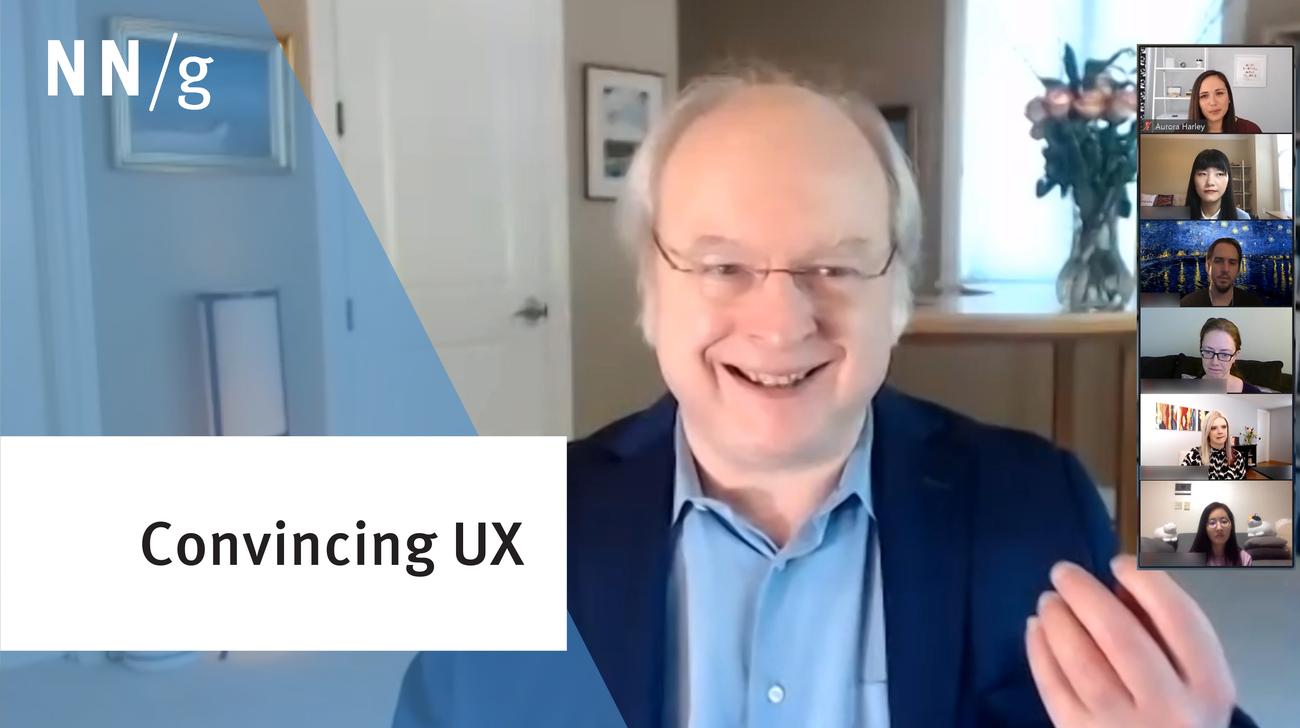
The relationship between accessibility and usability and the best ways to convince companies to take both seriously were some of the audience questions answered by Jakob Nielsen at the Virtual UX Conference.
Eyetracking studies show that users sometimes look at only a single result on a search-results page because that result is good enough for their needs.
To solve big-scale design problems, Don Norman recommends engaging with the community that has these problems and leveraging existing creativity and experience.
An engaging gameplay experience is good design. But there's a fine line between engagement and addiction, which would be bad UX, especially in the long term.
How to design a journey-mapping workshop that leads participants through current-state assumption mapping, pain-point identification, and future-state visioning.
Jakob Nielsen's 10 general principles for interaction design. They are called "heuristics" because they are broad rules of thumb for UX and not specific usability guidelines.
Empathy maps help UX teams visualize user attitudes and behaviors, building a shared understanding of end users while highlighting gaps in existing user data.
Modern day UX research methods answer a wide range of questions. To know when to use which method, each of 20 methods is mapped across 3 dimensions and over time within a typical product-development process.
User interviews have become a popular technique for getting user feedback, mainly because they are fast and easy. Use them to learn about users’ perceptions of your design, not about its usability.
User journeys and user flows both describe processes users go through in order to accomplish their goals, but they differ in scope, purpose, and format.
iOS 26’s visual language obscures content instead of letting it take the spotlight. New (but not always better) design patterns replace established conventions.
Elaborate usability tests are a waste of resources. The best results come from testing no more than 5 users and running as many small tests as you can afford.
In a card-sorting study, users organize topics into groups. Use this research method to create an information architecture that suits your users' expectations.