Articles & Videos

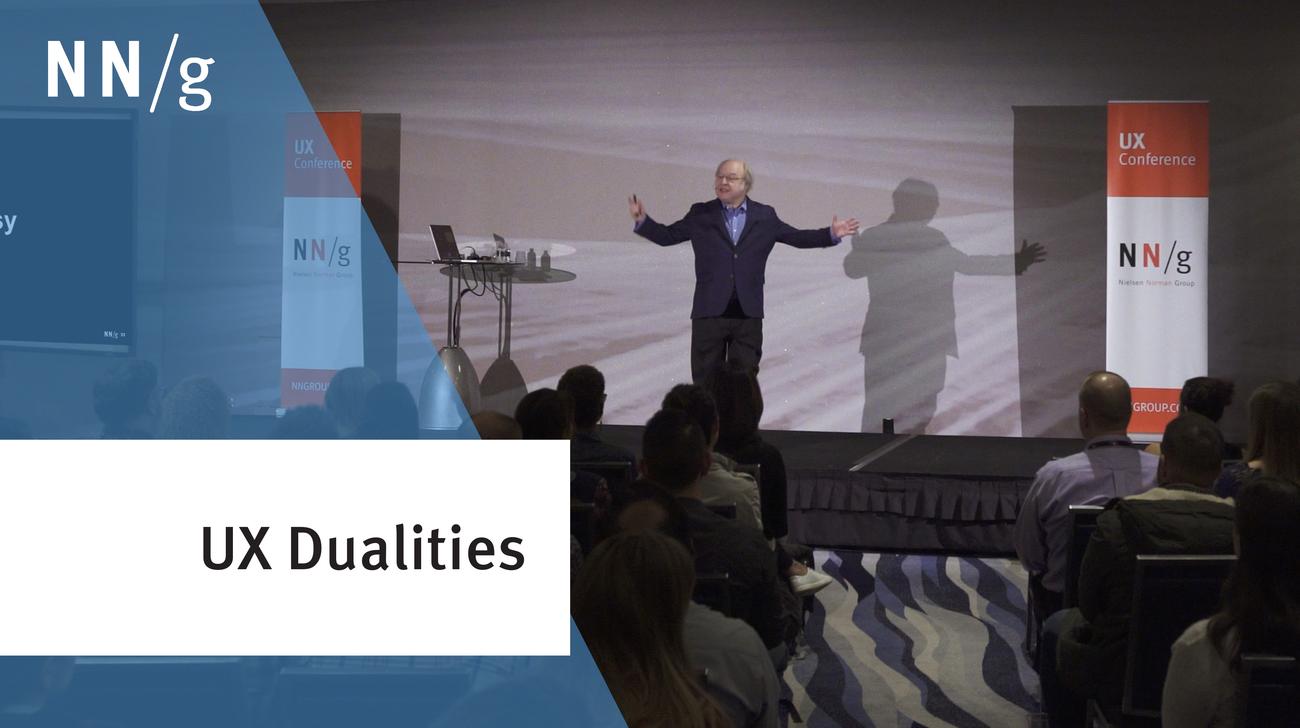
  • Dualities of User Experience (Jakob Nielsen keynote)

    Many issues in the user-experience field don’t have a simple answer. Rather there’s a tension between two good answers that are often polar opposites. Both extremes can be useful perspectives, and both have their advocates when people debate UX. How do we resolve these differences? This was Jakob Nielsen's keynote at the UX Conference in Las Vegas.

  • Slips vs. Mistakes

    User errors while using computers take two forms: slips (right intent, wrong action) and mistakes (wrong intent). Understanding the differences between the types of user error will help you design to prevent or minimize these problems.

  • Calculating ROI for Design Projects in 4 Steps

    Prove the value of your design efforts by estimating return on investment.

  • Drag–and–Drop: How to Design for Ease of Use

    Clear signifiers and clear feedback at all stages of the interaction make drag–and–drop discoverable and easy to use.

  • Bounces vs Exits in Web Analytics

    It's important to study why users leave websites. Analytics tools give you two metrics for web pages: exit rate and bounce rate. Understanding the difference between these two numbers is essential for better UX design.

  • Communicating UX to Your Colleagues and Organization

    When the organization and your coworkers don't understand UX, we have to apply our own methods to communicate more clearly with the target audience for our work.

  • UX Workshop Energizers and Icebreakers

    3 quick game-like activities you can use with participants in a UX workshop to get the team energized and ready to be creative and productive before turning to the real work of the meeting.

  • How to Film and Photograph Online Content for Usability: UX Details for Videos and Images

    Consider how your audience will be using the visuals to determine the optimal camera angle, set the right tone, choose the right props, and maintain attention.

  • UX Workshops vs. Meetings: What's the Difference?

    Meetings are for sharing information; workshops are for solving a problem or reaching an actionable goal. We compare the differences in purpose, scope, length, structure, and preparation time for workshops and meetings.

  • 4 Things to Do When Designing for Older Users

    The number of older adults who use computers and the Internet grows every year. This user population does have special needs, driven by the human aging process, and modest design changes can vastly increase the business you get from seniors.

  • 10 Usability Heuristics for User Interface Design

    Jakob Nielsen's 10 general principles for interaction design. They are called "heuristics" because they are broad rules of thumb for UX and not specific usability guidelines.

  • Empathy Mapping: The First Step in Design Thinking

    Empathy maps help UX teams visualize user attitudes and behaviors, building a shared understanding of end users while highlighting gaps in existing user data.

  • Journey Mapping 101

    A journey map is a visualization of the process that a person goes through in order to accomplish a goal.

  • How to Conduct a Heuristic Evaluation

    Step-by-step instructions to review your product to find potential usability and experience problems. Download a free heuristic evaluation template.

  • When to Use Which User-Experience Research Methods

    Modern day UX research methods answer a wide range of questions. To know when to use which method, each of 20 methods is mapped across 3 dimensions and over time within a typical product-development process.

  • Service Blueprints: Definition

    Service blueprints visualize organizational processes in order to optimize how a business delivers a user experience.

  • Design Thinking 101

    Design thinking is a user-centered process that helps teams understand needs, generate ideas, test solutions, and drive innovation.

  • Usability (User) Testing 101

    UX researchers use this popular observational methodology to uncover problems and opportunities in designs.

  • User Interviews: How, When, and Why to Conduct Them

    User interviews have become a popular technique for getting user feedback, mainly because they are fast and easy. Use them to learn about users’ perceptions of your design, not about its usability.

  • Usability 101: Introduction to Usability

    Usability makes designs easy, efficient, and satisfying to use. Improve it through early, repeated user testing with real users

  • User Journeys vs. User Flows

    User journeys and user flows both describe processes users go through in order to accomplish their goals, but they differ in scope, purpose, and format.

  • Affinity Diagramming for Collaboratively Sorting UX Findings and Design Ideas

    Use affinity diagramming to cluster and organize research findings or to sort design ideas in ideation workshops.

  • UX Research Cheat Sheet

    User research can be done at any point in the design cycle. This list of methods and activities can help you decide which to use when.

  • Using “How Might We” Questions to Ideate on the Right Problems

    Constructing how-might-we questions generates creative solutions while keeping teams focused on the right problems to solve.

  • Liquid Glass Is Cracked, and Usability Suffers in iOS 26

    iOS 26’s visual language obscures content instead of letting it take the spotlight. New (but not always better) design patterns replace established conventions.

  • User-Interface Elements: Glossary

    Use this glossary to quickly clarify definitions for key graphical user-interface elements and controls.

  • Why You Only Need to Test with 5 Users

    Elaborate usability tests are a waste of resources. The best results come from testing no more than 5 users and running as many small tests as you can afford.

  • Card Sorting: Uncover Users' Mental Models for Better Information Architecture

    In a card-sorting study, users organize topics into groups. Use this research method to create an information architecture that suits your users' expectations.
  • Open-Ended vs. Closed Questions in User Research

    Open-ended questions result in deeper insights. Closed questions provide clarification and detail, but no unexpected insights.

  • The Definition of User Experience (UX)

    "User experience" encompasses all aspects of the end-user's interaction with the company, its services, and its products.