User Testing Articles & Videos

  • Best Practices for Building and Maintaining Your Own Research-Participant Database

    Developing your own research-participant database allows you to be efficient in recruiting study participants, enabling you to run more studies with faster turnaround.
  • Protecting Participant Data: 6 Best Practices

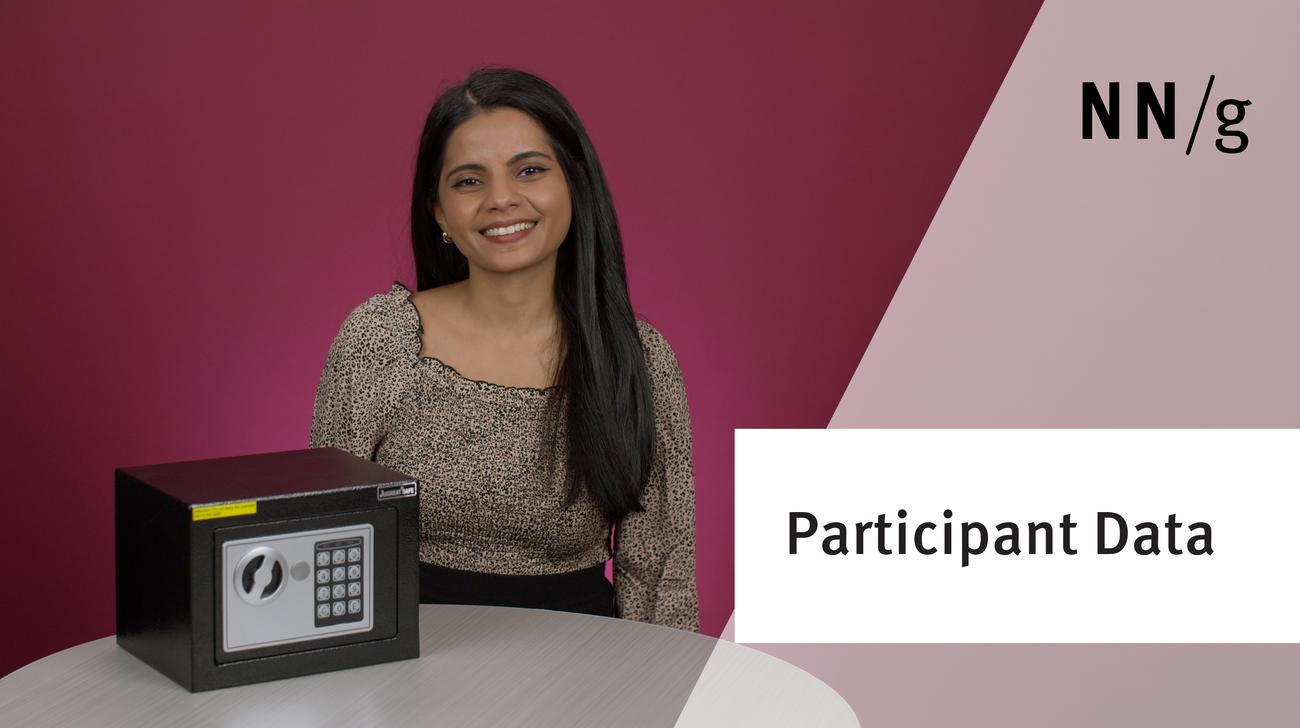
    Research participants are more vulnerable than ever as researchers conduct remote usability tests, use third-party applications, and store data online. Protect participant privacy by adhering to best practices before, during, and after data collection.

  • The System Usability Scale (SUS)

    The SUS is a well-established 10-question survey administered at the end of a user test; it gives you a measure of the perceived usability of your product and enables you to compare it with others.

  • Usability 101

    Usability assesses how easy user interfaces are to use. Usability is defined by 5 quality components: learnability, efficiency, memorability, errors, and satisfaction.

  • Discount Usability Revisited (Jakob Nielsen Keynote)

    3 methods for cheap and fast UX work are still good advice to emphasize iterative design and accelerate UX maturity improvements (This was Jakob Nielsen's keynote at the in-person Washington DC UX Conference)

  • Introducing a Participant to a Usability Test: A Demonstration

    Facilitation experts demonstrate how to prepare a participant for the test session. Use a facilitator’s script to help remember the important information that participants need to know.

  • You Have the Users You Have

    The only realistic design strategy is to cater to the actual people who use your product, instead of designing for an idealized super-user who knows more and is more motivated than the real audience.

  • 27 Tips and Tricks for Conducting Successful User Research in the Field

    Leave your office and go where the users are. Learn about common pitfalls and how to avoid them from our experience.

  • Clarify, Don't Mystify (UX Slogan #19)

    UX design must make all elements of the interaction understandable and explicit. Mystifying things to entice more clicks from users will only result in dissatisfied customers.

  • Using the Funnel Technique in Usability Testing

    Even when you want to test a specific feature, start with broader tasks to capture natural user behavior and observe what participants would do on their own. If they fail, follow up with directed tasks.

  • Checklist for Moderating a User Test

    10 things you should do when running a usability study. Remembering all the steps leads to good research insights. (The second of 2 videos on usability study checklists.)

  • Why and How to Use Demographics in UX

    Well-designed questions related to age, gender, race, income and other demographic characteristics help UX researchers screen participants, recruit a diverse participant pool, and segment data. These questions are sensitive and should put research participants at ease.

  • Checklist for Planning a User Test

    10 things you should do *before* you actually run a usability study. Good planning leads to good research insights. (The first of 2 videos on usability study checklists.)

  • Maintaining the Privacy and Security of Research Participants’ Data

    Maintaining participants’ data privacy and security before, during, and after data collection is critical to the user-research process. It protects participants from data breaches and cyber threats.

  • A Guide to Using User-Experience Research Methods

    Modern day UX research methods answer a wide range of questions. To help you know when to use which user research method, each of 20 methods is mapped across 3 dimensions and over time within a typical product-development process.

  • 5 Users: Okay for Qual, Wrong for Quant

    The recommended sample size (the number of study participants) is very different for qualitative user testing (small N) and for quantitative research (big N). Here's why the recommendations differ.

  • Polyhierarchy in Information Architecture

    Polyhierarchy is used to place a single item in more than one IA category. This can support users with different mental models but should be used judiciously.

  • Collecting UX Metrics During Qualitative User Studies

    Qualitative user research aims at insights, not numbers. Metrics for individual users help tell the story of how each person did, but mean values across a small sample won't be reliable.

  • The Funnel Technique in Qualitative User Research

    The funnel technique is used in user interviews and usability tests and ensures you get rich insights while not compromising validity.

  • When to Use Which User-Experience Research Methods

    To help you know when to use which user-research method, 20 methods are mapped across 3 dimensions and over time within a typical product-development process.