Manage your AI anxiety with two quick tips: small experiments and a news diet. Experiment with day-to-day communication and drafting with AI, as integrating AI into your research process. To avoid news overwhelm, subscribe to three weekly sources of information: a newsletter, an optimistic writing source, and a skeptical writing source.
Our research and evaluation show that there are currently few design-specific AI tools that meaningfully enhance UX design workflows. As of Spring 2024, AI isn’t ready for designers to take advantage of them.
NN/g’s 2023 Intranet Design Annual winners used AI for chatbots, tool recommendations, career guides, virtual assistants, and personalized communications to boost productivity.
The ELIZA effect describes users' tendency to quickly attribute human characteristics to artificial systems when the interaction feels human-like. This is why people fall in love with AI.
It can be tempting to follow the next big UX trend. Before adopting a UX trend, we must evaluate how the trend will support users and impact our workflows.
Do AI products have good user experience? Only partly, and to get better, we need to focus AI more on human needs than on what's technically possible. But AI can also help UX professionals do their job better, which will improve usability more widely.
Jakob Nielsen answers the question of how users' perception of artificial intelligence products and their user experience may be impacted by the way these services are promoted by vendors.
Are Siri, Alexa, and Google Assistant truly intelligent? While they do have some "intelligent" features, they are still far from what people expect such an intelligent assistant to do.
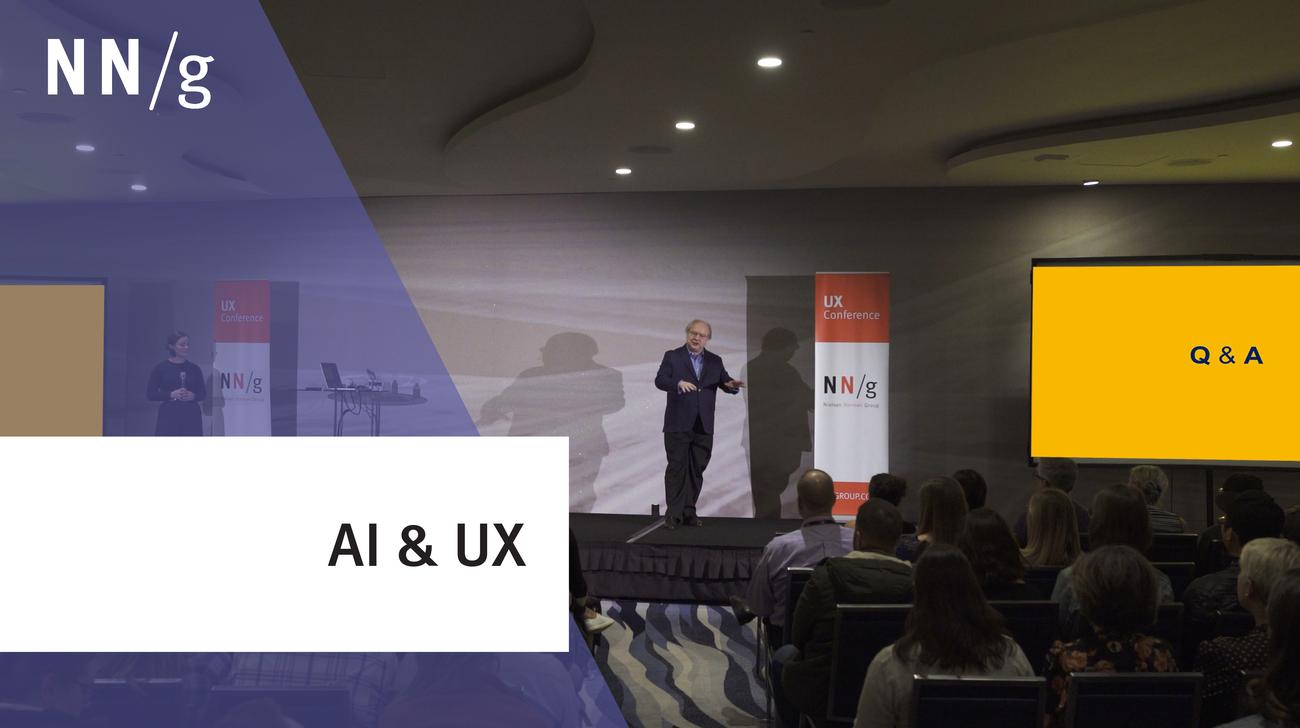
Each UI generation often takes two steps forward, then one step back. Even as new technologies emerge (e.g., Artificial Intelligence (AI) and speech recognition), knowing established UX guidelines will help you avoid missteps. This was Jakob Nielsen's keynote at the UX Conference in Copenhagen.