Personas and archetypes are different ways of communicating the same user research data. Archetypes describe categories of users; personas humanize those categories to illustrate real impact.
Design personas to evolve and change over time to secure their longevity. Design personas in a way that allows for updates when significant insights emerge, ensuring they remain relevant and maintain their usefulness over time.
Personas are personified representations of real information about our target audience that enable us to design with real customers in mind. They help us align ideas and apply what we know.
Avoid creating personas from analytics data alone. Personas are artifacts that aim to capture users' attitudes, goals, and pain points, aspects which analytics alone can't provide.
The empathy-mapping process helps distill and categorize knowledge of the user into one place, while the artifact serves as quick, digestible way to illustrate user attitudes and behaviors.
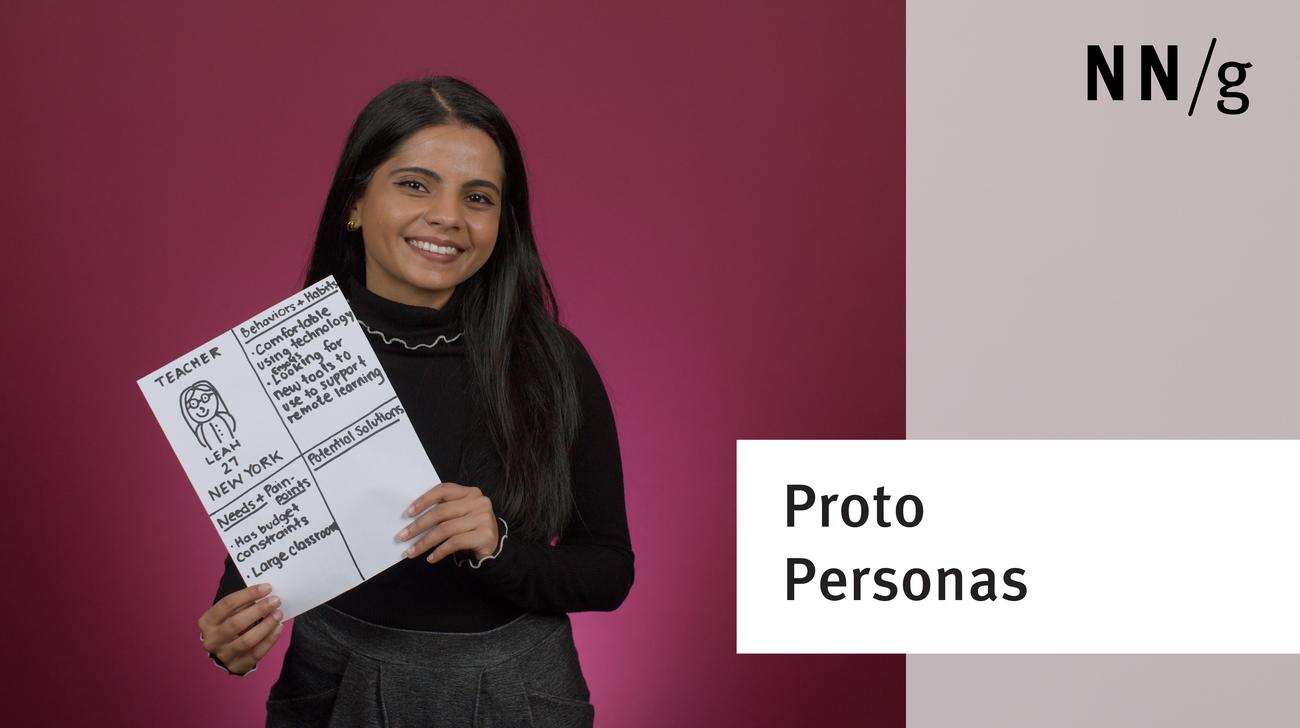
Proto personas capture a team's existing knowledge or assumptions about who their current users are. These should be used with caution because they are created with no new research.
Considering 3 main antipersonas in your design process can prevent much misuse or other grief which would undermine the user experience after the product is released.
The only realistic design strategy is to cater to the actual people who use your product, instead of designing for an idealized super-user who knows more and is more motivated than the real audience.
Antipersonas represent people who could misuse your product in ways that negatively impact target users and the business. Formalizing a description of the 8 aspects of an antipersonas can help a design team mitigate such risks.
Personas are usually a qualitative element in the UX design process, but statistical data from more users can be added for more precision, as long as the personas are still grounded in qualitative insights.
Personas are not "one size fits all" in the UX design process. Broad-scope personas work for high-level divisions but are too shallow for detailed design decisions.
Extensive user research with people shopping online identified 5 main types of behavior: product-focused, browsing, researchers, bargain-hunters, and one-time shoppers. Each user type benefits from different UX elements.
When you are in the early stages of designing a user experience flow, use scenario mapping to work out how different personas will use the proposed design to solve their tasks.
How to overcome common challenges in employing personas in UX design projects, including stakeholders who don't understand the value of approximated data or conversely press for over-generalized personas.
Jobs-to-be-done and personas are tools that identify user needs and attitudes. Each tool focuses on different aspects of the use experience and are compatible.
Analyzing data to identify meaningful segments of users is the most difficult part of persona creation. In this video we'll discuss how to look for similarities in various attributes using something much more straightforward than people: rocks!