The SUS is a well-established 10-question survey administered at the end of a user test; it gives you a measure of the perceived usability of your product and enables you to compare it with others.
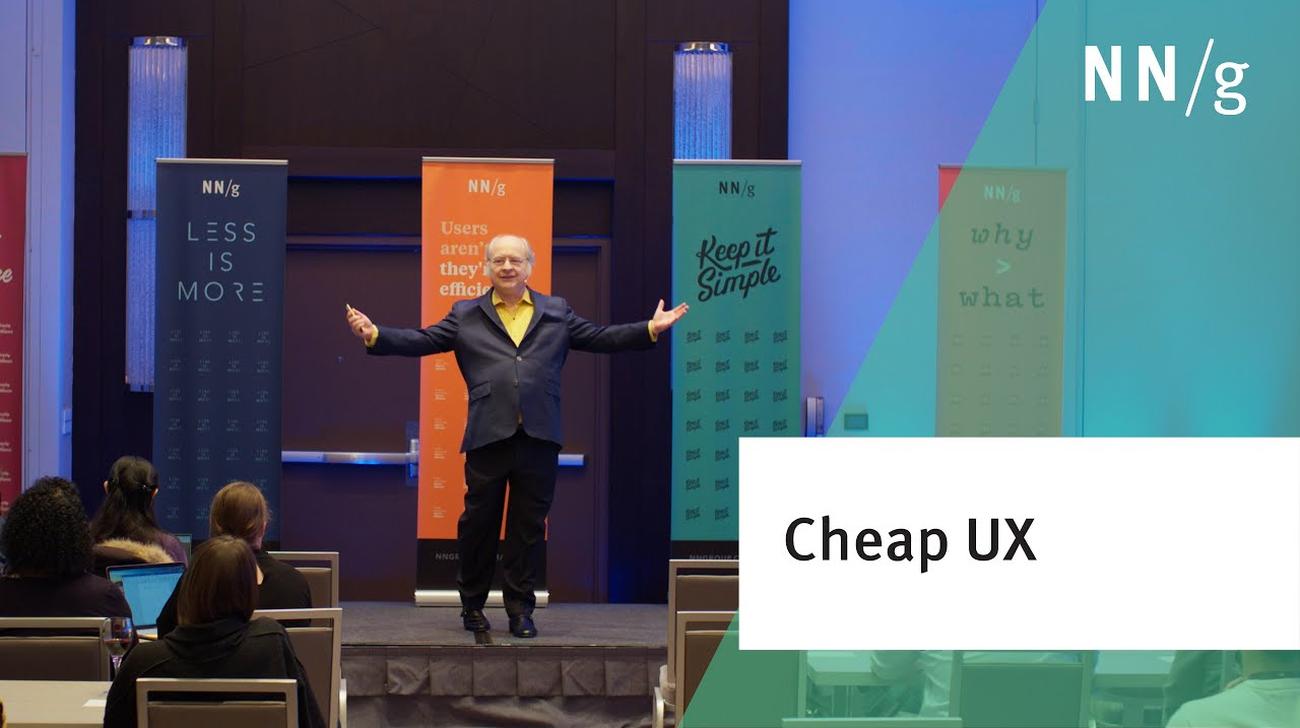
3 methods for cheap and fast UX work are still good advice to emphasize iterative design and accelerate UX maturity improvements (This was Jakob Nielsen's keynote at the in-person Washington DC UX Conference)
Facilitation experts demonstrate how to prepare a participant for the test session. Use a facilitator’s script to help remember the important information that participants need to know.
Response biases make it difficult to create good surveys. Follow these tips to counteract 10 of the major survey response biases and improve your survey data.
Keeping participants engaged and providing good-quality entries in diary studies can be challenging; recruit the right people, incentivize them appropriately, and keep recording entries simple.
10 things you should do when running a usability study. Remembering all the steps leads to good research insights. (The second of 2 videos on usability study checklists.)
Internal validity ensures that your study design does not favor any particular condition or response, while external validity is about a naturalistic study setup and choice of participants.
Members of a design team will often argue for different solutions to a UI problem. That's when to say "show me the data" to resolve the debate by empirical insights, rather than who argues the best.
Delight can be experienced viscerally, behaviorally, and reflectively. A great design is supported by all three of these pillars and is best evaluated with specific research methods.
Well-designed questions related to age, gender, race, income and other demographic characteristics help UX researchers screen participants, recruit a diverse participant pool, and segment data. These questions are sensitive and should put research participants at ease.
10 things you should do *before* you actually run a usability study. Good planning leads to good research insights. (The first of 2 videos on usability study checklists.)
Contextual inquiry can be conducted remotely for certain types of tasks, provided that your participants can share most of their work setting through a video-call platform.
You don't have to do all UX research yourself. You should learn from existing published work, which will save you much time, especially when beginning a new project.
Rule #1 for all user research is to study participants who are representative of the target audience. 5 best practices for recruiting screeners will improve the validity of your research.
Interviewing stakeholders provides helpful information about their context, allows us to identify business goals they are concerned with, and increases their support.
Stay focused and avoid long complaint sessions during a field study by communicating the purpose of the visit early on, maintaining the partnership relationship with participants, and looking for concrete examples over abstract generalizations.