Artificial Intelligence Articles & Videos

  • Service Design Metrics Shifting

    As AI becomes central to service delivery, traditional service metrics must evolve — new measures will assess AI-to-AI performance, human-AI collaboration, data quality, and user trust.

  • How AI Literacy Shapes GenAI Use

    Using generative AI often doesn’t mean using it well. AI literacy requires both prompt fluency and the ability to assess outputs.

  • AI-Moderated Interviews: If, When, and How to Use Them

    AI interviews offer faster feedback at scale, but they're not a replacement for in-depth, human-led semistructured interviews.

  • Demand Accuracy in Your AI Tools: Lessons from Baymard Institute

    Most AI-powered tools for UX lack reliability and accountability in their outputs. Demand transparency and proven accuracy, or don't buy it.

  • Don’t Outsource Analysis to AI

    When you outsource your analysis to AI, you risk more than just bad insights — you risk your credibility. Learn 4 reasons why relying on AI for qualitative analysis can backfire and why critical thinking still matters.

  • 4 Things GenAI Needs for Better Content Design

    Product-specific genAI needs to follow common digital writing practices in order to better fit users’ scanning needs.

  • State of UX 2026: Design Deeper to Differentiate

    UX faced instability in 2025 from layoffs, hiring freezes, and AI hype; now, the field is stabilizing, but differentiation and business impact are vital.

  • Don’t Start with AI, Start with the Problem

    To build good products, start by identifying the problem, not the solution. Especially with AI, if you start with a technology, delivering real value to your users and customers will be difficult.

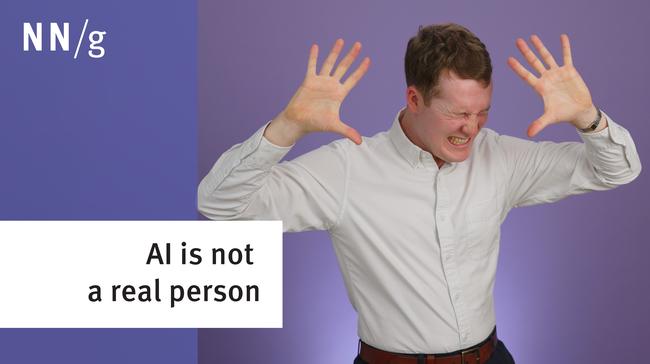
  • Humanizing AI Is a Trap

    LLMs humanize by design. Adding personality/emotion amplifies risk. Design real tools, not fake friends.

  • AI Literacy

    AI literacy is the ability to understand how AI works, use it effectively, and critically evaluate its output. But it isn’t a simple spectrum or just about how often someone uses AI—understanding, trust, and effective use vary widely.

  • Why AI-Generated Holiday Ads Fail — And What They Teach Us About Using AI in UX Work

    AI holiday ads lack authenticity and emotional resonance, highlighting the need for human judgment and attention to users’ needs in UX and creative work.

  • Explainable AI in Chat Interfaces

    Explanation text in AI chat interfaces is intended to help users understand AI outputs, but current practices fall short of that goal.

  • Top 10 UX Articles of 2025

    These 10 user-experience articles published in 2025 were those that our audience read the most.

  • Prompt to Design Interfaces: Why Vague Prompts Fail and How to Fix Them

    Create better AI-prototyping designs by using precise visual keywords, references, analysis, as well as mock data and code snippets.

  • Humanizing AI Does Not Help Your Users

    Humanizing AI is a quick trick, but will prevent your users from getting the most from the AI experiences you design.

  • Stop Making Your Team Figure Out AI on Their Own

    Making everyone figure out AI alone creates chaos and risk. Research and Design Operations teams must step up: analyze workflows, pilot tools, and support adoption systematically.

  • Good from Afar, But Far from Good: AI Prototyping in Real Design Contexts

    AI prototyping tools follow general directions but lack the judgment and nuance of an experienced designer.

  • AI Strategy: 3 Key Questions

    A strong AI strategy is built by answering those three essential questions honestly. What is our core business? Are we chasing real value or just perception? And what specific problem are we actually trying to solve?
  • Google AI Mode: Powerful Search, Poor Usability

    Google’s new AI Mode provides a new way to search the web but is hampered by discoverability and navigation issues — especially for AI novices.

  • GenUI: AI-Generated Interfaces

    Generative UI uses real-time AI to create personalized interfaces, shifting UX from static design to dynamic, user-specific experiences.