Research Methods Articles & Videos

  • Inductively Analyzing Qualitative Data

    Inductive analysis begins with no framework in mind and looks for naturally emerging patterns in the data.

  • What, When, Why: Research Goals, Questions, and Hypotheses

    Research questions, research goals, and hypotheses are 3 devices used to focus user research studies.

  • Deductively Analyzing Qualitative Data

    Deductive analysis begins with a framework in mind and makes sense of the data through that lens.

  • Why Prioritize Personas?

    Prioritizing your personas helps you make strategic design tradeoffs to ensure designs bring the most value to the business.

  • Usability Test Facilitation: 6 Mistakes to Avoid

    Become a better usability testing facilitator by avoiding common missteps, like asking leading questions or reacting to user behavior.

  • Informed Consent for UX Research

    Ethically sound UX research requires informed consent from a research participant. Informed consent means the participant fully understands what the study entails and the potential consequences of participating.
  • Help Users Think Aloud

    Help users think aloud by explaining what it is and why it's useful, reinforcing the behavior, and prompting along the way.

  • Problem Space and Solution Space Research

    Both problem-space and solution-space research are needed to design products that are useful and usable.

  • Building Rapport with UX Research Participants

    Researchers should build rapport and embrace real human interactions to put participants at ease during a study.

  • Protecting Participant Data: 6 Best Practices

    Research participants are more vulnerable than ever as researchers conduct remote usability tests, use third-party applications, and store data online. Protect participant privacy by adhering to best practices before, during, and after data collection.

  • The System Usability Scale (SUS)

    The SUS is a well-established 10-question survey administered at the end of a user test; it gives you a measure of the perceived usability of your product and enables you to compare it with others.

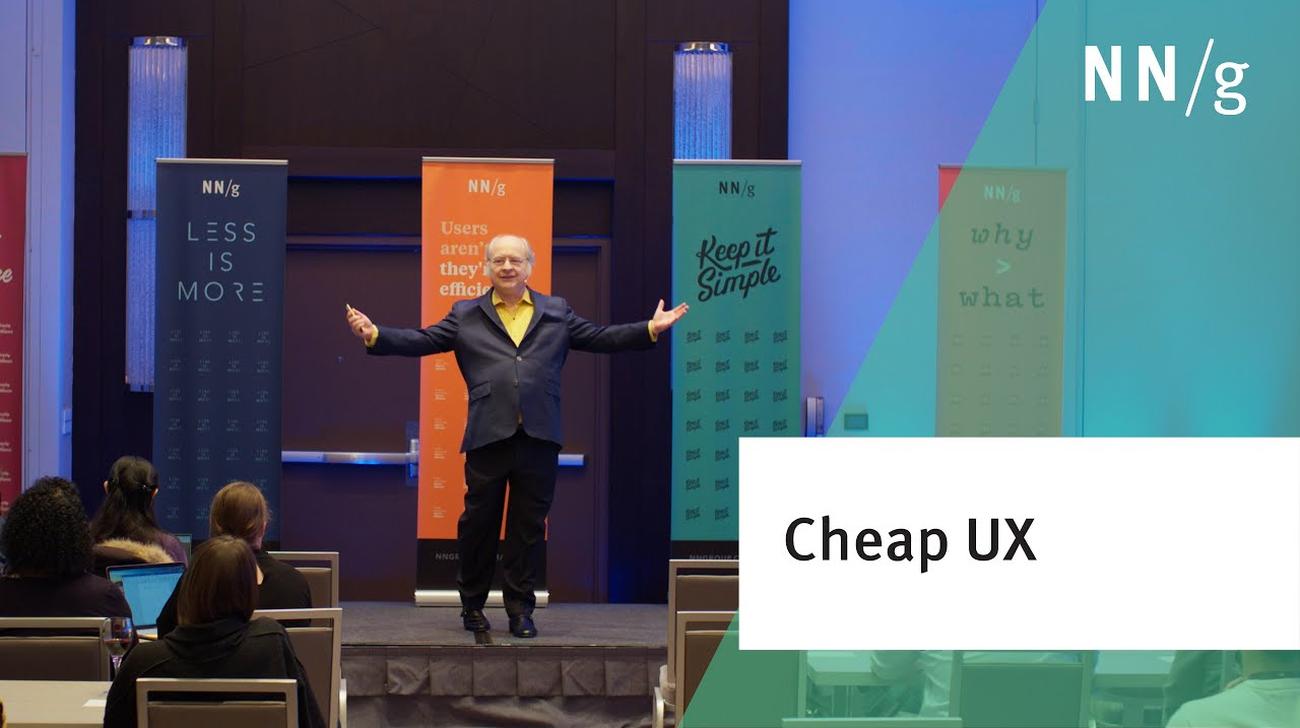
  • Discount Usability Revisited (Jakob Nielsen Keynote)

    3 methods for cheap and fast UX work are still good advice to emphasize iterative design and accelerate UX maturity improvements (This was Jakob Nielsen's keynote at the in-person Washington DC UX Conference)

  • Introducing a Participant to a Usability Test: A Demonstration

    Facilitation experts demonstrate how to prepare a participant for the test session. Use a facilitator’s script to help remember the important information that participants need to know.

  • Using the Funnel Technique in User Interviews

    Start with broad, open-ended questions in your interviews before introducing more specific questions to gather accurate, in-depth information.

  • Checklist for Moderating a User Test

    10 things you should do when running a usability study. Remembering all the steps leads to good research insights. (The second of 2 videos on usability study checklists.)

  • Internal vs. External Validity in UX-Study Design

    Internal validity ensures that your study design does not favor any particular condition or response, while external validity is about a naturalistic study setup and choice of participants.

  • Show Me the Data (UX Slogan #15)

    Members of a design team will often argue for different solutions to a UI problem. That's when to say "show me the data" to resolve the debate by empirical insights, rather than who argues the best.

  • Checklist for Planning a User Test

    10 things you should do *before* you actually run a usability study. Good planning leads to good research insights. (The first of 2 videos on usability study checklists.)

  • UX Researchers, We Like to Watch (UX Slogan #16)

    Watching users' actual behavior helps us gain insights to improve the user experience.

  • Secondary Research: Important UX Learning Right at Your Desk

    You don't have to do all UX research yourself. You should learn from existing published work, which will save you much time, especially when beginning a new project.