An 8-step process for UX designers and researchers to collaborate better with their stakeholders, for increased collaboration, to help stakeholders meet their goals, and to ensure the impact of your work.
Advance planning and having thought through alternatives can save you when facilitating a UX workshop and the unexpected happens (as it always does). Jan Haaland shares his experience during a panel with past participants in the UX Conference.
At the core of all the myriad of exercises and activity types in UX workshops are a simpler set of 7 foundational activities that can be blended to achieve the desired result.
With experience, UX teams have evolved techniques for better collaboration and design practices to involve and engage remote and distributed team members. With participants at the Virtual UX Conference.
Redesigning a user interface can be done in many smaller incremental releases or as one big complete redo. Big change is risky but necessary in 3 cases.
A general technique that's helpful in many kinds of UX workshops and design ideation is to first have team members work independently to create diverging ideas and solutions. Then, as a separate step, everybody works together to converge on the final outcome.
A clear vision gives the team something to aim for, and this is especially important for intranet projects, which often involve contributors from many different departments or functions.
In UX design, you always have to prioritize. Features, personas, usability problems, and the list goes on. Dot votes are a simple way to find the group's sense of what's the most important.
The facilitator of a UX workshop, meeting, or other team activity anywhere in the design process has the job of enhancing the group's performance by optimizing the process through structure, activity, and guidance.
To launch a new design operations practice in a company, prioritize and aim for manageable and achievable first steps. Preferably measurable ones that can prove value and form the basis for subsequent steps.
Human-centered design has 4 principles: understand the problem, the people, and the system, and do iterative design. But what if you don't have time to do all 4 steps?
Discoveries are a powerful part of the UX design process, but unfortunately, many teams are not doing true discovery. Here are 5 main ways to go wrong.
How to maximize team participation and the value of the outcome when running a UX workshop remotely. Different platforms have different benefits and downsides, so choose depending on your circumstances and needs.
Storytelling is a powerful technique for UX teams and for working with stakeholders, but only if you use the proper words for your audience's domain. Here are tips for building vocabulary for your stories.
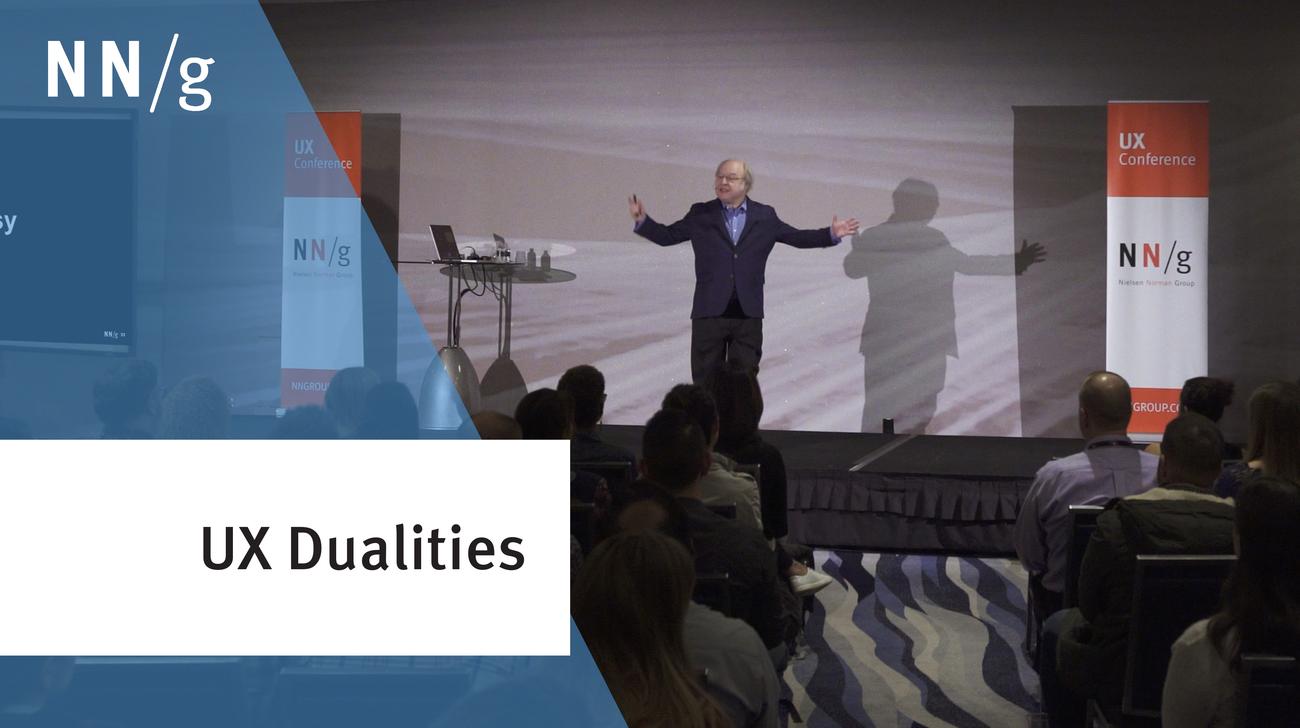
Many issues in the user-experience field don’t have a simple answer. Rather there’s a tension between two good answers that are often polar opposites. Both extremes can be useful perspectives, and both have their advocates when people debate UX. How do we resolve these differences? This was Jakob Nielsen's keynote at the UX Conference in Las Vegas.